
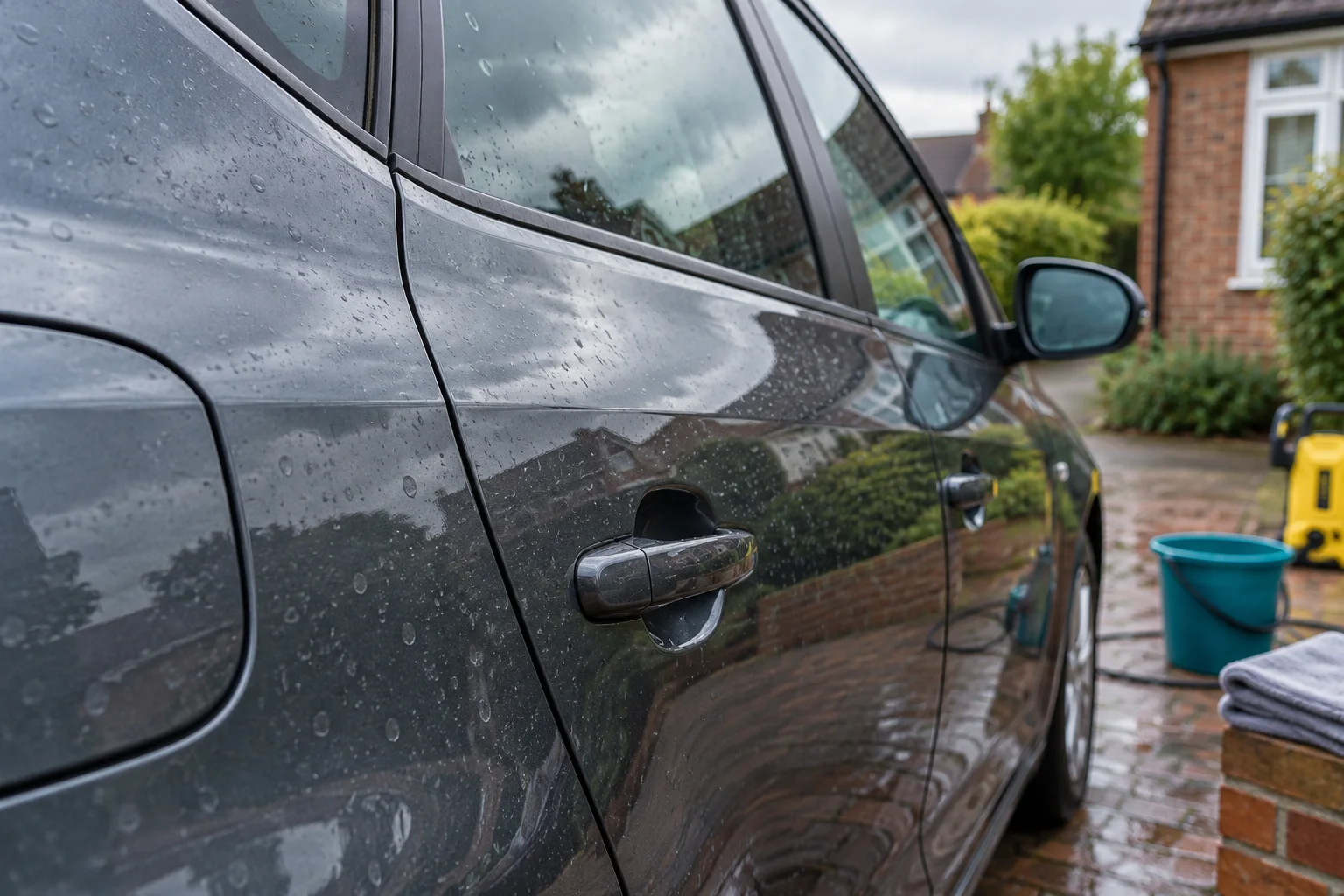
A clean car can acquire pale rings as the rinse water dries. That does not automatically mean the shampoo has failed or the paint needs polishing. First establish whether you are looking at dried mineral deposits, wash-product residue, water escaping from a trim gap or a mark that remains after the surface has been cleaned.
Start with the gentlest useful check on a cool, shaded panel. Rewash a small area with the correct shampoo dose, rinse it thoroughly and dry it immediately with a clean towel. Inspect it in good light before treating the rest of the car. This separates an ordinary wash-and-dry problem from something that needs a more specific approach.
Why hard water leaves marks
Hard water contains dissolved minerals, particularly calcium and magnesium. Thames Water explains that these minerals enter water as it passes through rock. When a droplet evaporates, some dissolved material can remain on the surface. A ring or outline can be more noticeable on dark paint or glass than on a pale panel.
Hardness is only part of the picture. A warm bonnet, direct sun, a slow drying routine and water trapped around mirrors all give droplets time to dry. Adding more shampoo does not remove the minerals from the final rinse. Nor does a freshly waxed or coated surface guarantee that water cannot leave a deposit: beads still need managing.
Avoid assuming every pale mark is the same. A broad smear may be un-rinsed wash product; a trail below a mirror may be a delayed drip; persistent outlines may need closer assessment. Gtechniq distinguishes mineral deposits from marks that have affected the finish itself. The appropriate remedy depends on which is present.
| What you see | A useful first check | What to avoid |
|---|---|---|
| Fine droplet rings across horizontal panels | Rewash, rinse and promptly dry one small section | Assuming every ring requires polishing |
| Broad streaks after using shampoo or a drying aid | Recheck dose, rinsing and the product’s finishing method | Adding another layer to hide the streaks |
| A trail returning beneath a mirror or badge | Dry the panel, then catch the next escaping drip | Repeatedly rubbing the same area with a saturated cloth |
| An outline still visible on clean, dry paint | Inspect in different light and identify the surface protection | Escalating to stronger products without compatibility checks |
Step 1: remove ordinary wash residue
Work on one manageable section rather than chasing marks around the whole vehicle. If the car has picked up fresh dust or road dirt since washing, rinse that away before making contact. A drying towel is not a substitute for washing a dirty surface.
Use a car shampoo at its own stated dilution. Rinse away the solution completely, then dry the test section before it air-dries. If the mark clears, repeat that controlled sequence where needed and adjust your routine next time. You do not need to add a dedicated spot-removal chemical simply because you live in a hard-water area.
For example, Autoglym Foaming Car Wash is a clean-rinsing option without an added finishing film. Its stated bucket instruction is two capfuls in 10 litres; that is not a verified millilitre measurement. It is a wash product, not a specialist mineral-deposit remover.
For a clean-rinsing bucket wash
Autoglym Foaming Car Wash 1L
A pH-neutral shampoo without added finishing film. The 1-litre bottle is a separate purchase when you already own your wash tools or prefer a separate wax or sealant step.
- 1 litre concentrate
- No added finishing film
- Two capfuls per 10 litres
Autoglym specifies two capfuls in 10 litres of water. Keep panels cool, rinse thoroughly and do not let the solution dry. Check the label and safety data sheet for your pack.
Step 2: decide whether further treatment is justified
If deposits remain after a proper wash, identify what you would be treating: gloss paint, matt paint, a wrap, glass, plastic trim or a coated surface. Check the vehicle, wrap or coating guidance before choosing a specialist product. Suitability for one surface does not establish suitability for its neighbour.
A dedicated water-spot remover may address mineral deposits, but its exact instructions matter: surface temperature, dwell time, application method, rinsing and aftercare vary. Read the complete directions for the product and your finish. Do not combine cleaners or substitute a household limescale remover, vinegar mixture or improvised acid recipe.
If a properly used, compatible treatment does not clear the mark, stop and seek an assessment from a reputable detailer. Etching and surface deposits are different problems. Repeating chemical applications or polishing by trial and error can create a larger job than the original spotting. Clay is not the automatic next step either; it has its own purpose and can mark paint when used incorrectly.
Step 3: shorten the gap between rinsing and drying
Prepare your drying towels before starting the wash. Work in shade on cool panels, keep the wash area manageable and avoid leaving the whole car wet while you put the other equipment away. For the full sequence, use our car-drying guide.
A dedicated drying towel gives you a way to remove rinse water without reaching for a household cloth. Meguiar’s Duo Twist is a 50 × 90cm, 1200gsm option. Those specifications describe its construction; they do not prove that it will dry every vehicle alone. Keep a second clean towel available when the first becomes too wet to finish cleanly.
For a dense 50 × 90cm drying towel
Meguiar’s Duo Twist Drying Towel
A 1200gsm duo-twist microfibre towel, with a longer rectangular shape. Consider it if you want a dense textile and can comfortably control that length around lower panels.
- 50 × 90cm
- 1200gsm microfibre
- 87% polyester / 13% polyamide
Follow its own wash and drying label. Density is not an independent absorbency test and does not guarantee one-towel drying for every car. Keep the trailing edge clear of the ground.
Lay or move the towel gently, using clean sections and keeping the trailing edge clear of the ground. Do not scrub dried marks with it. Check mirrors, handles, badges and number-plate edges again after the first pass so delayed drips do not recreate the problem. Use a separate finishing cloth where a recess is dirty.
What about spots on the windows?
Begin with a glass-compatible cleaner and a clean glass cloth to establish whether the mark is ordinary residue. Keep cleaner away from adjacent surfaces where its label requires it, and check any tint or glass treatment instructions. A product that removes fingerprints and wash smears is not automatically a mineral-deposit remover.
Autoglym Fast Glass is an option for routine glass cleaning. We include it for that role, rather than as a promise to remove etched or stubborn mineral marks. If an outline remains on otherwise clean glass, investigate a treatment specifically approved for that glass and any coating instead of increasing pressure with the cloth.
For a separate glass-cleaning job
Autoglym Fast Glass 500ml
A 500ml cleaner for interior and exterior glass, without abrasives, waxes or silicones. Useful when you need a glass cleaner but already own the rest of your wash kit.
- 500ml spray
- Interior and exterior glass
- No abrasives, waxes or silicones
Use dedicated clean cloths. Check tint-film and vehicle-screen guidance; apply to the cloth for compatible displays, never spray directly onto electronics.
Make the next wash easier
Note where the marks first appeared. If the bonnet spotted while you were washing the rear, change the timing or location. If streaks followed a particular finishing product, revisit its dose and wet- or dry-application sequence. If the same mirror creates a trail each time, add a final drip check.
For frequent washing in hard water, a properly specified rinse-water filtration system may be worth investigating separately. Check what it actually removes, its capacity, replacement requirements and how water quality is measured; an ordinary hose attachment is not evidence of mineral removal. First improve shade, rinsing and prompt drying. They remain useful even when the water itself is treated.
Common questions
Are water spots always permanent?
No. Some marks are surface deposits or wash residue and may clear with suitable cleaning. A mark that remains on clean, dry paint needs assessment; appearance alone does not prove permanent damage.
Will a ceramic coating prevent water spots?
Do not assume it will. Droplets can still dry on a protected surface. Follow the coating’s maintenance instructions and remove rinse water promptly.
Can I use vinegar or household limescale remover?
We do not recommend an improvised household treatment. The concentration, adjacent materials and finish compatibility may be unsuitable. Choose a product with instructions for the exact surface, or seek professional advice.
Should I wash the whole car again?
Start with a small, cool test section. If a correct wash, thorough rinse and immediate dry clear it, repeat that sequence where necessary. Persistent marks need diagnosis before stronger treatment.
Why do spots return below the mirrors?
Water can escape from a mirror housing or trim gap after you have dried the panel. Catch delayed drips with a clean finishing cloth, keeping any dirty recess cloth separate from paint-drying towels.
Sources and product instructions
Follow the label and care instructions for the exact version and surface you own.