
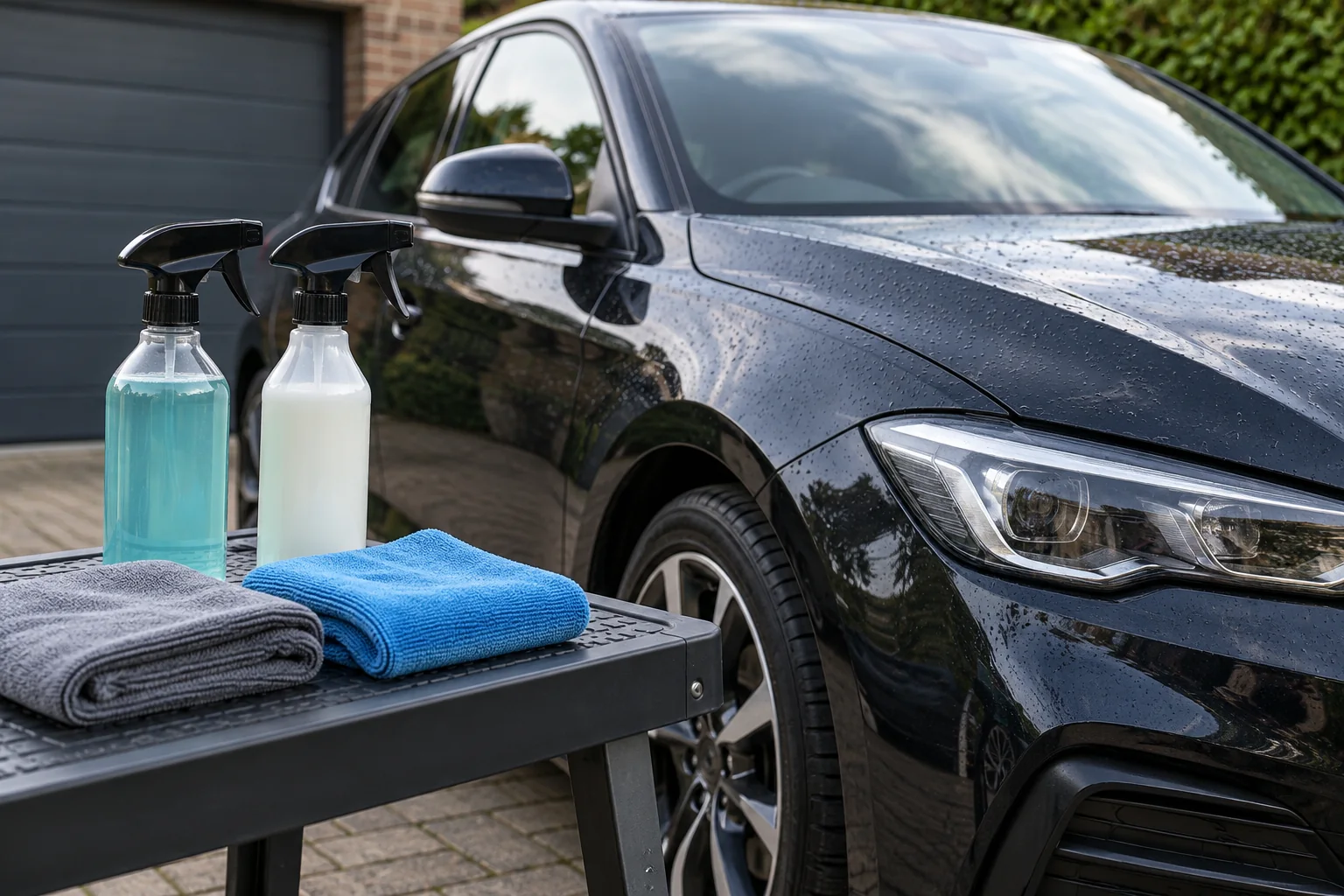
Match protection to your wash setup
If you prefer a deliberate paste application, compare car waxes for a simple routine instead. Choose one complete permitted method rather than treating wax and spray sealant as compulsory successive stages.
The most useful first question is when you want to apply the product. A dry-panel spray needs a clean, dried car and enough time for controlled spreading and buffing. A wet application belongs to a different sequence and may require effective rinsing. A product that sounds quick can still be awkward if its method does not fit your driveway, water access or available daylight.
“Spray sealant”, “ceramic spray” and “hybrid wax” overlap as marketing descriptions. They do not define one chemistry or one application technique. The choices here illustrate three practical methods; they are not a measured durability ranking or substitutes for professional coating advice.
| Product | Application type | Reason to choose or pause |
|---|---|---|
| Turtle Wax Hybrid Solutions Ceramic Spray Coating | Clean, dry paint; controlled spray and buff | Suitable for a separate finishing stage; do not treat as rinse-on protection |
| Autoglym Rapid Ceramic Spray | Wet or dry compatible paint, spread and buff | Flexible timing; dry application is the maker’s preference for maximum durability |
| Meguiar’s Hybrid Ceramic Wax | Wet application with different initial and maintenance instructions | Needs the correct rinse/dry sequence; not a conventional dry spray-and-buff substitute |
Dry-panel option: Turtle Wax Ceramic Spray Coating
Choose this type if you are happy to finish washing and drying before protection. That creates a clear inspection point: if the paint still has road film, gritty contamination or trapped water in awkward areas, resolve that before applying another product.
Use the bottle’s small-area spray-and-buff directions, with clean suitable cloths and its stated curing conditions. Additional coats have their own waiting requirements. Do not assume you can apply a second layer immediately or rinse the product away because another ceramic spray works that way.
For a dry-panel spray-and-buff finish
Turtle Wax Hybrid Solutions Ceramic Spray Coating 500ml
A separate spray coating for a freshly washed and dried car. Choose it when you prefer spreading and buffing a finishing spray to using a wet-applied wax.
- 500ml spray
- Apply to clean, dry surfaces
- Buff with clean microfibre
Follow the surface-preparation and curing directions. This is Ceramic Spray Coating, not Ceramic Wet Wax or the 3-in-1 Detailer; check specialist finishes and avoid soft convertible tops.
A dry-panel method can suit an owner with sheltered space and a manageable finishing window. It is a less convenient choice if every wash ends in direct sun with hot panels. Choosing an easier weather window can matter more than changing brand.
Wet or dry option: Autoglym Rapid Ceramic Spray
Rapid Ceramic Spray allows wet or dry application on approved surfaces, with dry application recommended by Autoglym for maximum durability. That gives flexibility, but does not remove the need to spread the product and finish with a clean cloth. Use a light amount, not a heavy soaking of the panel.
The product suits compatible paintwork and colour-coordinated plastics. It is not intended for glass or unpainted plastics. Establish where the approved surface ends around mirrors, seals and textured trim so you can control overspray and transfer.
For a spray-and-buff choice with wet or dry application
Autoglym Rapid Ceramic Spray 500ml
A spray protectant that Autoglym permits on wet or dry compatible paintwork, with dry application recommended for maximum durability. Apply sparingly and finish with a clean cloth.
- 500ml spray
- Wet or dry paint method
- Clean finishing cloth needed
Not intended for glass or unpainted plastics. Work on cool surfaces out of direct sun; check finish and installer guidance for wraps, film and specialist paint.
Autoglym’s additional-coat and washing intervals are product-specific: allow 24 hours before another coat and avoid washing within 24 hours. If the car’s storage or weather exposure makes an instruction difficult to follow, address that practical constraint before starting. A spray bottle does not make environmental conditions irrelevant.
Wet-routine option: Meguiar’s Hybrid Ceramic Wax
This 768ml product is relevant when you want protection within a water-based wash routine. The important distinction is its initial base-coat process compared with subsequent maintenance applications. Read the complete label before wetting or spraying the car; do not skip straight to a short summary of the later rinse stage.
Reliable rinsing and a careful final dry are part of the buying decision. Someone who cannot carry out that process has not solved the problem by choosing a larger bottle. Equally, a rinse-stage product should not be worked like a conventional dry wax because its name contains “wax”.
For protection incorporated into the rinse stage
Meguiar’s Hybrid Ceramic Wax 768ml
A wet-application hybrid protection spray. It suits a wash routine with reliable rinsing and drying access rather than a conventional dry-panel spray-and-buff method.
- 768ml bottle
- Wet application
- Separate initial and maintenance methods
The first base-coat application and subsequent maintenance method differ. Follow the exact bottle instructions, including rinsing and drying, and check the actual surface.
Check paint, coating and installer guidance as well as the product label. A broad paint-care claim does not approve every matt finish, film, recent repair or aftermarket treatment. If your car has specialist protection, begin with its maintenance system and approved alternatives.
Prepare a surface worth protecting
Use a compatible shampoo and a controlled contact wash. Rinse away cleaning residue, then inspect the paint. Protection cannot compensate for grit, incompletely removed traffic film or unidentified contamination. Treat an isolated issue with an appropriate method rather than making aggressive decontamination compulsory across the whole car.
For dry application, dry fully enough to prevent stray water diluting or redistributing the product. For wet application, follow the exact definition of wetness and rinsing in the directions. Do not invent a universal rule about leaving a particular amount of water on the panel.
If the paint needs correction, understand polish first. Applying an abrasive preparation product after sealant can reduce the protective finish. Decide the order before beginning instead of repeatedly removing and replacing layers.
Control product and cloth loading
- Work in the conditions permitted by the bottle, on suitably cool surfaces.
- Use the stated amount and section size. Start conservatively rather than coating the entire car at once.
- Keep a suitable clean cloth for spreading and another for finishing where instructed.
- Inspect from more than one angle before moving on, especially on dark paint.
- Change cloth faces as residue builds and isolate any cloth dropped on the ground.
- Follow the product’s curing, washing and additional-coat directions before the next treatment.
Cloths used for protective products need their own laundry stream. Do not put a loaded finishing cloth straight into a drying-towel box. Towel washing and task separation explain how to prevent residue migrating to glass or drying textiles.
If the finish looks patchy
Stop adding product and check the simplest causes: surface temperature, cleanliness, dose, wet/dry method and cloth loading. Review the manufacturer’s remedy for high spots or residue. Avoid immediately reaching for a stronger polish, solvent or abrasive pad, which can affect both protection and paint.
If the surface has changed colour, become sticky or developed persistent unfamiliar marks, seek advice before continuing. Choosing one suitable spray and applying it correctly is more useful than hiding an uncertain result beneath another layer.
Common questions
Is spray sealant the same as ceramic coating?
No. Consumer spray protection and installed coatings can have different preparation, curing and maintenance requirements. Ceramic wording alone does not tell you the method, lifespan or compatibility.
Can I apply every spray sealant to a wet car?
No. The featured Turtle Wax spray coating uses a dry-panel method, Autoglym Rapid Ceramic Spray permits wet or dry application, and Meguiar’s Hybrid Ceramic Wax has a wet application process. Follow the exact bottle rather than borrowing another product’s instructions.
Why does spray protection leave streaks?
Possible causes include excess product, hot panels, a dirty base, unsuitable conditions, incomplete removal or loaded cloths. Pause and check the product directions. More spray and harder rubbing can make residue harder to manage.
Can spray sealant go on glass and plastic?
Only where the particular product approves them. Autoglym Rapid Ceramic Spray is not intended for glass or unpainted plastics. A paint-protection recommendation does not automatically cover windscreens, trim or matt finishes.
Should I add several coats for more protection?
Only follow a supported additional-coat method and its waiting period. Autoglym gives a 24-hour interval before a second coat and advises against washing within 24 hours. More layers are not automatically useful, and those directions do not apply to every spray.
Sources and product instructions
Follow the label and care instructions for the exact version and surface you own.