
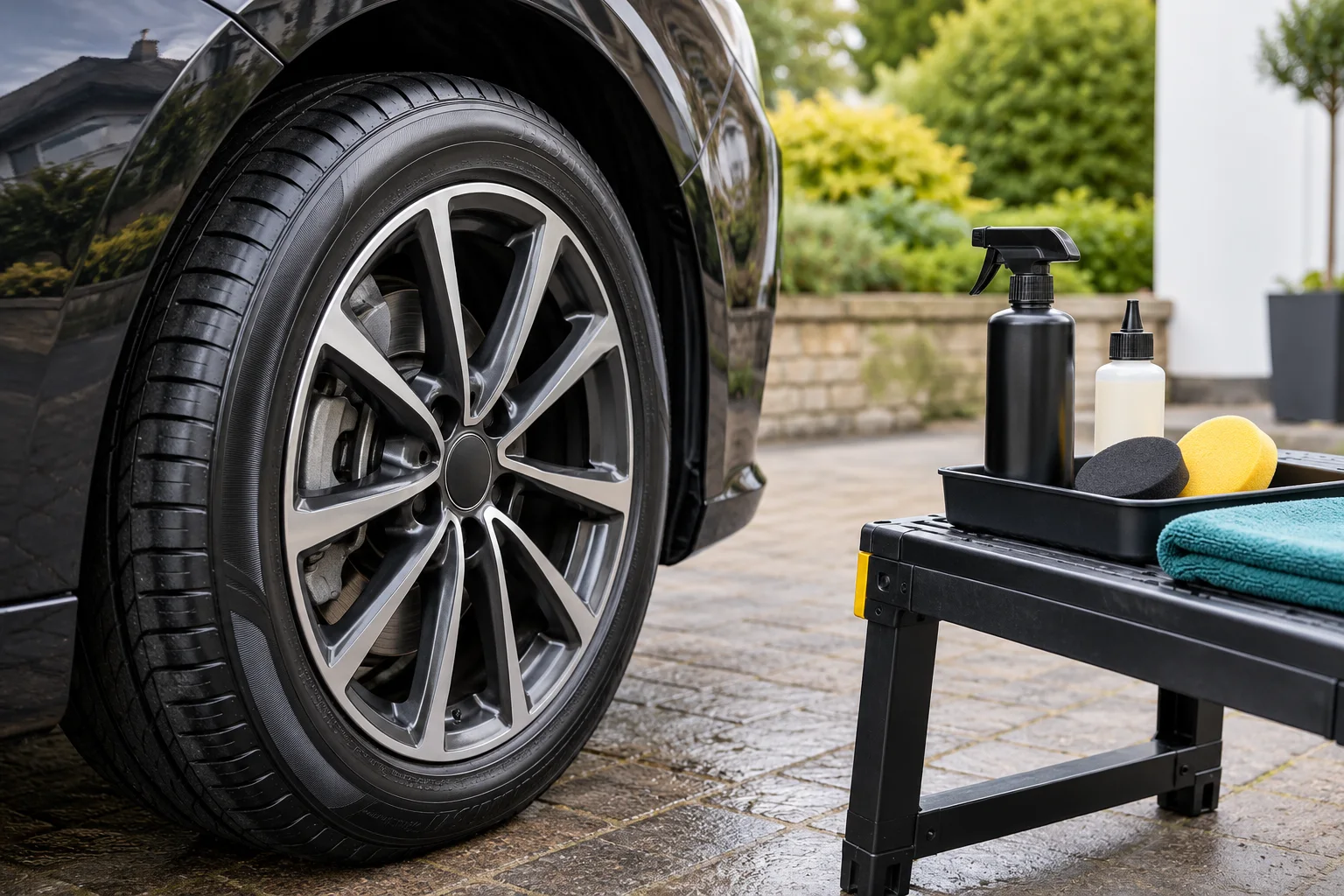
Choose the permitted routine before the finish
A tyre dressing is an optional cosmetic step. It changes the appearance of cleaned sidewalls; it is not a repair for aged, cracked or damaged rubber. Leaving a clean tyre undressed is a complete choice, and the tyre maker's care requirements come before a dressing brand's broad suitability claim.
That distinction matters in practice. Michelin's sidewall guidance advises avoiding cleaning products, particularly silicone-containing products. If your tyre instructions restrict dressings or cleaning chemicals, follow them and skip the conflicting product. The comparisons below are for car-tyre sidewalls where the maker permits that kind of treatment.
Spray and gel change application, not every requirement
| Question | Spray example | Gel examples |
|---|---|---|
| How is it spread? | Direct spray or an instructed sponge method | Product placed on a suitable hand applicator |
| Wet or dry rubber? | Instant Tyre Dressing permits wet or dry sidewalls | The featured gels call for clean, dry preparation |
| How is overspray controlled? | Use the permitted sponge method where helpful | No spray plume, but excess and smears still need control |
| Can it sling? | Excess or unsettled product can transfer | Gel can also transfer if over-applied or left in recesses |
| Is shine fixed by format? | The named spray offers a sheen or wiped matt method | The named gels have their own gloss/wipe-off instructions |
These are product-specific examples, not rules for every spray or gel. A bottle's format cannot tell you its solvent system, compatibility, drying time or lasting finish. Read the exact label and use directions before comparing the result you want.
Instant Tyre Dressing: spray format with a sponge option
Autoglym's Instant Tyre Dressing is a liquid spray for cleaned sidewalls and permits wet or dry application. It can be left to dry for a light sheen or have excess removed for a matt finish. That flexibility can suit a routine where the car has just been washed, provided the tyre maker permits it.
You do not have to spray indiscriminately around the wheel. Autoglym also describes spraying onto a sponge and wiping around the sidewall to control overspray. Keep the product away from tread, brakes and other excluded surfaces, and keep the sponge separate from paint and wheel-cleaning textiles.
An optional sidewall finishing step
Autoglym Instant Tyre Dressing 500ml
A spray dressing for cleaned car-tyre sidewalls, used on wet or dry rubber. Leave it to dry for a light sheen or remove excess as directed for a more muted finish.
- 500ml spray
- Wet or dry sidewalls
- Optional finishing product
Use only if your tyre maker permits dressing. Keep off tyre tread and braking surfaces; not for motorcycle tyres. A sponge controls overspray. Dressing is cosmetic and cannot repair cracked or worn rubber.
High Performance Tyre Gel: clean and dry before application
Autoglym's High Performance Tyre Gel is intended for hand application using a small amount on its recommended foam applicator. Start with clean, dry sidewalls. Its guidance warns that wet application can produce an uneven appearance, so do not carry the spray product's wet-rubber permission across to the gel.
The finishing method is adjustable: allow it to dry for gloss or wipe while wet for a satin result, following the exact directions. Spread into the sidewall's contours without leaving puddles around raised lettering or the rim edge. The product's reduced-fling positioning is not permission to drive away with visible excess.
For controlled dressing on permitted sidewalls
Autoglym High Performance Tyre Gel 500ml
A hand-applied tyre gel with a gloss or satin finishing method. Use a small amount on the recommended applicator and work it into clean, dry sidewalls.
- 500ml bottle
- Clean, dry sidewalls
- Hand application
Use only if your tyre maker permits dressing. Keep off tread, brakes and control surfaces; not for motorcycle or bicycle tyres. Wet application can leave a patchy finish, and excess product still needs controlling.
Endurance: control the layer even without a spray plume
Meguiar's Endurance is another hand-applied gel. The selected UK pack is 473 ml, separate from spray products and gel/applicator bundles with similar names. Its application guidance calls for clean, cool, dry tyres and a suitable foam pad or soft cloth.
Meguiar's specifically advises removing excess to help prevent spin-off. That is a useful buying and technique distinction: gel removes spray overshoot from the application, but a surplus layer can still move when the tyre rotates. Follow the label's settling and finishing instructions rather than assuming every gel needs the same fixed wait.
For a hand-applied gloss finish
Meguiar’s Endurance High Gloss Tyre Gel 473ml
A 473ml gel dressing for clean, cool, dry car-tyre sidewalls where the tyre maker permits its use. A foam pad helps spread a controlled layer without spray overshoot.
- 473ml gel
- Foam-pad application
- Remove excess product
Remove excess as directed to help prevent spin-off; the gel format does not guarantee zero sling. Keep off tread and do not use on motorcycles, bicycles or other two-wheeled vehicles.
The applicator can matter more than the bottle format
A pad that matches the sidewall profile helps you place the product where it belongs. Too large a working face on a low-profile tyre can make it harder to avoid the rim and tread shoulder. A saturated pad can also deliver more product than you intended, even when you squeeze out only a small fresh amount.
The X3090 is a soft foam applicator with a contoured grip and a protective sleeve. The selected listing is the pad, not a bottle of Endurance. Use its shape to control the layer, and remember that the sleeve contains residue rather than washing it away.
For controlled sidewall application
Meguiar’s Tyre Dressing Applicator
A soft foam dressing pad with a contoured grip and protective storage sleeve. The selected listing is the applicator, separate from Endurance gel.
- Soft foam pad
- Contoured grip
- Protective sleeve
Reserve it for tyre dressing and match it to the sidewall profile. Keep dressing off tread and brakes; the sleeve contains residue but does not clean a contaminated pad.
Reserve the pad for tyre dressing. Do not use it to spread polish on bodywork later, or put it loose against clean drying towels. Follow its care and storage requirements and replace damaged foam rather than trying to make a ragged pad cover evenly.
Compare a complete application, not promised weeks of gloss
For a practical purchase, ask how the product fits your preparation and finishing routine. If the tyre cannot be dried properly, a dry-application gel is a poor fit for that moment. If you want to avoid overspray, a permitted sponge method or controlled gel application may be more useful than switching brands for a larger shine claim.
Bottle size alone does not establish cost per set of tyres. Consumption changes with the permitted dose, tyre size, pad condition and desired finish. Do not use an arbitrary number of applications from a retailer description as a measured saving.
Keep the dressing stage separate from sidewall cleaning. Old residue and dirt need an appropriate permitted cleaning method; more dressing does not remove them. Where tyre-maker advice rules out the chemical routine, choose a compatible wash and leave the finish natural.
A controlled finish without chasing more gloss
- Confirm that the exact tyre's care permits the intended treatment.
- Prepare and clean by its permitted method; dry where the selected dressing requires it.
- Apply a controlled amount to the specified sidewall area, keeping tread and braking surfaces clear.
- Work evenly and handle excess according to that product's finish method.
- Allow the instructed settling or drying before use; do not substitute a universal timer.
- Store the dedicated applicator separately from clean wash textiles.
If specks appear on bodywork afterwards, follow the dressing-sling guide. Identify whether they came from overspray, trapped water or excess product before buying a different bottle. Format is one part of the decision; the permitted method and controlled layer do most of the practical work.
Common questions
Is gel always better than spray tyre dressing?
No. Compare the exact product’s permitted preparation, application and finishing method. A spray can offer an instructed sponge application, while a gel can still sling if excess remains. Tyre-maker restrictions come first, and an undressed clean sidewall is a valid outcome.
Can tyre gel go onto wet tyres?
Follow the named gel’s instructions. Both featured gels use clean, dry preparation; Autoglym warns that wet application can look patchy. Instant Tyre Dressing’s wet-or-dry permission belongs to that spray and should not be copied onto another product.
Can I use dressing on Michelin tyres?
Follow Michelin’s guidance for your tyres. Its sidewall advice cautions against cleaning products, especially silicone-containing products. Do not use a dressing brand’s general automotive suitability to override a tyre-maker restriction; leave the sidewall undressed when the treatments conflict.
Will a gel completely prevent sling?
No guarantee is established by the format. Excess product, residue in lettering or an unsuitable preparation can still cause transfer. Meguiar’s Endurance guidance explicitly calls for removing excess to help prevent spin-off. Follow the exact application and settling instructions.
Can these dressings be used on motorcycle tyres?
Do not use these car-sidewall examples on motorcycle or bicycle tyres, tread, brakes or control surfaces. The detailed product restrictions matter even where a broad comparison table suggests wider use. Follow the exact product and tyre-maker guidance.
Sources and product instructions
Follow the label and care instructions for the exact version and surface you own.
- Autoglym Instant Tyre Dressing: wet/dry and sponge application
- Autoglym High Performance Tyre Gel: dry-sidewall and application instructions
- Meguiar’s Endurance High Gloss Tyre Gel G7516EU
- Meguiar’s Endurance: remove excess to prevent spin-off
- Meguiar’s Tyre Dressing Applicator X3090
- Michelin: sidewall damage and cleaning-product cautions