
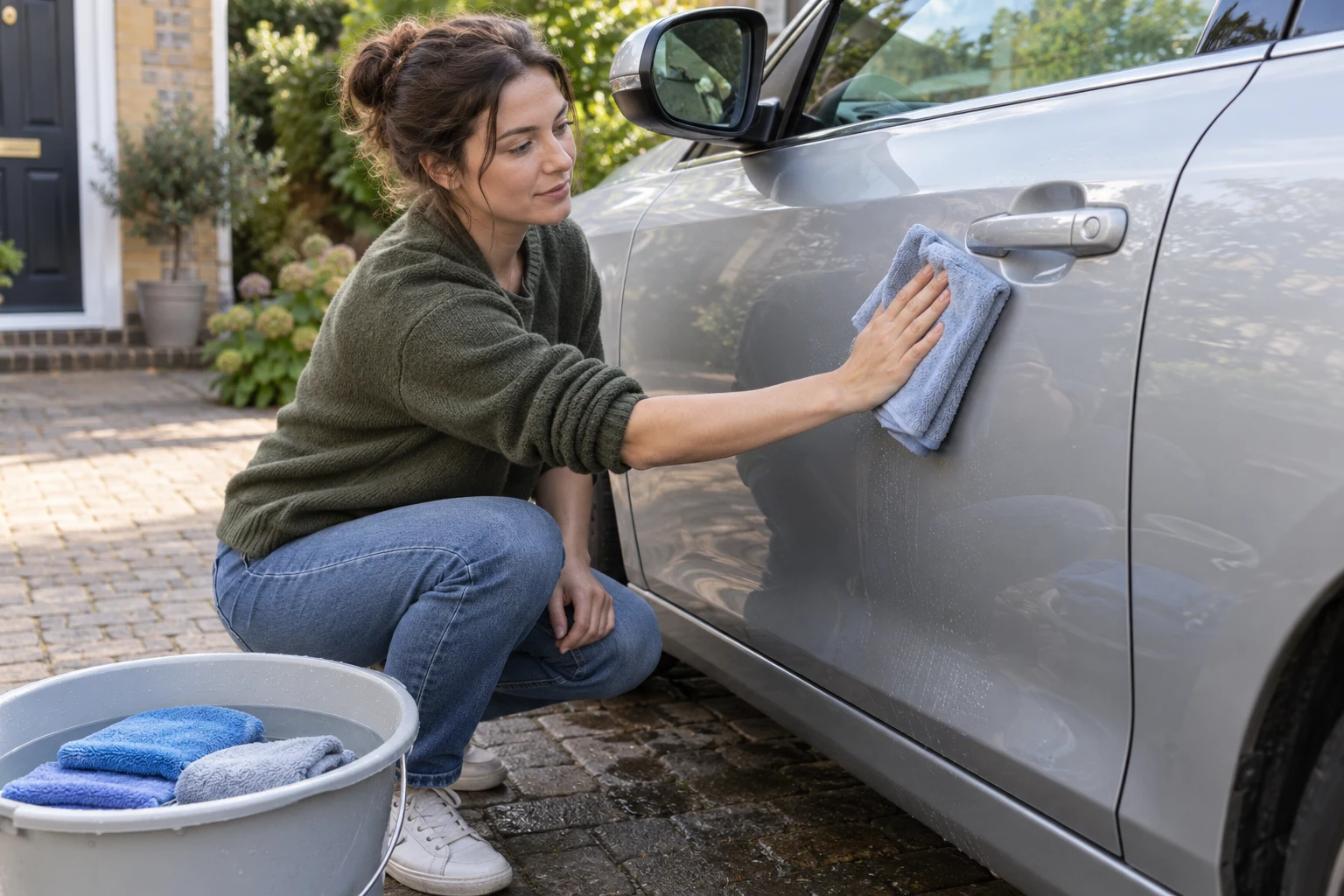
Decide whether rinseless suits today’s car
Rinseless washing uses a dedicated product diluted in water, clean wash media and prompt drying. It can make maintenance washing practical when a running hose is awkward, but it does not change the physical problem of abrasive dirt on a panel. Start by looking at the car, not the bottle’s promise of convenience. The rinseless-versus-waterless comparison separates this wet-media method from a ready-to-use spray-and-cloth routine.
Light road film on a maintained car presents a different task from dried mud behind the wheels or sand across the bonnet. Inspect lower panels, the rear and horizontal surfaces in good light. If bulk contamination needs flushing away, arrange an appropriate rinse first. A lack of hose access is not evidence that wiping is now the suitable method.
Confirm the outer surface and its care instructions. Coatings, wraps, paint-protection film, matt finishes and repaired panels can impose additional limits. A product’s broad material list should be checked against those instructions. For a new coating or film installation, respect its first-wash conditions as well.
Use a rinseless product, not diluted ordinary shampoo
Choose a product with an explicit rinseless washing method; the rinseless-product buying guide compares the selected concentrate packs and accompanying textiles. Optimum No Rinse Wash & Shine is a blue concentrate designed for this approach. Check the received bottle’s version and dose; similar names do not make Wash & Shine, Wash & Wax and Opti-Coat formulas identical.
For a measured bucket-based rinseless wash
Optimum No Rinse Wash & Shine 946ml
A single 946ml bottle of the blue Wash & Shine rinseless concentrate. Used with the specified water mixture and clean wash media, followed by drying each completed section.
- 946ml single bottle
- Blue Wash & Shine concentrate
- Water dilution and separate drying required
Check the received revision and directions. This is not the green Wash & Wax or yellow Opti-Coat formula. Heavy mud and grit need bulk removal first; no universal permission for specialist finishes, displays or interior assemblies.
Keep washing dilution separate from quick-detailer, clay-lubricant or waterless recipes. One bottle can have several intended uses at different concentrations. A stronger spray mix is not automatically better for a bucket, and an ordinary contact shampoo should not be left unrinsed because it has been mixed weakly.
For a label specifying one part concentrate to 256 parts water, five litres of measured water needs about 19.5ml of concentrate. That is water already in the bucket, not five litres of finished mixture. Use a suitable measuring tool rather than assuming every cap holds the same amount.
Prepare clean media and a dirty-cloth container
Have more clean media available than you expect to use, plus a separate place for used cloths. A folded plush towel offers several faces, but those faces must remain genuinely clean. Once a face has collected dirt, do not turn it back onto paint later in the session.
For a supply of separate clean plush cloth faces
The Rag Company Eagle Edgeless 500 — blue four-pack
Four blue 16 × 16in plush edgeless microfibre towels, specified as 500gsm and a 70/30 blend. Useful for permitted rinseless or waterless methods with frequent changes to clean faces.
- Four blue towels
- 16 × 16in / about 41cm square
- 500gsm / 70:30 blend
A four-pack is a starting supply, not a guaranteed whole-car allowance. Wash and inspect before use, keep dirty cloths separate and follow textile care. Plush fibres do not make trapped grit harmless.
Wash new towels as the maker directs and inspect for grit, hard seams, labels or manufacturing debris before the first job. Keep cloths that have touched tyres, wheels, exhaust soot or dressing out of the paint kit. Soft fibres do not neutralise a hard particle caught between them and the panel.
Lay out the bucket, measuring tool and drying towel before wetting the first section. Keep clean cloths away from the ground and chemical overspray. If using several towels in a clean-solution method, avoid returning a dirty one to the fresh supply. If using a reusable mitt method, follow the product’s rinsing and tool-cleaning directions carefully.
Work in shade on cool panels
Find a manageable working area out of direct sun where possible, using the hot-weather washing checks to judge the working window. A hot bonnet can shorten the time available between washing and drying. Wind, panel colour and residual heat after driving also affect how quickly the solution disappears, so an air-temperature reading alone does not settle the decision.
Work on one small section at a time. The first section is an opportunity to check control: can you wet, gently clean and dry it before the mixture dries? If not, reduce the area, move to better conditions or pause. Do not solve rapid drying by adding an arbitrary extra dose.
Keep doors and windows appropriately closed for the exterior work. Plan around badges, mirrors and accessible trim without flooding openings. Rinseless washing uses less running water, but it still needs sensible handling of wet cloths, drips and waste solution.
Wash with light contact and frequent changes
Wet the permitted wash media with the correctly mixed solution. Apply any approved pre-spray as the product directs, then make controlled light passes over the chosen section. Start with cleaner upper areas and work towards dirtier lower areas, changing to fresh faces or tools as needed.
Watch what the cloth collects. If grit remains, the cloth drags or dirt is not releasing through the permitted method, stop that area. Scrubbing harder with a small patch of towel defeats the benefit of a carefully prepared supply. Reassess the contamination and whether a pre-rinse or different wash is needed.
Do not stretch one clean face across the whole car. The length of a pass is less important than whether the tool is still clean enough for the next contact. Keep dirty lower-body equipment separate, and put any dropped cloth aside until it has been properly washed and inspected.
Dry each completed section
Once the section is clean using the specified method, dry it promptly with separate suitable media. The drying towel should collect clean moisture, not finish removing visible dirt. If soil remains, return to the cleaning stage before drying.
For drying clean bodywork
Gtechniq MF2 Drying Towel
A 60 × 90cm, 450gsm microfibre towel intended for car drying. Its larger area gives you a dedicated drying tool instead of relying on a small polish-buffing cloth.
- 60 × 90cm
- 450gsm microfibre
- Dedicated drying towel
Use a light touch on clean bodywork after completing the chosen wash method. Inspect for grit, wash after use and follow the textile’s care label. A drying towel cannot make a dirty surface safe to wipe.
Use light contact and a clean area of the towel, supporting loose corners so they cannot trail onto paving. Change towels if saturation makes them smear. Catch accessible drips after they emerge from handles or mirrors instead of forcing a cloth into gaps.
If solution dries prematurely, use the product’s stated recovery method. Optimum’s directions call for rewashing and drying again. Treat repeated premature drying as a sign to change conditions rather than spending the whole session buffing stubborn residue.
Inspect before calling the job finished
Look at the dry surface from more than one angle. A smear may be leftover liquid, an over-strong mixture, a saturated towel or dirt that needed another permitted pass. Diagnose the simple cause before adding a gloss spray that makes the result harder to assess.
Do not use the method as an automatic decontamination treatment. Tar, bonded fallout and mineral deposits remain separate questions. Their removal products also need approval for the actual finish; rinseless washing does not grant that permission.
Leave the kit ready for the next wash
Separate used washing and drying media, then launder them according to their textile instructions. Inspect the bucket and measuring tool before storage. Label any permitted retained mixture with its product and intended use, and follow the bottle’s storage and disposal directions rather than keeping dirty solution indefinitely.
Check the location’s washing arrangements before starting the next session, including where waste liquid can be handled appropriately. Lower water use is useful, but it does not establish permission to wash in every shared garage or car park. A repeatable rinseless routine depends on suitable dirt, a measured mixture, plenty of clean media and a clear stopping point when those conditions are missing.
Common questions
Does rinseless washing use no water?
It uses water to dilute the concentrate and wet the wash media. Rinseless describes omitting the traditional final hose rinse after the permitted wash; it does not mean wiping paint dry.
Can I rinseless-wash a muddy car?
Do not start by wiping caked-on mud or gritty deposits. Remove bulk contamination with a suitable pre-rinse or use a conventional wash. If that cannot be done where the car is parked, choose another location or postpone the full wash.
Can ordinary shampoo be used without rinsing?
Not unless its exact instructions provide a rinseless method. A conventional shampoo normally needs rinsing. Making a weaker bucket does not turn it into a purpose-made rinseless product.
How many cloths do I need?
Enough clean faces to complete the actual dirt level without reusing contaminated sections, plus separate drying media. A four-pack is a starting supply rather than a guaranteed whole-car allowance.
What if the solution dries before I finish?
Follow the product’s recovery method. Optimum directs rewashing the section and drying again. Do not rub a dry residue or continue on a panel that is too hot to keep under control.
Sources and product instructions
Follow the label and care instructions for the exact version and surface you own.