
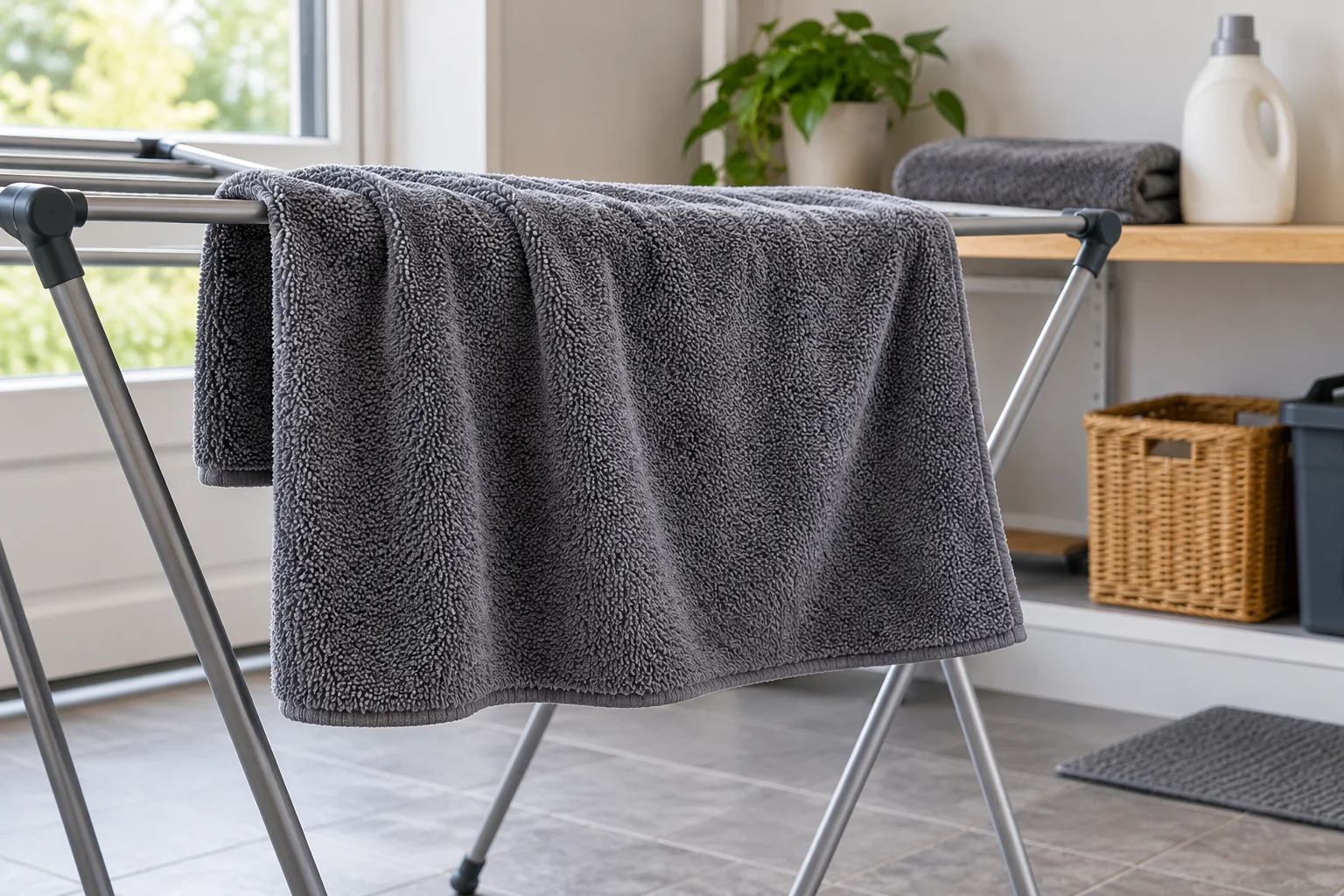
Keep drying performance separate from dirty-tool cleanup
A drying towel should start with clean fibres and a suitable absorbent surface. If it shares a wash load with oily tyre applicators, wax-loaded cloths or gritty utility textiles, contamination can migrate into a tool intended to touch clean paint. Sorting is therefore part of washing the towel, not a separate organisational nicety.
Check the care instructions before choosing temperature, detergent and drying method. “Microfibre” describes a broad material category, not a complete laundry specification. Fibre blend, weave, backing, stitching and the maker’s requirements all affect what treatment is suitable.
Step 1: sort by previous use and inspect
Keep ordinary drying towels apart from glass, polish, wax, sealant and wheel textiles. A towel used as a drying aid with a protective product may carry different residues from one used only on rinsed paint. Label that role so you can make a sensible laundry decision afterwards.
Shake or handle the towel only in a clean area and inspect for particles, tar, hardened deposits and damaged edges. If it has fallen on the ground, isolate it immediately. Do not wipe another clean panel while hoping the debris will fall out in use.
| Textile or product | Published direction | What it means in practice |
|---|---|---|
| Gtechniq MF2 drying towel | Global page maximum 40°C; UK page maximum 50°C; received label controls; non-biological detergent, no bleach or softener; air or low tumble dry | Choose detergent and cycle within that complete set of limits |
| Autoglym Ultra-Soft Drying Towel | Wash separately up to 40°C; no fabric conditioner; tumble drying recommended | Do not borrow a higher limit from another towel; follow the received label for drying settings |
| CARPRO MFX detergent | Machine dose 50ml; gentle/synthetic 40–60°C guidance | The detergent range is subordinate to the textile’s lower limit and detergent restrictions |
Step 2: select a compatible detergent
Use the type and amount permitted by the textile maker. Avoid fabric conditioner and unwanted softener residue. Check the detergent drawer and dosing equipment rather than assuming the bottle you choose is the only laundry product that can reach the load.
CARPRO MFX is a dedicated cleaner for microfibre and polishing pads, with a 50ml machine-wash dose. It is relevant where the textile maker permits that detergent. Its separate soaking instructions are not a universal recipe for every towel, pad or backing material.
For cleaning waxy and oily textile residues
CARPRO MFX Microfibre Wash Detergent 500ml
A dedicated microfibre and polishing-pad detergent. CARPRO gives a 50ml machine-wash dose and separate soaking instructions, which must be used within the textile or pad maker’s care limits.
- 500ml bottle
- 50ml machine-wash dose
- Textile care limits take priority
A detergent’s 40–60°C guidance cannot override a towel’s lower temperature limit or detergent restrictions. Cleaning cannot restore melted fibres or make hardened coating cloths safe for paint.
MFX’s 40–60°C machine guidance does not approve washing a 40°C towel at 60°C. Nor should a specialist detergent be assumed to meet an explicit non-biological requirement without confirmation. Where instructions conflict or ingredient suitability is unclear, use the towel’s supported method or ask the maker.
Avoid adding extra detergent simply because a towel has stopped absorbing well. Excess residue can create another problem. Start with correct sorting, a compatible dose and effective rinsing; investigate persistent contamination separately.
GYEON TowelWash is another 500ml detergent option where the textile permits its method. Its published dose options and air-drying directions remain specific to that product.
For washing detailing textiles
Gyeon Q²M TowelWash 500ml
A dedicated detergent for cleaning reusable microfibre towels and compatible wash accessories. Useful for a growing textile kit when you want one clearly identified wash product.
- 500ml bottle
- Dedicated microfibre detergent
- No added fabric softener
Follow the textile’s care label and the detergent bottle for dose and cycle. Do not add softener or bleach. Detergent does not make hardened coating towels suitable for paintwork again.
Compare detergent doses without assuming equal wash loads
CARPRO’s MFX machine-wash instruction specifies 50ml. GYEON’s TowelWash directions show 15/30ml options, while the technical consumption field shows 30ml per wash. Neither source defines a common load mass for comparing these products. Match the chosen GYEON quantity to the received instructions. The source gives no load-mass breakpoint that assigns 15ml to a light load and 30ml to a heavy load.
| Product / source option | Source dose | Complete events Calculated | Left over Calculated | Allocated dose cost Hypothetical price |
|---|---|---|---|---|
| CARPRO MFX | 50ml | 10 | 0ml | £1.20 |
| GYEON TowelWash — 15ml option | 15ml | 33 | 5ml | £0.36 |
| GYEON TowelWash — 30ml option | 30ml | 16 | 20ml | £0.72 |
Method: complete dosing events = round down bottle ml ÷ dose ml; remainder = bottle ml − complete events × dose ml. Allocated dose cost = assumed bottle price × dose ml ÷ bottle ml. At 15ml, 33 events consume 495ml and leave 5ml. That remainder is not another full dose. The £0.36 figure allocates only the detergent consumed; the bottle still costs the assumed £12 upfront.
The figures exclude measuring losses, an extra rinse, electricity, water and any separate cleaning treatment. They compare nominal consumption, not equally sized loads, residue removal or restored absorbency. A lower dose cost is useful only after the detergent, load and care method are suitable. Do not reduce the actual required dose to reach the table’s event count, combine leftover products, or substitute a pad-soaking recipe for the machine-wash instruction.
Download the three dose scenarios, cost assumptions and source links (CSV). Replace the hypothetical price with the delivered price of the exact bottle; retain its matching dose and size.
Find a shared temperature range, then check the rest of the care label
The global MF2 page gives a 40°C maximum, while the UK MF2 page gives 50°C. Both specify non-biological detergent and exclude bleach and softener. Use the received towel’s care label and its matching instructions; do not borrow the higher regional limit. The drying-towel buying guide compares the textile specifications separately.
| Textile / label scenario | Textile maximum | Numeric intersection Calculated |
|---|---|---|
| Autoglym Ultra-Soft | 40°C | 40°C |
| MF2 — received label says 40°C | 40°C | 40°C |
| MF2 — received label says 50°C | 50°C | 40–50°C |
| Hypothetical 30°C-limit textile | 30°C | No numeric overlap |
Method: retain the detergent’s lower bound of 40°C and use the lower of 60°C and the textile maximum as the upper bound. If that upper bound is below 40°C, there is no shared numeric range. A hypothetical textile limited to 30°C therefore has no overlap with these MFX instructions. Choose another expressly permitted method rather than raising the textile limit.
A shared temperature is only one condition. This calculation does not establish whether MFX satisfies MF2’s non-biological-detergent requirement, or authorise mixing towels that must be washed separately. Check detergent composition, load separation, cycle and drying directions independently. GYEON’s warm-water wording is not converted into an invented numeric limit. Its air-drying instruction also remains a separate choice from any towel maker’s permission to tumble dry.
Download the temperature intersections and their care-source boundaries (CSV). Blank numeric cells identify a missing intersection; they do not mean a 0°C wash.
Example: Gtechniq MF2
The MF2 illustrates why the whole care instruction matters. The global source gives a 40°C maximum and the UK source gives 50°C. Follow the received label and matching care directions; both sources specify non-biological detergent and exclude bleach and softener. It allows air drying or low-temperature tumble drying and calls for dust-free storage.
If you already own the towel, follow those directions rather than buying a replacement solely because it needs routine cleaning. The product is included here to make the care distinction concrete, not to suggest a new towel is necessary after each wash.
For drying clean bodywork
Gtechniq MF2 Drying Towel
A 60 × 90cm, 450gsm microfibre towel intended for car drying. Its larger area gives you a dedicated drying tool instead of relying on a small polish-buffing cloth.
- 60 × 90cm
- 450gsm microfibre
- Dedicated drying towel
Use a light touch on clean bodywork after completing the chosen wash method. Inspect for grit, wash after use and follow the textile’s care label. A drying towel cannot make a dirty surface safe to wipe.
Example: Autoglym Ultra-Soft Drying Towel
Autoglym’s towel has a different 40°C upper washing limit and a separate-wash instruction. The maker says to wash before first use and avoid fabric conditioner. Its tumble-drying recommendation should be followed with the received care label’s permitted settings.
This is not contradictory advice: the towels are different products. A mixed load can be restricted by the most sensitive item, but contamination differences may still make separate washing preferable. Combining everything at a lower temperature does not solve product transfer between cloths.
For an 80 × 60cm twisted-loop towel
Autoglym Ultra-Soft Drying Towel
A dedicated twisted-loop drying towel, listed at 80 × 60cm. Its shape offers a broad drying area without moving up to an especially long towel.
- 80 × 60cm
- Twisted-loop construction
- Dedicated car-drying towel
Wash separately before use and follow the care label. Current manufacturer directions allow machine washing up to 40°C without softener and recommend tumble drying; check the supplied drying setting.
Step 3: wash and rinse without overloading
Allow the load room to move and rinse. Follow the machine instructions alongside textile care; a tightly packed drum is a poor starting point for removing residues. Keep gritty equipment and household lint-shedding materials out of a drying-towel load.
Use the permitted programme and temperature, then inspect the result. If detergent remains, use a suitable additional rinse rather than adding another chemical. Persistent greasy or stiff areas need a considered response based on the contaminant and maker’s directions, not increasingly hot cycles.
A towel carrying ordinary spray-product residue is not automatically the same as one used for a setting coating. Where a coating has hardened, do not attempt to turn the cloth into a sensitive paint-drying towel. Detergent claims do not reverse every chemical change.
Step 4: dry completely and inspect again
Air-dry where permitted in a clean, ventilated area, with the towel spread so all sections can dry. Keep it clear of floors, workshop dust and dirty rails. If tumble drying is permitted, use the specified settings and avoid laundry additives that conflict with the care instructions.
Do not substitute a radiator or other concentrated heat source for an approved drying method. Damage can change the textile permanently, even if the towel still looks tidy when folded. Examine pile, edges and seams before returning it to paint work.
Step 5: store dry, then check before the next car wash
If proper washing does not restore a serviceable towel, use the car-drying towel comparison to choose a replacement by size, handling and care instructions. Replacing a towel is a separate decision from adding more detergent.
Store completely dry towels in a clean covered compartment separate from used textiles, wheel tools and chemicals. A sealed box keeps dust out only after drying is complete; it cannot finish drying a damp folded towel.
At the next wash, recheck the towel before use. Assess absorbency on a suitable clean test surface or an inconspicuous part of the permitted drying process without grinding a questionable towel into paint. If it still drags, smears or contains hard material, stop and investigate rather than increase pressure.
Task separation helps prevent repeat contamination. Replace or retire towels whose fibres or cleanliness can no longer be trusted, and label their new role clearly. A tired towel does not automatically become suitable for glass, trim or another delicate surface.
Common questions
What temperature should I wash a car-drying towel at?
Follow the received towel label. Gtechniq’s global MF2 page gives 40°C maximum and its UK page gives 50°C; both specify non-biological detergent. Autoglym Ultra-Soft specifies separate washing up to 40°C. A detergent range does not override the textile limit.
Can I tumble-dry a car towel?
Only where its maker permits it and within the stated settings. MF2 allows air drying or low-temperature tumble drying. Autoglym recommends tumble drying for its Ultra-Soft towel; follow the received care label for settings rather than assuming high heat.
Do I need a specialist microfibre detergent?
Not always. A permitted ordinary detergent may satisfy the towel’s instructions. Specialist cleaners can help with suitable residues, but do not override requirements such as non-biological detergent or a lower temperature limit.
Why has my drying towel become less absorbent?
Possible causes include product deposits, detergent or softener residue, incomplete cleaning, or damaged fibres. Check its history and care directions, clean and rinse appropriately, then reassess. Detergent cannot repair heat damage or guarantee recovery.
Can a coating towel become a drying towel after washing?
Do not reassign a towel with hardened coating residue to paint drying. GYEON excludes coating towels from reuse in its TowelWash guidance. Keep coating application textiles separate and follow the coating maker’s disposal and care instructions.
Sources and product instructions
Follow the label and care instructions for the exact version and surface you own.