
A useful wash starts before the mitt
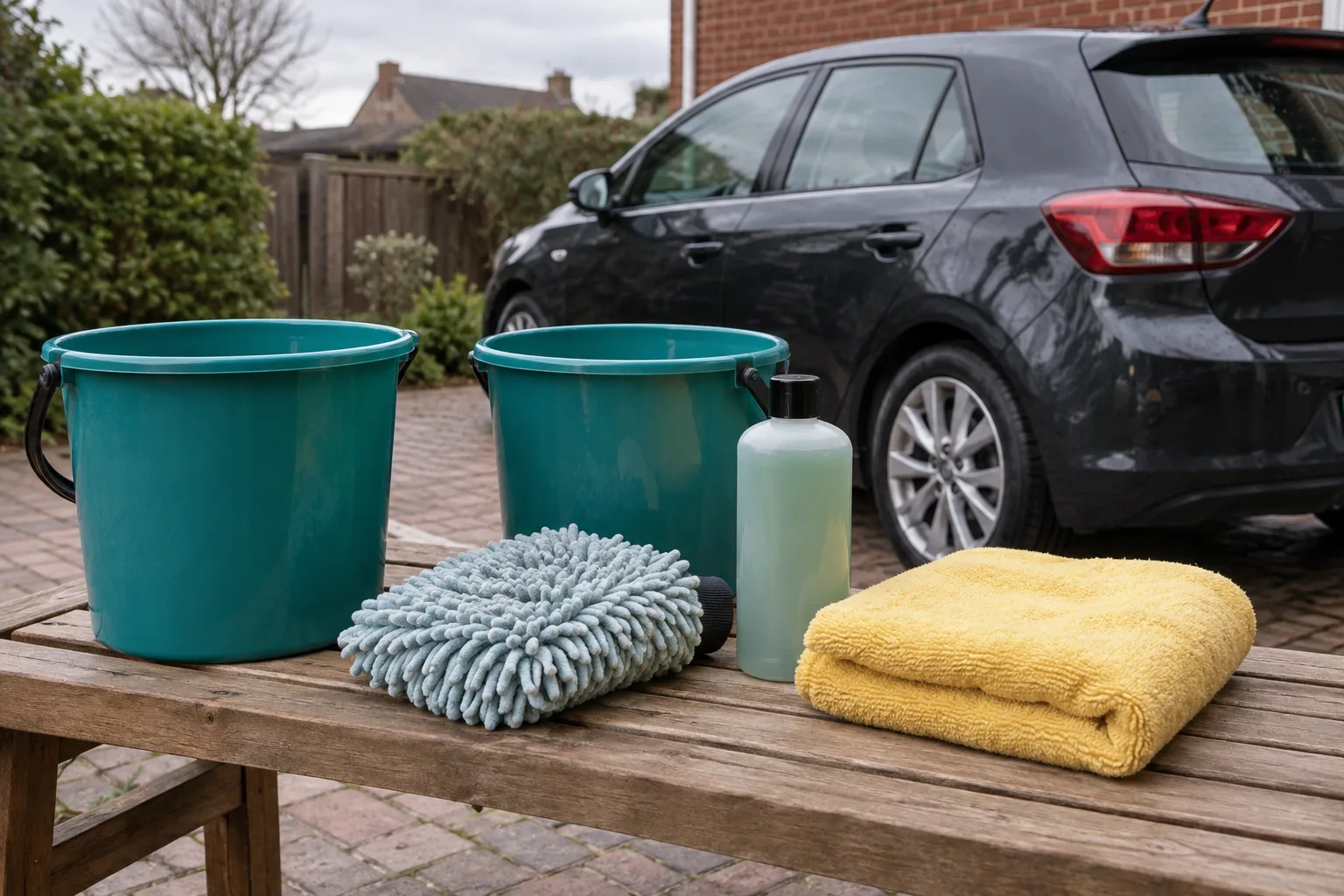
For routine car washing, start with a suitable shampoo, a clean wash tool, separate wash and rinse buckets and a dedicated drying towel. Rinse loose dirt before contact washing, work on cool panels and follow the instructions for your car’s finish.
The order matters more than a cupboard full of bottles. A manageable routine makes it easier to keep tools clean and finish the job before products dry on the car. Keep the wheel tools separate from anything used on the bodywork.
Find the right car-washing method
A first wash, a maintenance wash and a car covered in gritty mud are different starting points. Choose the method for the dirt, available rinsing and actual finish before buying another liquid. The detailed guides below separate ordinary contact washing, optional pre-washing and lower-water methods so you can build one complete routine.
| Your next job | Start here | What to establish first |
|---|---|---|
| First home wash | Follow the full wash | A suitable rinse, clean contact tools and a drying plan |
| Buying missing essentials | Compare a complete basket | Equipment you already own and what a boxed set leaves out |
| Adding a pre-wash | Place foam in the routine | Pre-washing and the later shampoo wash have different jobs |
| No convenient hose | Compare alternative methods | Dirt suitability, clean cloth supply and any necessary pre-rinse |
| Drying marks remain | Diagnose water spots | Residue, deposits and a mark in the finish need different responses |
| Changing washer accessories | Identify the connections | Both mating ends, the supported system and component limits |
Build a complete home-wash routine
Start with how to wash a car at home, then use the two-bucket explainer and the drying guide for the practical details. If rings remain after rinsing, follow the water-spot troubleshooting guide.
Choose each part of the kit
- Car shampoos: four options for different finishing routines.
- Microfibre wash mitts: three constructions and their care differences.
- Car drying towels: dimensions, density and handling.
- Shampoo versus wash and wax: understand the film left after washing.
- Shampoo dilution and cost per wash: measure correctly and compare usable doses.
- Boxed kits versus buying separately: buy around the equipment you already own.
Shampoo without buying another bundle
If you already own the tools, buy shampoo on its own. GWash is a bucket-wash option; it does not add a wax-finishing step. Keep the dilution on its bottle separate from the instructions for any other shampoo.
A standalone bucket-wash shampoo
Gtechniq GWash 500ml
A concentrated, pH-neutral shampoo for a regular contact wash. A useful single-bottle choice when you already own a mitt and towels and do not need another boxed set.
- 500ml concentrate
- Bucket-wash shampoo
- pH-neutral formulation
Use the dilution on your UK bottle. This is GWash, not Ceramic GWash or a snow-foam pre-wash; follow your coating or finish supplier’s care instructions.
A wash tool that fills the gap
A boxed liquid set still needs a contact-wash tool. Choose a mitt you can rinse easily, then clean it as directed after the wash.
A reusable bodywork wash tool
Meguiar’s Super Thick Microfibre Wash Mitt
A microfibre mitt for contact washing the bodywork. Meguiar’s specifies machine washing, so it can be cleaned and reused as part of your regular wash routine.
- Microfibre
- Machine washable
- Separate from wheel-cleaning tools
Rinse it frequently during the wash and keep it separate from wheel tools. A dirty mitt can mark paint; no mitt guarantees scratch-free washing.
Pre-washing, foam and equipment fit
Start with using a pressure washer on a car and snow foam versus contact shampoo to place the pre-wash in the full routine.
- Choose a Kärcher K-series foam lance: compare three attachments after checking the gun.
- Identify snow-foam connectors: distinguish the actual mating ends and older-gun exceptions.
- Choose a routine pre-wash: compare three chemicals by method and restrictions.
- Calculate dilution and PIR: measure the output and calculate a starting bottle mix.
- Diagnose watery foam: check pickup, supply and expected product behaviour.
- Clean and maintain the lance: separate flushing from model-specific repairs.
- Choose a pump sprayer: match chemistry, liquid or foam delivery and usable fill.
- Control dwell and avoid drying: work within the exact chemical’s instructions.
Match the washer accessories
- Choosing a snow-foam lance for a Nilfisk washer: distinguish Click&Clean lance ends from bayonet mounting.
- Choosing a snow-foam lance for a Bosch washer: match the exact model, part and accessory rating.
- Choosing a short-trigger gun for car washing: compare a complete compact setup with a supported original-style alternative.
- Pressure-washer hose and quick-release compatibility: identify both hose ends, distinguish M22 seals and check the complete system.
Alternative washing methods and difficult conditions
- Rinseless car washing: method, suitability and limits: assess dirt, measure the solution and manage clean wash media.
- Choosing a rinseless car-wash product: compare exact concentrate packs and the textiles needed alongside them.
- Rinseless versus waterless car washing: separate bucket washing from spray-and-wipe use and recognise their limits.
- Washing a car in hot weather: choose shade, cool panels and sections you can finish before drying.
- Cleaning car door shuts: maintain accessible painted ledges with controlled moisture.
Adapt the routine for winter
- A winter car-cleaning routine: choose a workable wash window, keep visibility clear and deal with damp mats.
- Cleaning road salt from bodywork: rinse before contact, assess remaining film and keep sensitive areas clear of strong jets.
Deal with specific deposits after a wash
If ordinary washing leaves material behind, identify it before adding pressure or chemicals. Follow the focused guides for bird droppings, tree sap, tar spots, insect remains or bodywork iron fallout. Mechanical clay treatment is a separate suitability decision.
Finish the glass and inspect exterior details
After the main wash, follow exterior-glass cleaning and inspect black plastic trim. Use panoramic-roof care for roof-specific limits and rubber-seal cleaning for accessible seals.
Specialist finishes and soft tops
Use the finish-specific routines for coated paint, wraps, PPF and matt or satin paint. Convertible fabric and vinyl roofs have separate material and rinsing requirements.
Match the equipment to the routine
A hose-and-bucket wash
With a suitable rinse supply, build your routine around a bucket shampoo, a wash mitt and a drying towel. A pressure washer isn’t a compulsory first purchase.
Already have a boxed set? Check which essentials it leaves out before buying more bottles.
Adding a pressure washer
The machine’s maximum pressure is only part of the decision. Use the nozzle, setting and distance specified in its manual for your surface.
Kärcher’s K 5 Power Control instructions set painted-surface restrictions. Read the manual for your own model rather than copying settings to every washer.
Adding snow foam
Check your washer’s exact model and the connection point before choosing a lance. A domestic bayonet, threaded fitting and quick-release coupling are different connections; an adaptor must match both sides.
The bottle’s mix and the concentration reaching the panel are not necessarily the same. Follow the foam manufacturer’s instructions for your actual lance setup, including dilution and dwell time.
Keep drying separate from polishing
A clean drying towel removes rinse water. A finishing cloth spreads or buffs a finishing product. Some wet-applied waxes have their own cloth-and-drying procedure, so check that instruction before deciding which towel the job needs.
Rinse or wash textiles as their manufacturer directs. If a towel drops onto the driveway, put it aside until properly cleaned. See kit care and storage for a simple way to keep clean and used equipment apart.
A towel intended for the drying step
The MF2 gives this job its own large cloth. It is an option for an ordinary rinse-and-dry wash, not a reason to rub at dirt left on the car. Use clean sections, a light touch and the towel’s care instructions.
For drying clean bodywork
Gtechniq MF2 Drying Towel
A 60 × 90cm, 450gsm microfibre towel intended for car drying. Its larger area gives you a dedicated drying tool instead of relying on a small polish-buffing cloth.
- 60 × 90cm
- 450gsm microfibre
- Dedicated drying towel
Use a light touch on clean bodywork after completing the chosen wash method. Inspect for grit, wash after use and follow the textile’s care label. A drying towel cannot make a dirty surface safe to wipe.
Common questions
Do I need a pressure washer?
A suitable hose can support an ordinary home wash. Pressure equipment is optional and must be used according to the exact machine’s car-cleaning instructions.
Why use two buckets?
One holds shampoo solution and the other rinses contamination from the mitt. Change dirty rinse water and inspect the mitt; two buckets do not guarantee scratch-free washing.
Can a drying towel remove water spots?
A towel collects rinse water before it evaporates. Persistent dried marks need diagnosis rather than stronger rubbing with the drying towel.
Do all shampoos leave the same finish?
No. Some rinse without an added finishing film, while wash-and-wax and protective washes deliberately leave ingredients behind. Check compatibility and choose the routine you want.
Should I wash every cloth in the same cycle?
Follow each textile’s care label. Some wash mitts are hand-wash only and machine-wash temperatures or drying methods vary. Keep wheel textiles separate from paint towels.
Sources and product instructions
Follow the label and care instructions for the exact version and surface you own.