
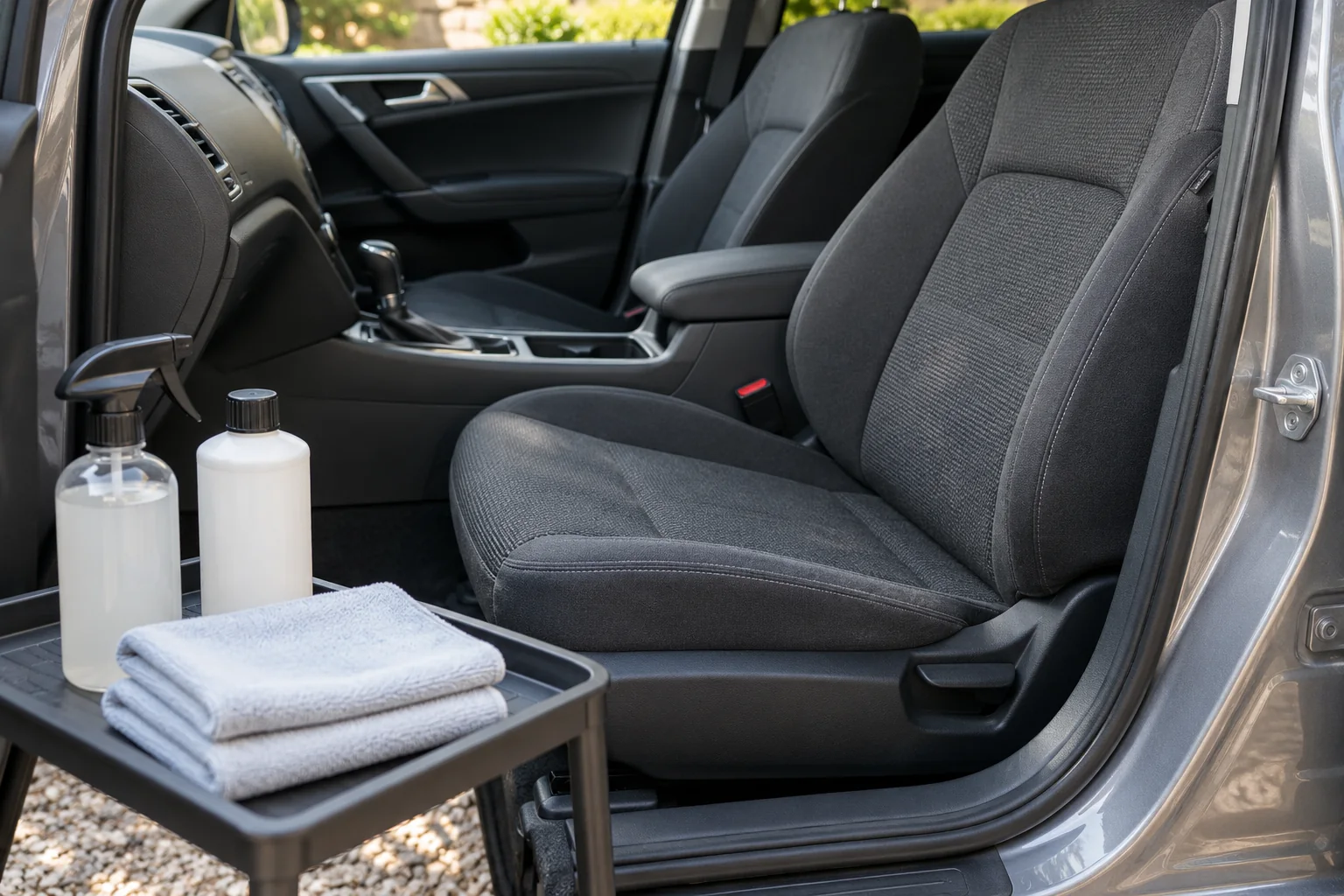
Match the cleaner to the seat covering
An upholstery-cleaner label does not settle whether your particular seat can be wet-cleaned, brushed or extracted. Identify the material first: ordinary woven fabric, a suede-like covering, leather and imitation leather can look similar in photographs while needing different methods. Check the vehicle trim specification and care instructions before buying.
Then identify the job. A fresh surface mark, general contact grime and a deep spill into seat padding are different problems. A suitable hand-cleaning spray may be enough for the first two. A persistent smell or a heavily soaked cushion can require assessment beyond another bottle of cleaner.
The three choices below separate a familiar light-spray method, cloth-applied ready-to-use cleaner and a concentrate with distinct dilution instructions. They are not a stain-removal ranking.
Three cleaner choices with different preparation
| Cleaner | Preparation and role | Decision before buying |
|---|---|---|
| Autoglym Interior Shampoo 500ml | Ready-to-use, light hand application on compatible fabric | Can you follow the cloth or sponge and residue-removal method? |
| Gtechniq I2 Tri-Clean 500ml | Ready-to-use, applied to a damp cloth | Does the vehicle permit this cleaner on the actual covering? |
| ValetPRO Advanced Interior Cleaner 1L | Concentrate, measured for the intended method | Can you distinguish hand dilution from extraction dilution? |
Autoglym Interior Shampoo: a straightforward hand-cleaning option
Autoglym directs vacuuming first and a light application on fabric, with a clean cloth or firm sponge and frequent rinsing of that tool. It is a method for controlled surface cleaning, not an invitation to saturate the padding.
Choose it when the surface is compatible and you want to avoid mixing concentrate. You still need clean tools, a way to remove dirty residue and enough time for the seat to dry. It is not suitable for display or infotainment systems, so do not use the bottle as a general answer for the entire dashboard.
For fabric seats and removable mats
Autoglym Interior Shampoo 500ml
A ready-to-use cleaner for compatible interior fabrics and hard surfaces. Useful for local cleaning after vacuuming, without introducing an extraction machine.
- 500ml spray
- Fabric and carpet cleaning
- Use after vacuuming
Vacuum first and apply lightly on compatible fabric. Not suitable for displays or infotainment. Autoglym permits leather use through a soft clean cloth, rather than direct spraying; vehicle material care still governs use.
Gtechniq I2 Tri-Clean: put the product on the cloth
The UK Tri-Clean instructions apply the cleaner to a damp microfibre cloth, followed by gentle work and a clean cloth to remove residue. That gives it a distinct cloth-based role when controlling liquid around seat panels and adjacent trim.
Gtechniq lists a broad range of interior materials, but the vehicle's care still takes priority. Choose around the cleaning method and compatibility, rather than treating hygiene or odour wording as a reason to use it on every fabric. This guide makes no disinfecting claim and does not extend it to a child restraint.
For a controlled cloth-based interior clean
Gtechniq I2 Tri-Clean 500ml
A ready-to-use interior cleaner for compatible fabrics, plastics and leather. The UK directions apply the product to a damp microfibre cloth, then remove residue with a clean cloth.
- 500ml spray
- Cloth application
- Separate from fabric protection
Vehicle material instructions take priority. Test discreetly, keep liquid out of openings and do not treat broad material claims as permission to clean every screen or child restraint.
ValetPRO Advanced Interior Cleaner: a concentrate needs a measuring plan
The 1L concentrate is a different purchase from the ready-to-use version. ValetPRO gives hand-cleaning dilutions up to 1:20 for light stains and 1:9 for heavier soiling, with a separate 1:80 extraction direction. Use the label on the received version and confirm whether its ratio means product to water before measuring.
The useful buying question is whether you regularly need a mixed working solution and can label it clearly. A bigger bottle is less convenient if you have no suitable measuring container, trigger bottle or storage arrangement. Do not increase strength because the seat remains marked.
Its extraction direction is not permission to fill any machine or wet-clean any seat. Confirm the exact machine's solution rules and the vehicle's care first. This guide compares the chemical, without ranking extraction machines.
For owners who can measure a concentrate
ValetPRO Advanced Interior Cleaner 1L
A pH-neutral concentrate for compatible interior fabrics and hard surfaces. The manufacturer gives separate hand-cleaning and extraction dilutions rather than one mixture for every job.
- 1L concentrate
- Separate hand and machine dilutions
- Fabric and hard surfaces
Check the received label and distinguish the 1L concentrate from the ready-to-use version. A machine dilution does not establish that your seat or extractor permits it. Test for colour transfer.
Check what is needed after applying the cleaner
Residue removal is part of the purchase decision. A cleaner that needs frequent cloth rinsing requires clean water and spare textiles. A cloth-applied product needs enough clean faces to stop spreading the same dirt around. If every cloth is already used for polish or tyre dressing, buy or set aside suitable interior cloths first.
Read the complete method before starting, including whether the surface should be cool, how to test colour fastness, how to remove residue and when the surface can be used again. “No rinse” marketing does not mean leaving a heavy film or ignoring the prescribed wipe-off step.
Compare value using working solution, not bottle size alone
For ready-to-use products, bottle volume is broadly the usable liquid volume. For concentrate, calculate the mixed volume at the actual permitted ratio, then compare the amount you use on a typical job. Neither calculation predicts how many seats you can clean: material, soiling and application method change consumption.
If a label defines 1:20 as one part concentrate to twenty parts water, there are twenty-one total parts. For example, a 420ml mixture would contain 20ml concentrate and 400ml water. That is an arithmetic illustration of that definition, not a universal recipe for the products here. Never confuse it with a percentage of the final mixture.
Keep extraction and hand cleaning separate
An extractor introduces more than another attachment. You need permitted upholstery, a compatible low-foaming solution where required, controlled application and recovery, and a realistic drying arrangement. A dry handheld vacuum cannot recover the liquid afterwards.
Do not pour a hand spray into a machine unless both manufacturers permit it. Do not assume a machine suitable for household carpet is automatically approved for heated, ventilated or electronically monitored car seats. Where the manual is unclear, ask the vehicle supplier or a suitable upholstery professional before buying equipment.
Use a stop rule for difficult marks
Patch-test in an inconspicuous area and assess it after drying. Stop if colour comes away, the pile changes or the covering reacts. Once you have followed the permitted cleaning method, a persistent mark calls for reassessment rather than progressively stronger mixtures and harder brushing.
For the full sequence, use cleaning fabric car seats. If the surface is leather or a leather substitute, use the material-specific seat guide before choosing a cleaner.
Match machine detergent to the actual extractor
The extractor buying guide compares two complete systems and their separate detergent pairings. Follow the extraction how-to only where both the seat covering and assembly allow it. A hand-spray recommendation does not establish tank-detergent approval.
Common questions
Is upholstery cleaner the same as an extraction machine?
No. A hand-cleaning spray is a chemical product. An extractor applies and recovers solution using a machine. A product must be approved for the chosen method, and the seat and machine instructions must also allow it.
Can I put Interior Shampoo in an extractor?
Do not assume so. This guide uses Autoglym Interior Shampoo for its stated hand-cleaning method. Only put a solution into a machine when that exact use is permitted by the product and machine instructions.
Does a larger concentrate bottle always cost less per clean?
No. Compare the actual price paid, the correct working dilution, the amount used and any measuring equipment. Concentrate is only useful value if you can mix and use it correctly.
Can I use these cleaners on a child car seat?
These recommendations concern the vehicle upholstery. A child restraint has its own cover, harness and buckle instructions. Follow that exact manual rather than applying a general car-interior recommendation to it.
Will a stronger mixture remove every stain?
No. Staining, dye loss and material damage are different problems. Stay within the label directions. Stop if colour transfers, the texture changes or a mark persists after the permitted method.
Sources and product instructions
Follow the label and care instructions for the exact version and surface you own.