
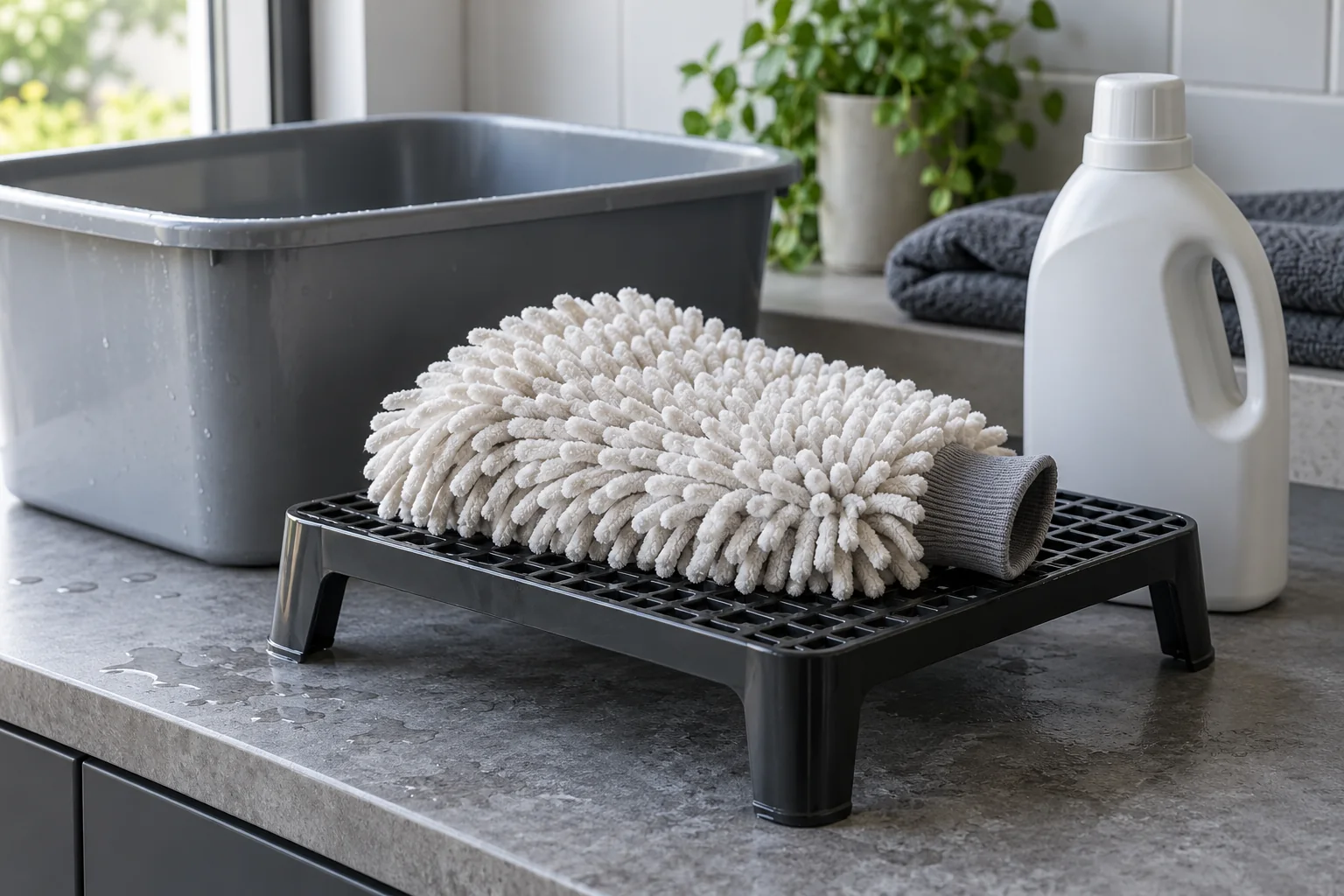
A rinsed mitt is not automatically a clean mitt
During a wash, fibres can collect loose dirt, oily road film and shampoo residue. Rinsing helps remove the loose load, but the mitt still needs inspection, appropriate cleaning and complete drying. Putting a damp mitt straight into a closed bucket leaves the next wash dependent on whatever remained in it.
The aim is to remove contamination while preserving the mitt’s construction. Microfibre chenille, plush synthetic mitts, wool, foam and other materials can have different care limits. Choose the instructions for the exact mitt you own rather than the hottest wash setting or strongest cleaner available.
Step 1: isolate the mitt from dirtier equipment
At the end of washing, keep the bodywork mitt away from wheel brushes, tyre applicators and lower-level utility cloths. Do not leave it on the ground while emptying buckets. Use a clean place for the transition from washing the car to cleaning the kit.
If a mitt has been used on wheels or another contaminated task, label it for that role and do not return it to the bodywork routine. Separate equipment is easier to manage than relying on a laundry cycle to undo a history of mixed use.
Step 2: rinse and inspect before laundry
Rinse loose dirt out using a permitted water temperature. Work through accessible fibres gently, including the cuff and seams where particles can lodge. Avoid scrubbing it against a gritty sink or twisting the construction harder than the maker permits.
Inspect in good light. Look and feel gently for remaining particles, hardened deposits, fibres stuck together, splits and loose internal material. Do not pull a sharp fragment through the pile and assume the surrounding fibres are then clean. Persistent or uncertain contamination is a reason to retire the mitt from paint contact.
| Condition | Next action | Paint-use decision |
|---|---|---|
| Ordinary wash dirt, intact construction | Rinse, then follow the maker’s cleaning and drying method | Inspect again before the next wash |
| Dropped on grit or driveway debris | Isolate immediately; clean and inspect carefully | Do not resume until confident it is uncontaminated; replace if uncertain |
| Used on wheels or greasy utility work | Keep within a separately labelled task stream | Do not promote back to bodywork |
| Hardened residue, damaged backing or persistent particles | Replace or retire from sensitive work | Do not rely on detergent to restore a compromised mitt |
A specific example: Autoglym Polar Mitt
Autoglym supplies the Polar Mitt with a washbag and gives a 40°C machine-wash method. The bag is part of those directions, not an optional storage accessory. Its hand-cleaning alternative uses cold or warm water. The maker also describes leaving the mitt in the bag to hang dry.
This is a useful choice when you want clearly defined care instructions as well as a washing tool. Follow the received version’s directions and avoid borrowing another brand’s higher wash temperature. Keep strong detergents and wheel-cleaner residues away from it.
For grip and a supplied washbag
Autoglym Polar Mitt with Washbag
A 420gsm wash mitt with a tapered elasticated cuff, centre seam and included wash/storage bag. Useful when grip and a machine-washable cleanup routine matter to you.
- 420gsm construction
- Centre seam and tapered cuff
- Wash/storage bag included
Follow the temperature label on the supplied mitt: published Amazon and manufacturer temperatures differ. Store only when dry. It does not replace a pre-wash or make a dirty surface scratch-proof.
Do not treat the washbag as a way to contain grit so the mitt can be washed without inspection. Remove loose contamination first. A bag also does not make a damaged or unsuitable mitt safe for paint afterwards.
Step 3: choose a permitted detergent and wash load
Use a detergent compatible with the mitt’s instructions, in an appropriate dose. Avoid fabric conditioner and residues from laundry products that conflict with the textile care. Check the machine’s drawer and previous use so you are not unintentionally introducing softener or heavily contaminated household textiles.
GYEON Q²M TowelWash is a dedicated textile-cleaning option with separate light and heavier-load dosing directions. It can be relevant to compatible microfibre care, but the mitt’s own temperature, detergent and construction requirements still control the wash. A specialist bottle is not permission to override them.
For washing detailing textiles
Gyeon Q²M TowelWash 500ml
A dedicated detergent for cleaning reusable microfibre towels and compatible wash accessories. Useful for a growing textile kit when you want one clearly identified wash product.
- 500ml bottle
- Dedicated microfibre detergent
- No added fabric softener
Follow the textile’s care label and the detergent bottle for dose and cycle. Do not add softener or bleach. Detergent does not make hardened coating towels suitable for paintwork again.
Keep the load manageable and grouped by contamination. A mitt that needs dirt removed should not be bundled with glass cloths or wax-loaded applicators simply because all are made from synthetic fibres. If the exact mitt requires separate washing, follow that rule.
Step 4: rinse thoroughly and dry by the mitt’s method
After washing, check that detergent has rinsed away and the fibres have not retained debris. Where a permitted hand wash is used, rinse in clean water rather than repeatedly working it in the original dirty solution. Avoid adding an improvised chemical soak to compensate for poor rinsing.
Dry in a clean, ventilated place using the permitted method. Do not assume tumble drying is suitable for every mitt construction, even if some car towels allow it. Keep it away from dirty floors, falling workshop debris and direct heat that the maker has not approved.
A dry surface does not guarantee that the cuff or inner construction is dry. Allow the whole mitt to finish before storing it. If there is a persistent odour, residue or change in feel, investigate the care process and condition instead of masking it with fragrance.
Step 5: store for a clean start next time
Put a completely dry mitt in a clean labelled compartment away from wheel tools, chemical bottles and used textiles. A covered dry-textile box can keep dust off; a sealed box is not a drying space. Leave the storage empty until the mitt is ready.
At the next wash, inspect again before it touches paint. If it has fallen, been handled with greasy gloves or acquired debris in storage, the previous laundry cycle is no longer the relevant assurance. Organising a compact kit makes the clean-to-used route straightforward.
Know when washing has reached its limit
If the mitt needs replacing, compare microfibre wash-mitt constructions and care requirements before buying. Choose a tool whose cleanup method fits the routine you can maintain.
A specialist detergent can remove suitable residues, but it cannot rebuild melted fibres, repair backing or guarantee removal of every hard particle. A low-cost replacement can be the more sensible choice when a mitt’s condition is uncertain. Keep any retired tool clearly labelled and avoid assigning it to another delicate surface by default.
Common questions
Can a wash mitt go in the washing machine?
Only if its maker permits it. Autoglym’s Polar Mitt has specific machine-wash instructions: use the supplied bag and wash at 40°C. Do not apply that method automatically to wool, sponge, leather-backed or other mitt constructions.
Can I wash the mitt with drying towels?
Separate washing is a useful way to keep trapped dirt and residues away from sensitive drying textiles. Follow the actual maker’s instructions. Autoglym advises separating the Polar Mitt from sensitive materials and allows only appropriate uncontaminated cloth combinations in its care guidance.
What if I drop the mitt on the driveway?
Stop using it on the car. Isolate it, rinse and inspect thoroughly, including seams and cuff. Washing does not prove every abrasive particle is gone. Replace it or retire it from paint use if debris remains or its condition is uncertain.
Should I use fabric conditioner on a wash mitt?
Do not use it on the featured microfibre mitt. It can leave unwanted deposits and conflicts with its care instructions. Also avoid strong cleaners, bleach or wheel-cleaner residues unless the exact textile maker explicitly permits them.
How often should I replace a wash mitt?
There is no reliable universal wash count. Inspect for persistent particles, hardened contamination, damaged fibres, loose stitching and deteriorated backing. Replace or retire a compromised mitt rather than waiting for a calendar interval.
Sources and product instructions
Follow the label and care instructions for the exact version and surface you own.