
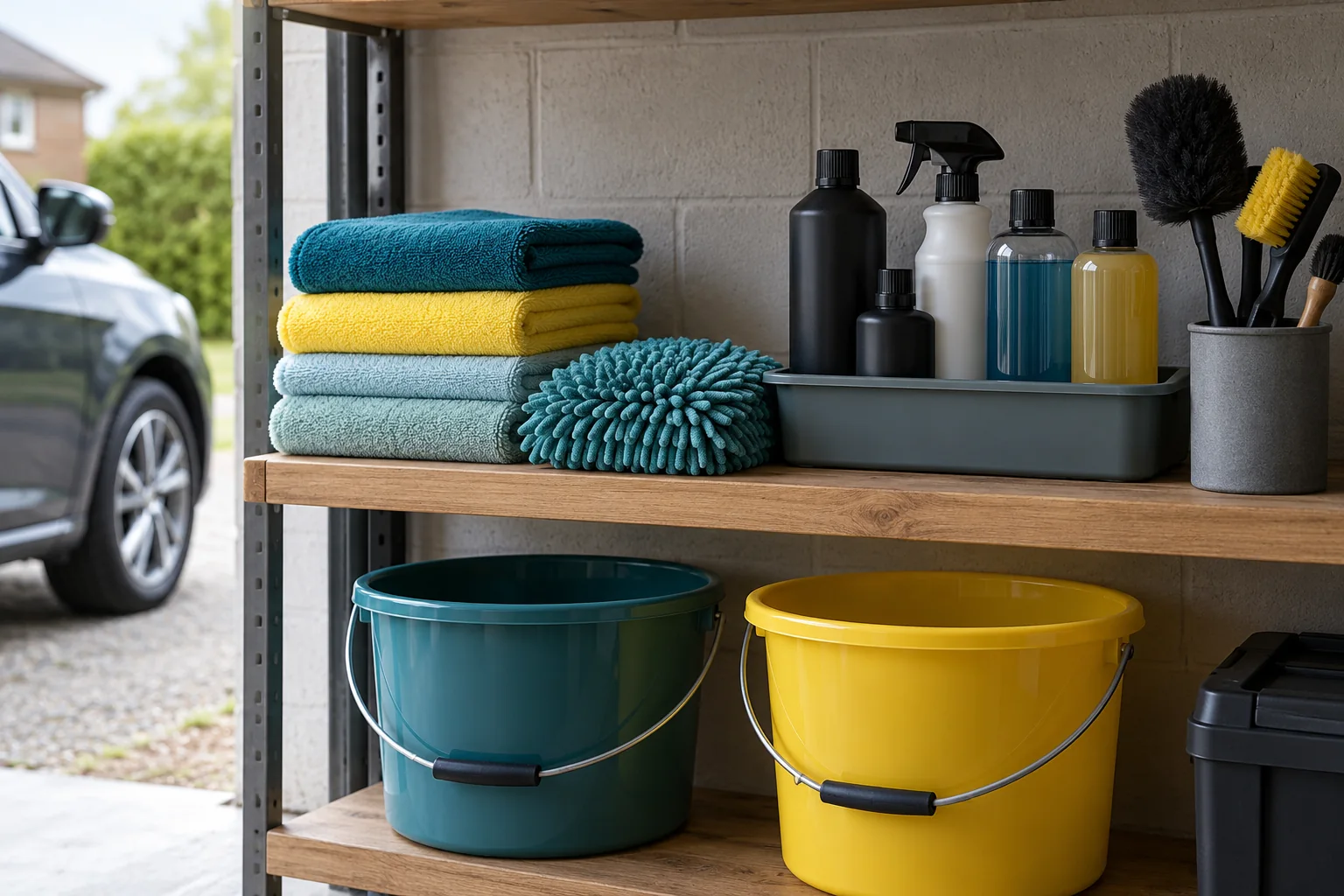
Begin with the jobs you repeat
A compact kit should make a normal wash easy to start and easy to put away. It does not need a bottle for every possible stain or a large selection of overlapping finishes. List the work you actually do: routine wash, drying, wheels, glass, ordinary interior cleaning and any chosen protection stage.
For each job, identify the tools, chemical and cleanup method. An item without a clear role is a candidate to leave off the next order. A tool that is always missing, dirty or damp is a storage-process problem to solve before adding more products.
Give the kit four separate routes
| Group | Store when ready | Keep away from |
|---|---|---|
| Clean bodywork kit | Completely dry mitt and drying towels in covered clean storage | Wheel tools, gritty cloths, chemical leaks and used wax cloths |
| Finishing and interior textiles | Labelled by task, with glass kept away from oily residues | Mixed used laundry and abrasive pads |
| Wheel and utility equipment | Cleaned and dried in a separate marked container | Anything that will return to clean bodywork |
| Chemicals | Original closed labelled containers in suitable secure storage | Food, children’s access, heat and incompatible products as specified |
Set aside a temporary “used” collection point during the job. It should keep used items apart without pretending they are ready for storage. Empty it into appropriate cleaning and drying routines afterwards; do not leave damp kit sealed between washes.
Use a small box for the clean essentials
A standard 9-litre Really Useful Box can provide a covered compartment for a modest set of fully dry textiles or dedicated small accessories. Choose the contents first and check usable dimensions. A folded towel can take more space than the nominal capacity suggests, particularly if you need room to remove it without disturbing everything else.
Label the box by role, such as “clean drying”, rather than just “car stuff”. A visible label makes it easier for another person to put an item back correctly. Clear walls help you see the contents, but do not replace clean-to-used separation.
For storing clean, fully dry cloths
Really Useful Box 9 Litre — Clear
A clear lidded box for a small collection of folded towels and applicators. Labelling it “glass” or “bodywork” makes a separate clean-textile space easy to identify.
- 9 litre capacity
- 395 × 255 × 155mm external
- Clear box with lid
Dry everything before closing the lid. This is an organiser, not a drying container or a chemical-safety cabinet. Check shelf space and keep chemical storage separate.
Keep oily finishing cloths and wheel equipment in different compartments. If there is only space for one shelf, separate smaller containers are more useful than one unstructured pile. Check the shelf’s load and access requirements as well as its footprint.
Choose a larger box only for a defined load
The standard clear 35-litre Really Useful Box measures 480 × 390 × 310mm externally. The maker lists a smaller usable interior of 370 × 310 × 280mm. These are different measurements for different decisions: shelf fit versus actual contents.
Allow space to lift the lid, operate handles and remove the box safely. Do not order an XL, folding or multipack variant expecting identical dimensions. The exact Amazon choice here is the standard 35C clear box.
For a larger dry-textile compartment
Really Useful Box 35 Litre Clear
A clear lidded polypropylene storage box with locking handles. The standard 35-litre model measures 480 × 390 × 310mm externally, with smaller usable internal dimensions.
- 35L standard clear box
- 480 × 390 × 310mm external
- 370 × 310 × 280mm internal
Use for fully dry, clean kit and check shelf clearance including the lid and handles. This ordinary storage box is not a chemical cabinet, drying chamber or verified spill-containment system.
This is dry-kit organisation. The box is not being recommended as a chemical cabinet, a verified spill-containment unit or a drying chamber. Store liquids through their own label and safety-data requirements, even if a retailer photograph happens to show bottles inside a general storage box.
Keep applicators attached to a product role
A simple pad label avoids mixing wax, polish and trim products. Autoglym’s Perfect Polish Applicator is a relevant example with warm-water cleaning and air-drying directions. Follow the liquid and applicator instructions together and inspect before reuse.
Do not make a finishing pad do double duty for tyre dressing because it fits an empty gap in the box. Nor should an applicator carrying dried abrasive or embedded grit return to paint after a superficial rinse.
Controlled hand application
Autoglym Perfect Polish Applicator — Twin Pack
Two shaped foam applicators for compatible polishes and dressings. Autoglym lists Super Resin Polish among their intended uses; the pointed edges help you work around trim.
- Two applicators
- Shaped foam
- Wash and air dry
Reserve a separate applicator for tyre dressing. After use, wash in clean warm water and air dry. Check the bottle’s method; these are not machine-polishing pads.
If a product kit already supplies an applicator and cloth, inventory those before buying extras. Additional clean cloths can be useful for changing loaded faces during a job, but duplicate packages are not automatically a more capable routine.
Arrange the shelf in the order you work
Put the everyday clean wash tools where you can reach them without moving chemical containers. Give wheel equipment a separate marked position. Keep glass cloths and finishing textiles covered so that dusty workshop activity does not contaminate them between washes.
Store chemicals upright and closed in a place that meets the exact product’s conditions. A portable caddy may help move an appropriate selection to the car, but it is not automatically the correct permanent storage or chemical segregation system. Return bottles after use and follow the label for leaks and disposal.
Make space for drying elsewhere. The most carefully labelled shelf fails if the only place to put a freshly washed mitt is back into a sealed box. A clean drying rack or other permitted arrangement is part of the kit’s footprint.
A workable reset after each wash
- Return chemical lids and triggers to the closed position as directed; wipe exterior residue only by a suitable method.
- Separate used bodywork, glass, finishing and wheel textiles before laundry.
- Clean brushes, mitts and applicators according to their own instructions.
- Inspect for damage or contamination that makes an item unsuitable for its previous role.
- Dry completely in clean conditions, including cuffs, seams and pad backing where relevant.
- Refill only the clean storage compartments and note anything genuinely missing for the next wash.
Use the mitt-cleaning guide and drying-towel care for the textile details. The reset takes attention, but it prevents the next wash starting with a mystery damp pile.
Expand only when there is a clear gap
Use the boxed-kit versus separate-purchases comparison to cost only the missing tools. Keep the chemical-storage requirements separate from the space measured for dry towels; an organiser is not automatically suitable chemical storage.
If glass repeatedly smears, check cloth separation before buying another cleaner. If a drying towel struggles, check cleaning and finish residue before ordering a larger one. If paint needs only protection, do not add a polisher because the shelf has room.
A compact kit stays useful when every item has a task, every used item has a cleanup route and every purchase solves an actual limitation. Measure storage around that system rather than expanding the product collection to fill a box.
Common questions
What is the smallest useful home car-cleaning kit?
It depends on the routine, but begin with compatible washing equipment, a bodywork mitt, a drying method, separate wheel tools and enough clean textiles for the tasks you actually do. Add specialist products only for an identified need.
Can I put everything in one large box?
Only if suitable compartments preserve separation and the items are fully dry, but separate task containers are often easier. Keep chemicals stored according to their labels and SDS. An ordinary lidded box is not a chemical cabinet or a drying space.
Should I measure the outside or inside of a storage box?
Both. External dimensions determine shelf fit and handling clearance; internal dimensions determine what actually fits. Allow room to lift the lid and handles, and do not assume a nominal litre capacity describes the usable shape.
Can I store a wet mitt in a wash bucket?
Not as a closed storage routine. Clean it, inspect it and dry it fully by its maker’s directions first. A bucket or lidded box can trap moisture and keep residues in contact with the textile.
Do I need a new applicator for every wax application?
Not automatically. Use a sound clean applicator suitable for that product, follow its cleanup directions and keep it dedicated to its role. Replace damaged or contaminated tools, and do not mix polish, wax and tyre products on one pad.
Sources and product instructions
Follow the label and care instructions for the exact version and surface you own.