
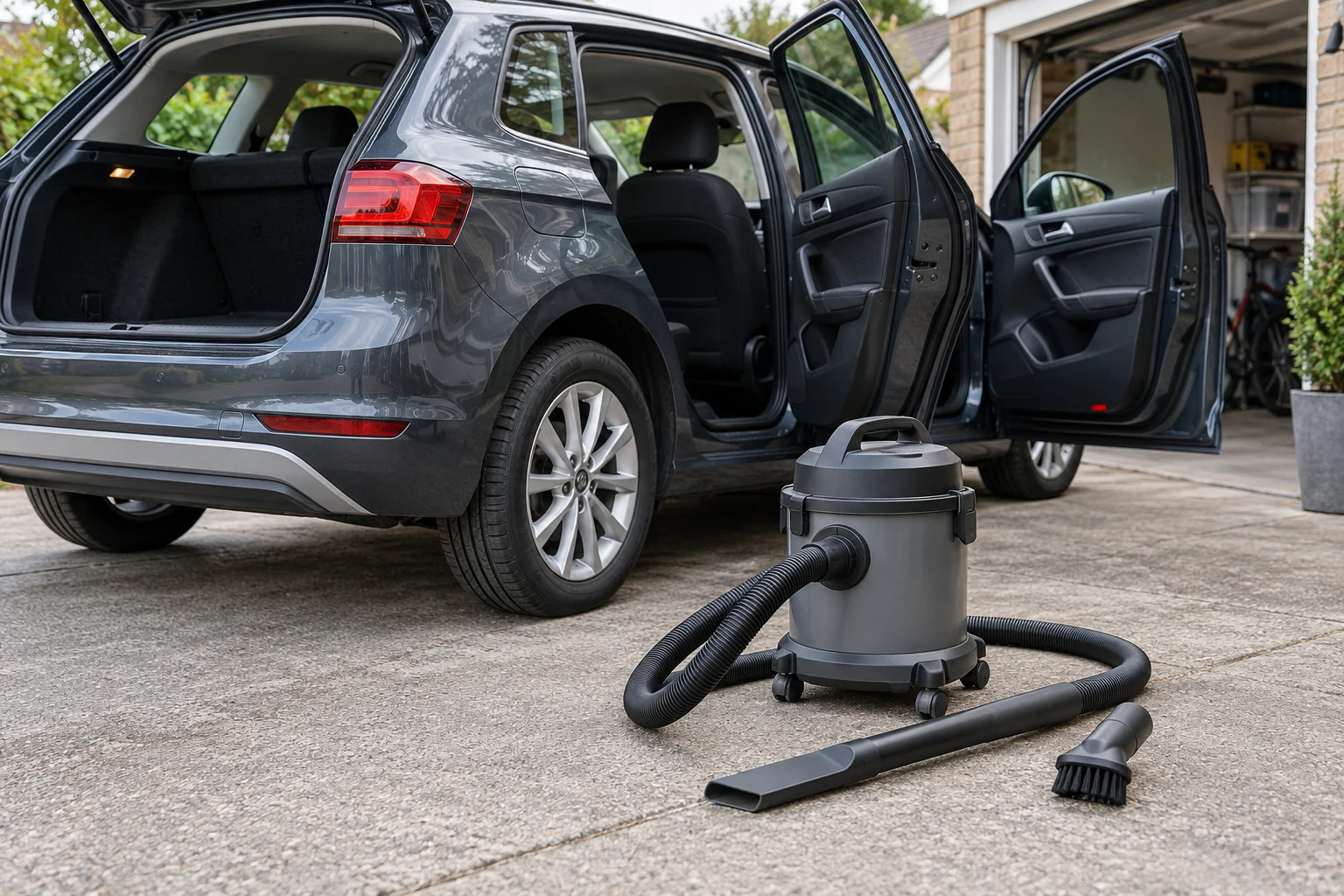
Buy for the pickup task you actually need
A wet-and-dry vacuum is useful when you want one correctly configured machine to collect ordinary dry debris and permitted liquids. It is different from a dry-only car vacuum and from an upholstery spray extractor. The word “wet” describes liquid recovery; it does not mean the machine has a pump to apply cleaning solution to seats.
Start with the jobs in your routine. Crumbs and loose carpet dirt may be covered by an existing car vacuum. Occasional permitted liquid recovery adds a wet-capable machine and a filter-changeover routine. Cleaning compatible seats with delivered solution and recovery belongs to the upholstery-extractor guide.
Do not choose solely by motor wattage or the largest tank. Access, hose behaviour, attachments, storage and the work needed after wet pickup matter in a family-car routine. A machine that is awkward to reach, empty or dry may add more effort than its headline specification suggests.
The options
These two mains machines offer different tank sizes, hose lengths and filter arrangements. The comparison follows their selected UK models and operating instructions; it does not rank cleaning performance from wattage.
| Feature | Kärcher WD 3 V-17/4/20 | Vacmaster WD L20 240V |
|---|---|---|
| Container | 17L plastic | 20L stainless steel |
| Hose / cable | 2m / 4m | 3.5m / 5m |
| Dry setup | Cartridge system; bag as directed for the debris | Cartridge and nylon pre-filter; bag where directed |
| Liquid setup | No dust bag; follow cartridge instructions | Foam filter replaces cartridge and nylon pre-filter; no bag |
| Useful distinction | Smaller stated container and a simpler filter-system format | Longer hose and a shared car/workshop role |
| Spray extraction | No cleaning-solution pump | No cleaning-solution pump |
Kärcher WD 3: a 17-litre cartridge-filter system
The selected UK WD 3 V-17/4/20 has a 17L plastic container, a 2m hose and 4m cable. Its included crevice nozzle gives a starting tool for accessible gaps, while the broad floor nozzle is not automatically the best shape for every seat or footwell. Check any additional car-tool kit separately; accessories shown with a similar bundle may not be included here.
For a 17-litre wet-and-dry car-cleaning setup
Kärcher WD 3 V-17/4/20
A corded wet-and-dry vacuum with a 17L plastic container, 2m hose, 4m cable, cartridge filter and crevice nozzle. It collects suitable dry debris or liquids in the correct configuration; it does not spray cleaning solution.
- 17L container
- 2m hose / 4m cable
- Wet/dry pickup; no spray pump
Remove the dust bag for liquid pickup and follow the received filter instructions. Tank size is not a guaranteed recoverable water volume. Keep the electrical supply dry and check separately for any optional car-tool kit.
Kärcher describes the one-piece cartridge system as suitable for wet and dry work without changing the filter. That does not mean the dust bag stays fitted for liquid pickup or that a wet filter is ready for fine dry dust immediately afterwards. Follow the exact bag, filter and drying directions for the task.
Choose it if its hose, container and storage footprint fit the places you clean. The 17L figure is the container size, not a promise that the machine can recover 17L of water before its wet-pickup limit. Read the fill and float instructions rather than treating the whole container as usable liquid capacity.
Vacmaster WD L20: a longer-hose shared setup
The selected WD L20 240V is model VK1620SWC-01L. Its 20L stainless-steel tank, 3.5m hose, 5m cable, crevice tool and dusting brush may suit someone who also has a legitimate workshop-cleaning use. The longer hose can help with access around a car, but it still needs room to route without pulling the machine or catching trim.
For a larger shared car-and-workshop vacuum setup
Vacmaster WD L20 240V
A 20L stainless-steel wet-and-dry vacuum with 3.5m hose, 5m cable, crevice tool and dusting brush. Its dry setup includes cartridge and pre-filter stages; liquid pickup uses the supplied foam filter.
- 20L stainless-steel tank
- 3.5m hose / 5m cable
- Distinct dry and liquid filter setups
For wet pickup, replace the cartridge and nylon pre-filter with the foam filter and remove the dust bag as directed. It is a suction vacuum, not an upholstery spray extractor. Its workshop classification is not a claim of sanitising seats or suitability for every dust.
The liquid configuration is a specific buying consideration. Vacmaster directs replacing the cartridge and nylon pre-filter with the supplied foam filter, and removing the dust bag. Do not copy the Kärcher cartridge arrangement onto this model. Keeping the alternate parts clean, dry where required and easy to identify is part of owning the system.
Its dust-extractor features are a separate workshop role, not a reason to choose a larger machine for ordinary crumbs. Check the actual dust and job permissions if using it outside car cleaning. A filtration label does not establish suitability for every hazardous material or prove that a car seat has been sanitised.
Check reach from the machine to the awkward area
Think about the rear footwell, boot and far side of the cabin. Hose length and cable length are separate measurements; adding them together does not guarantee that the nozzle can reach every corner. The socket position, safe cable route and how the hose bends through a door all affect usable access.
A longer hose can reduce repositioning, but it can also drag across a sill or press against a seat. Plan where the machine stands and keep it stable. Do not park a canister on a seat or pull it by a stretched hose to gain another few centimetres.
Check the included attachments and how they fit. A quoted nominal diameter does not prove that a random brush, crevice tool or another brand’s hose will connect securely. Verify the complete connector and model compatibility before buying an accessory. Use soft suitable contact surfaces for upholstery and avoid hard edges on delicate trim.
Measure hose access and the power route separately
The selected WD 3 has a 2m hose and 4m power cable. Vacmaster’s WD L20 240V support page specifies 3.5m and 5m respectively. A cable gets power to the machine; a hose reaches from the parked machine to the nozzle. Adding them together does not establish a usable radius around a car.
Measure each route along its real path, including the door opening and the bend towards a footwell. The following route lengths and spare-length allowances are assumptions for a planning example. They are not measurements of a particular car or recommended electrical clearances.
| Separate route | Assumed path + slack | WD 3 Calculated margin | WD L20 Calculated margin |
|---|---|---|---|
| Hose | 1.5m + 0.3m | +0.2m | +1.7m |
| Hose | 2.5m + 0.3m | -0.8m | +0.7m |
| Hose | 3.5m + 0.3m | -1.8m | -0.3m |
| Cable | 3m + 0.5m | +0.5m | +1.5m |
| Cable | 4.5m + 0.5m | -1m | +0m |
For a 2.5m hose path plus 0.3m spare, the WD 3 is 0.8m short and the WD L20 has 0.7m remaining on paper. A 4.5m power path plus 0.5m allowance uses the L20’s entire listed cable length; zero margin is a reason to reconsider positioning, not reassurance that an awkward cable run is safe.
A positive number does not account for every connector, nozzle or bend, and does not approve an extension lead or wet-area power arrangement. Reposition safely rather than pulling the machine by its hose, stretching fittings or leaving a tensioned cable across a walkway. Use the exact machine’s electrical and wet-pickup instructions. Confirm the hose’s machine-end attachment as well as nominal accessory diameter before buying an extension.
Download all ten model/route scenarios and source lengths (CSV). Replace the assumed paths with your own separate hose and cable measurements.
Check the cupboard opening as well as nominal capacity
The WD 3’s selected UK listing, model 1.628-103.0, gives a 34.9 × 32.8 × 49.2cm envelope. Vacmaster’s support specifications give 44 × 39 × 54cm for the 240V L20. These are the upright machine dimensions, not a promise that an assembled hose and tools fit inside that rectangle.
| Exact machine | L × W × H Source dimensions | Floor rectangle Calculated | Example space Calculated L × W × H |
|---|---|---|---|
| Kärcher WD 3 V-17/4/20 1.628-103.0 | 34.9 × 32.8 × 49.2cm | 1,144.72cm² | 44.9 × 42.8 × 54.2cm |
| Vacmaster WD L20 240V VK1620SWC-01L | 44 × 39 × 54cm | 1,716cm² | 54 × 49 × 59cm |
Method: footprint = length × width; add 10cm to length and width for two assumed 5cm side gaps, and 5cm to height. The WD 3’s nominal floor rectangle is 1,144.72cm²; the L20’s is 1,716cm². Turning either rectangle changes its orientation, not its area. Check the shelf depth, door hinges and access needed to lift the head and store a dry hose.
The extra 5cm is an example allowance, not a manufacturer ventilation or operating instruction. Store equipment clean and dry according to its manual; a cupboard dimension does not approve running it inside an enclosed cupboard. Nominal 17L and 20L container capacities do not establish usable liquid pickup, seats cleaned, suction strength or storage convenience.
Download the original dimensions, calculated rectangles and clearance assumptions (CSV).
Price the required attachments and delivery with the machine
First decide whether the supplied crevice and upholstery tools can reach your intended areas. Then add only a missing, approved accessory. This hypothetical basket deliberately gives the WD 3 an £18 tool gap and £4 delivery, while the L20 route has neither. It illustrates how a lower machine price can produce a higher complete outlay; it is not a claim that these gaps exist in every retailer bundle.
| Machine route | Machine Assumed | Missing tools Assumed | Delivery Assumed | Total Calculated |
|---|---|---|---|---|
| Kärcher WD 3 V-17/4/20 | £80 | £18 | £4 | £102.00 |
| Vacmaster WD L20 240V | £100 | £0 | £0 | £100.00 |
At these assumptions, £80 + £18 + £4 = £102 against £100. The WD 3 machine price would need to be £78 to match the £100 total: comparison total minus its £22 extras. Change the missing-tool and delivery figures when your actual bundle differs. A spare filter or bag is an extra purchase only when needed; no arbitrary replacement interval is included.
Before paying, settle the filter changeover, accessory fit, storage and separate electrical route. The L20’s longer listed hose is a reach specification, not evidence of better debris pickup. Neither a container-size comparison nor this basket turns a wet-and-dry vacuum into a spray extractor. For that different task, use the extractor setup comparison.
Download the two assumed baskets and calculated totals (CSV).
Make changeover easy enough to do correctly
Before buying, read both dry and wet setup instructions. A machine should be switched off and disconnected as its manual requires before changing bags, filters or accessories. Keep the correct parts available rather than improvising when a spill occurs.
Useful ownership questions include:
- Where will the dry filters and unused bags be stored during wet work?
- Can the container and hose be emptied and cleaned without bringing dirty water into the car?
- Is there a suitable place for parts to dry before storage or the next dry job?
- Are replacement bags, filters and model-specific tools identifiable?
- Can you use the machine within its electrical, location and weather restrictions?
Do not use an ordinary dry vacuum for liquids while waiting for the new machine. Likewise, do not assume a wet-capable vacuum is suitable for fuel, solvent, ash or any unknown chemical spill. Follow its stated permitted materials and seek the appropriate help for excluded contamination.
Wet pickup is not a complete upholstery-cleaning system
A wet vacuum can recover permitted liquid in the correct setup, but it does not deliver a measured spray or approve wetting a seat. A hand spray and suction nozzle do not automatically reproduce an extractor’s method. Seat construction, cleaner suitability and drying remain separate decisions.
If the real goal is extracting compatible woven seats, compare a purpose-made spray extractor and its approved detergent. Keep a dry-pickup route for pre-cleaning. Some larger multifunction machines combine roles, but the two vacuums selected here do not have that solution-delivery system.
Choose the manageable complete kit
For mainly car use, compare access and storage before paying for workshop features you do not need. For a shared household/workshop role, check each intended job against the manual and keep contaminated tools out of the cabin kit. In both cases, budget for the appropriate consumables and compatible attachments rather than assuming the base machine contains every car accessory.
After permitted wet pickup, empty, clean and dry the machine as directed. A larger tank does not remove that work. Choose the system whose complete routine you can carry out consistently, then keep mat cleaning and seat extraction within their own material limits.
Common questions
Can a wet-and-dry vacuum shampoo car seats?
The two selected machines provide suction pickup, not solution spraying. A spray extractor has a delivery and recovery system. Neither machine type makes an otherwise unsuitable seat safe to soak or extract.
Do all wet-and-dry vacuums use the same filter for liquids?
No. Kärcher’s selected cartridge system and Vacmaster L20’s foam-filter changeover differ. Read the exact manual, remove the dust bag for liquids as directed and follow drying requirements before dry work.
Does a 20L tank hold 20L of recovered water?
Do not infer usable liquid capacity from container size alone. The machine’s fill limit, float and configuration govern wet pickup. Stop and empty it as the manual directs.
Is a higher-wattage motor always better for car cleaning?
Motor input alone does not settle nozzle performance or useful access. Compare the complete hose, tool, filter and ownership setup rather than ranking machines from wattage.
Will any 35mm car brush fit these machines?
Not automatically. Nominal diameter alone does not establish connector or model compatibility. Check the exact tool and connection before buying or forcing a part onto the hose.
Sources and product instructions
Follow the label and care instructions for the exact version and surface you own.
- Kärcher WD 3 V-17/4/20 UK 1.628-103.0: specification and cartridge system
- Kärcher wet/dry range: bag removal for liquids and filter care
- Vacmaster WD L20 240V: exact model, tank, hose and supplied tools
- Vacmaster WD L20 support: foam-filter changeover for liquids
- Kärcher SE 3 Compact Home manual: no dry pickup, extraction and system cleaning