
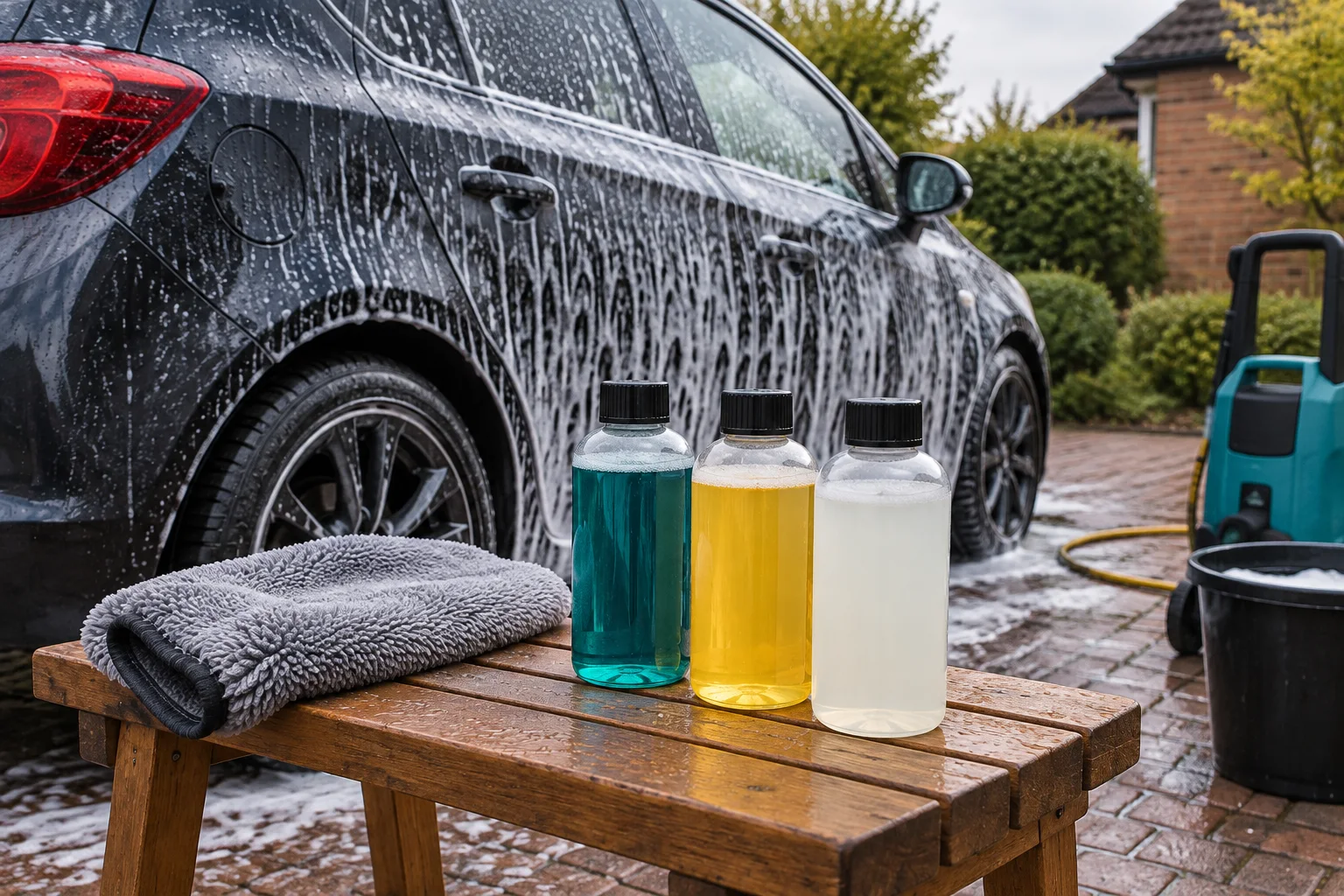
Choose the pre-wash around the routine you can actually follow
A useful snow foam loosens suitable road dirt before you touch the paint. The decision starts with the chemical's application instructions, your equipment and the surfaces on the car. A large bottle, neutral-pH description or thick photograph cannot answer all three questions.
For an ordinary home wash, favour a product with a clear dilution method and a dwell window you can supervise. You need enough time to rinse before it dries, somewhere to store the concentrate correctly and a separate plan for any remaining traffic film. Use our snow foam versus shampoo comparison if the two stages are getting mixed together.
Three snow foams, with different measuring instructions
| Product | Measuring approach | Application consideration |
|---|---|---|
| Autoglym Polar Blast 2.5 L | Start with 100 ml product plus 500 ml water in the lance bottle | A lance-led routine; not suitable for soft-top convertibles |
| Bilt-Hamber Touch-Less 5 L | 0.5–2% panel-impact ratio (PIR) | Lance, pump or trigger application; calibrate a lance |
| Bilt-Hamber Auto-Foam 5 L | Typical 4% PIR; manufacturer describes 1–5% according to the job | Functional wetting foam; a dense blanket is not the target |
The manufacturer instructions use different dosing methods. Compare each figure at the point where it applies: the bottle mixture or the solution reaching the panel. Do not compare “1:5 in the bottle” with “2% at the panel” as though they are equivalent strengths.
Polar Blast: a straightforward bottle recipe
Polar Blast suits someone who wants a defined starting mix in a compatible foam lance. Autoglym specifies 100 ml of product with 500 ml of water, adjusting the lance to suit. That makes 600 ml of mixture; it does not mean fill any bottle to its brim after adding 100 ml. A larger reservoir may simply hold unused space.
Work on cool surfaces in shade. Autoglym describes application and rinsing from the bottom upwards and allows dwell up to ten minutes, without allowing the product to dry. Treat that as a ceiling subject to conditions, not a ten-minute wait on every car. The selected product is not suitable for soft-top convertibles. Keep it out of a contact-wash bucket unless an exact product instruction explicitly permits that use.
For a pH-neutral lance pre-wash
Autoglym Polar Blast 2.5L
A dedicated pre-wash concentrate for a pressure-washer foam gun. Autoglym gives 100ml product plus 500ml water as a starting bottle mixture before adjustment of the lance.
- 2.5-litre concentrate
- pH-neutral pre-wash
- 100ml + 500ml bottle example
The selected listing excludes soft-top convertibles. Use cool shaded surfaces and rinse before it dries. Its bottle mixture is not the concentration at the panel, and it is not a bucket-shampoo instruction.
Touch-Less: measure what reaches the car
Touch-Less is a useful option when you want a specified working concentration and are willing to measure your equipment. Bilt-Hamber gives a 0.5–2% PIR range and a one-to-five-minute dwell window, with cool panels and no drying. Select within the instructions for the contamination and application; extra concentrate is not an automatic improvement.
A pump sprayer delivers the mixture you put into it. A foam lance adds pressure-washer water, so a 2% reservoir mixture will be diluted further. Use the PIR guide and calculator before trying to transfer a direct-spray recipe to a lance. The 5 L listing selected here states the same 0.5–2% range; follow the label on the bottle you receive if the formulation or instructions differ.
For a measured panel concentration
Bilt-Hamber Touch-Less 5L
A pre-wash that can be applied through suitable pressure equipment or a compatible pump sprayer. The selected 5-litre listing states a 0.5–2% panel-impact-ratio range, matching the manufacturer’s guidance.
- 5-litre concentrate
- 0.5–2% stated PIR
- Lance or compatible pump application
Use the exact pack’s dose and check the finish and application equipment. A lance needs calibration; a pump sprayer uses its final working mixture. Follow the 1–5-minute instruction without allowing drying.
Auto-Foam: judge the wetting and rinse, not the blanket
Auto-Foam is another pre-wash concentrate with a panel-concentration approach. Bilt-Hamber describes a typical 4% PIR, with a broader 1–5% range according to the job, and around five minutes of dwell in suitable conditions. That 4% figure belongs to Auto-Foam: it should not be copied onto Touch-Less.
The manufacturer emphasises the foam's wetting and cleaning behaviour rather than extreme thickness. It also describes pump application at an appropriate dilution, without expecting the same visible foam as a lance. If a wet, correctly dosed application runs down the panel, check the actual instructions and results after rinsing before concluding that the product has failed.
For a wetting pre-wash rather than foam theatre
Bilt-Hamber Auto-Foam 5L
A 5-litre pre-wash intended to wet and loosen road contamination before shampooing. Its manufacturer describes a typical 4% panel concentration and permits suitable pump application without expecting thick foam.
- 5-litre container
- Typical 4% PIR example
- Lance or suitable pump application
The technical sheet gives a 1–5% panel range according to the job. Keep dose, surface and equipment instructions together; Auto-Foam’s figures are not Touch-Less’s figures.
Check the finish as carefully as the dirt
Read exclusions for the actual surface: ordinary painted bodywork is not the same as a soft-top roof, damaged lacquer, exposed repair, wrap, satin finish or delicate trim. Follow the surface maker's care requirements where relevant. A product described as wax-safe or pH-neutral does not establish suitability for every material, concentration or dwell time.
Keep the chosen working solution within its instructions. Avoid mixing concentrates or adding shampoo to make the foam look richer. A mixture can behave differently from either product alone, and its combined surface or sprayer compatibility is not established by two separate labels.
For an unusual finish, uncertain repair or a surface that already reacts badly to washing, resolve compatibility before a whole-car application. A discreet test can reveal some problems but cannot establish long-term compatibility with every coating or material.
Make a realistic amount and compare costs fairly
Reservoir size is capacity, not a mandatory dose. If 600 ml covers your car at the instructed setting, filling a 1.2 L bottle does not make the wash better. Measure a repeatable amount, note what you use and avoid storing leftover diluted chemical in the lance.
Compare bottles by the concentrate consumed for your car at a suitable working dose, rather than bottle price alone. For illustration, 100 ml portions from 2.5 L yield 25 portions. A calibrated 10 L total output at 2% uses 200 ml concentrate; 5 L would yield 25 such portions. At 4%, the same output uses 400 ml, or 12.5 portions from 5 L. These are arithmetic examples with stated assumptions, not equal-performance claims or promised washes per bottle. Actual coverage changes the result.
Put the pre-wash into a complete wash
- Prepare the washer or compatible sprayer and have the rinse ready before applying chemical.
- Check the panels are cool and the working area is suitable. Move, cool the car appropriately or postpone if drying cannot be controlled.
- Measure the product using its own bottle recipe or working-concentration method.
- Apply as directed, supervise the wet film and rinse before it dries.
- Inspect without rubbing the dirty paint. Follow with a correctly diluted contact shampoo and clean mitt where the wash requires it.
- Rinse, then dry the car with a suitable clean towel.
If your main problem is a weak or uneven spray rather than chemical choice, follow the watery-foam checks before buying another concentrate. If the bottle never draws down, changing chemistry will not fix the pickup fault.
Common questions
Which snow foam is best for routine home washing?
Choose by the surfaces, equipment and measuring method you can follow. Polar Blast has a defined starting bottle mix; Touch-Less and Auto-Foam specify panel concentrations. None is a universal choice for every finish, and a thicker blanket alone does not establish better cleaning.
Can I use the same dilution for Touch-Less and Auto-Foam?
No. The selected Touch-Less instructions specify 0.5–2% PIR, while Auto-Foam describes a typical 4% PIR and a job-dependent range. Read the actual bottle instructions and measure the equipment rather than borrowing a dose from another product.
Is snow foam safe on a soft-top roof?
Do not assume so. The Polar Blast product selected here is not suitable for soft-top convertibles. For another chemical, check the exact product and roof manufacturer instructions before application. Ordinary painted-panel guidance does not establish fabric-roof compatibility.
Does snow foam replace a contact wash?
Pre-washing loosens suitable contamination before rinsing. Remaining traffic film may still need the appropriate shampoo and clean mitt. Follow the exact product instructions and inspect after rinsing; do not judge cleanliness from the foam blanket or assume every pre-wash is a bucket shampoo.
Should I buy the biggest bottle to save money?
Only if the instructed working dose, storage and likely use make sense. Work out concentrate consumed per application with explicit coverage assumptions. Bottle size alone does not show cost per car, because different products use different dosing methods and your equipment adds water differently.
Sources and product instructions
Follow the label and care instructions for the exact version and surface you own.