
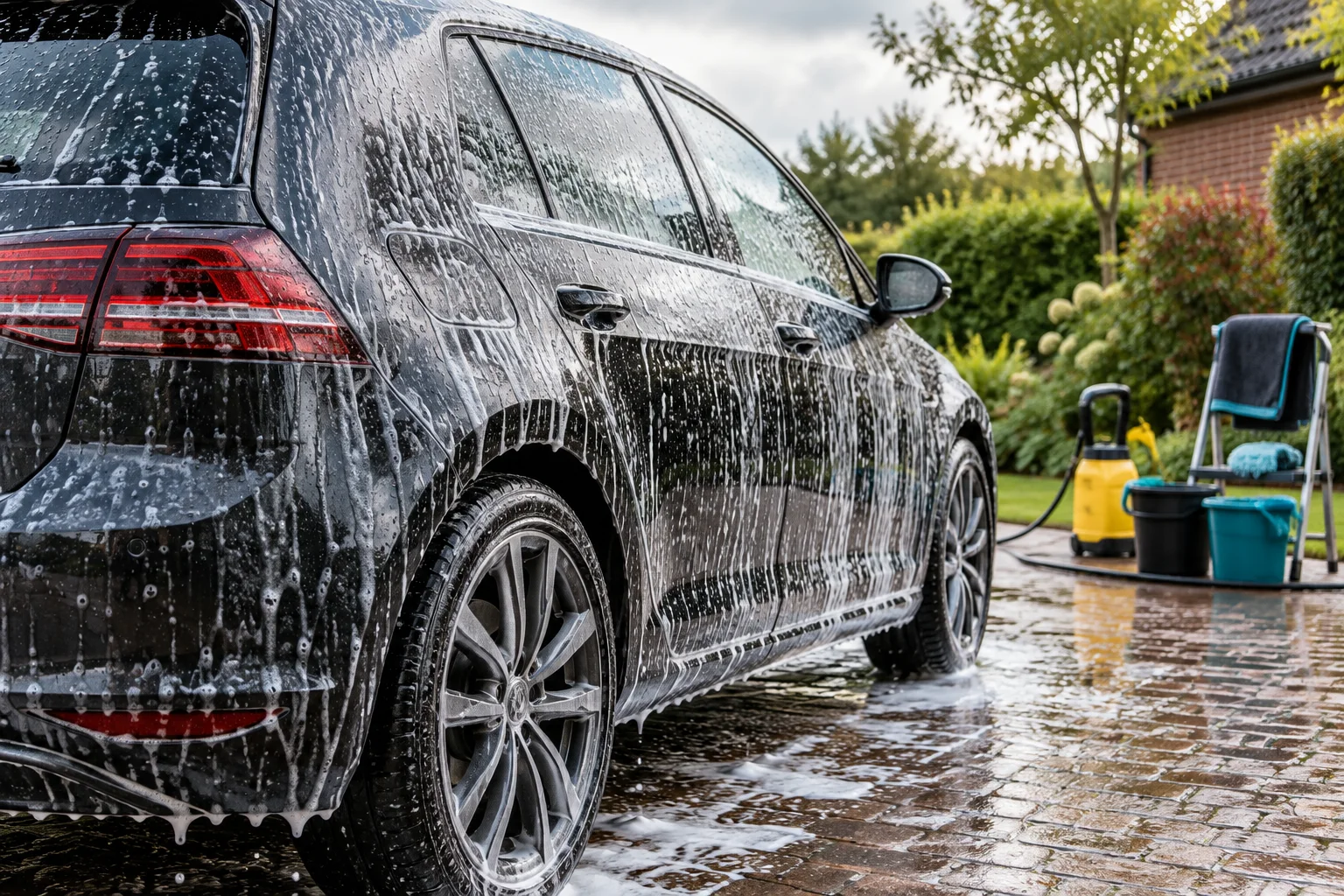
Dwell is useful contact time with a limit
Dwell gives the pre-wash time to work before rinsing. It is not a target to maximise regardless of conditions. The exact product supplies the permitted range or ceiling; panel temperature, shade, wind and the wet film decide whether you need to rinse sooner.
Have the washer or other instructed rinse method ready before applying chemical. If you cannot keep the application within the product's conditions, change the location, reduce the manageable area where the instructions allow, or postpone. A timer cannot make a drying film safe to leave.
Read each product's own window
| Product | Manufacturer guidance | What controls the decision |
|---|---|---|
| Autoglym Polar Blast | Up to 10 minutes, without allowing drying | Cool surfaces, shade and a wet film; the ceiling is not a required wait |
| Bilt-Hamber Touch-Less | 1–5 minutes, without allowing drying | Correct instructed concentration and cool conditions |
| Bilt-Hamber Auto-Foam | Around 5 minutes in suitable conditions | Its own dose and application instructions; do not extend dwell into drying |
These examples apply to the named products, not all snow foams. Use the label supplied with your bottle where instructions or formulation differ. Never transfer a ten-minute maximum onto a chemical with a shorter specified window.
Polar Blast: a maximum is not a countdown goal
Autoglym specifies cool surfaces, shade and no drying, with dwell up to ten minutes. It also describes application and rinsing from the bottom upwards. Follow that method rather than replacing it with a sequence borrowed from another chemical.
The starting lance mixture is 100 ml product plus 500 ml water. Correctly measuring that mixture does not permit leaving it on a warm panel until the maximum time passes. The selected Polar Blast is not suitable for soft-top convertibles, regardless of how short the dwell is.
For a pH-neutral lance pre-wash
Autoglym Polar Blast 2.5L
A dedicated pre-wash concentrate for a pressure-washer foam gun. Autoglym gives 100ml product plus 500ml water as a starting bottle mixture before adjustment of the lance.
- 2.5-litre concentrate
- pH-neutral pre-wash
- 100ml + 500ml bottle example
The selected listing excludes soft-top convertibles. Use cool shaded surfaces and rinse before it dries. Its bottle mixture is not the concentration at the panel, and it is not a bucket-shampoo instruction.
Touch-Less: keep concentration and dwell together
Bilt-Hamber specifies a 0.5–2% panel-impact ratio and a one-to-five-minute dwell window for Touch-Less, with cool surfaces and no drying. Measure your lance's output if using that method; the reservoir percentage alone is not the panel concentration.
A shorter controlled application within the instructions is different from applying too little chemical and waiting much longer. If you cannot achieve the instructed combination of concentration, application and wet dwell, resolve that setup rather than improvising a stronger or longer treatment.
For a measured panel concentration
Bilt-Hamber Touch-Less 5L
A pre-wash that can be applied through suitable pressure equipment or a compatible pump sprayer. The selected 5-litre listing states a 0.5–2% panel-impact-ratio range, matching the manufacturer’s guidance.
- 5-litre concentrate
- 0.5–2% stated PIR
- Lance or compatible pump application
Use the exact pack’s dose and check the finish and application equipment. A lance needs calibration; a pump sprayer uses its final working mixture. Follow the 1–5-minute instruction without allowing drying.
Auto-Foam: do not judge the remaining film by thickness alone
Auto-Foam's typical application is around five minutes with an appropriate working dose; its manufacturer describes a typical 4% PIR and a job-dependent range. The film may drain without resembling an extremely thick foam blanket. That does not establish that it is already dry.
Conversely, visible foam elsewhere on the car does not prove every exposed area remains wet. Watch the upper, exposed and thinner-coated areas as well as the obvious lower-panel foam. Rinse in time for the whole treated area, not just the place that still looks frothy.
For a wetting pre-wash rather than foam theatre
Bilt-Hamber Auto-Foam 5L
A 5-litre pre-wash intended to wet and loosen road contamination before shampooing. Its manufacturer describes a typical 4% panel concentration and permits suitable pump application without expecting thick foam.
- 5-litre container
- Typical 4% PIR example
- Lance or suitable pump application
The technical sheet gives a 1–5% panel range according to the job. Keep dose, surface and equipment instructions together; Auto-Foam’s figures are not Touch-Less’s figures.
Check conditions before the chemical goes on
A car that feels cool in one shaded area may have warmer panels elsewhere. Direct sun can move across the driveway while you set up. Wind can also change the way a film behaves, so a mild air temperature alone is not a reliable dwell plan.
Walk around the car first. Decide where you will start, where the rinse hose runs and whether the complete application is manageable. Remove avoidable delays: do not start a dwell and then assemble the rinse lance, fetch another hose or search for the right connector.
Follow the selected chemical's instructions for initial rinsing and starting surface condition. Do not assume pre-wetting is always required or always prohibited. If cooling the car is necessary, do so using a compatible method and begin the chemical only once its specified conditions can be met.
Watch the wet film, not just the timer
Use a timer as a reminder to inspect rather than as permission to walk away. Watch for areas where the liquid film is thinning, breaking up or approaching dryness, especially on exposed panels. A draining foam can still be wet; a patch of persistent bubbles can coexist with drying around its edges.
Do not try to extend a dwell by leaving a partly dried application in place while repeatedly misting isolated areas, unless the exact product instructions provide such a method. Rinsing before drying is the priority. Do not brush or rub drying residue into the surface to “activate” it.
If the chemical is drying sooner than its intended routine allows, rinse as instructed and reconsider the conditions before continuing. More concentrate or a thicker layer is not a general fix for a hot or windy application.
If the pre-wash has started to dry
Stop adding more chemical and rinse the affected area promptly using a method appropriate for the product and surface. Avoid aggressive scrubbing, a concentrated pressure jet or an improvised acidic or alkaline treatment. Those actions add new variables without identifying the residue or the condition of the finish.
Once the surface has been rinsed and the routine safely completed, inspect under suitable light. Marks can have more than one cause, including mineral deposits and product residue. Use the hard-water spots guide for that distinction rather than assuming every mark needs the same remover.
If a mark persists, or the finish looks changed, stop escalating chemicals and seek the relevant product or surface-maker guidance. A photograph cannot prove that an unknown mark is safe to polish or chemically remove.
Build a repeatable routine without chasing a maximum
- Check product, surface, concentration and suitable conditions.
- Prepare the full application and rinse setup before starting.
- Apply by the product's specified sequence and start supervising the first treated area.
- Inspect the wet film throughout the permitted dwell; rinse sooner when needed to prevent drying.
- Complete the rinse, inspect and move to the appropriate contact-wash stage.
- Flush the attachment and store it according to the maintenance routine.
The best routine is one you can control from application through rinse. Treat the manufacturer's maximum as a boundary, and make the conditions suitable before applying the chemical rather than trying to rescue an unmanageable dwell afterwards.
Common questions
How long should snow foam stay on a car?
Use the exact product instructions and rinse before drying. The named examples differ: Polar Blast allows up to ten minutes, Touch-Less specifies one to five minutes and Auto-Foam describes around five minutes in suitable conditions. None overrides the cool-surface and no-drying requirements.
Should I always wait the full stated dwell time?
No. A maximum is a limit, not a required wait when the film is approaching dryness. Supervise the application and rinse earlier as needed. If conditions cannot support the product’s intended routine, change the location or timing before applying it.
Can I use snow foam in direct sun?
The featured products call for cool suitable conditions, with shade specified where relevant. Do not rely on air temperature alone or assume extra foam will prevent drying. Choose a suitable location and make sure the treated area stays within the exact product’s application requirements.
Does foam running off mean it has dried?
Not necessarily. Some products deliberately form a wet, draining film. Inspect the actual surface and thinner exposed areas rather than judging only the remaining bubbles. Drainage and drying are different observations, but either way the product’s concentration and dwell instructions still apply.
What should I do if snow foam dries on the paint?
Rinse promptly by the product-appropriate method and avoid aggressive scrubbing or an improvised chemical remedy. Inspect after rinsing. If marks remain or the finish appears changed, identify the problem and consult the product or surface guidance before attempting stronger treatment.
Sources and product instructions
Follow the label and care instructions for the exact version and surface you own.