
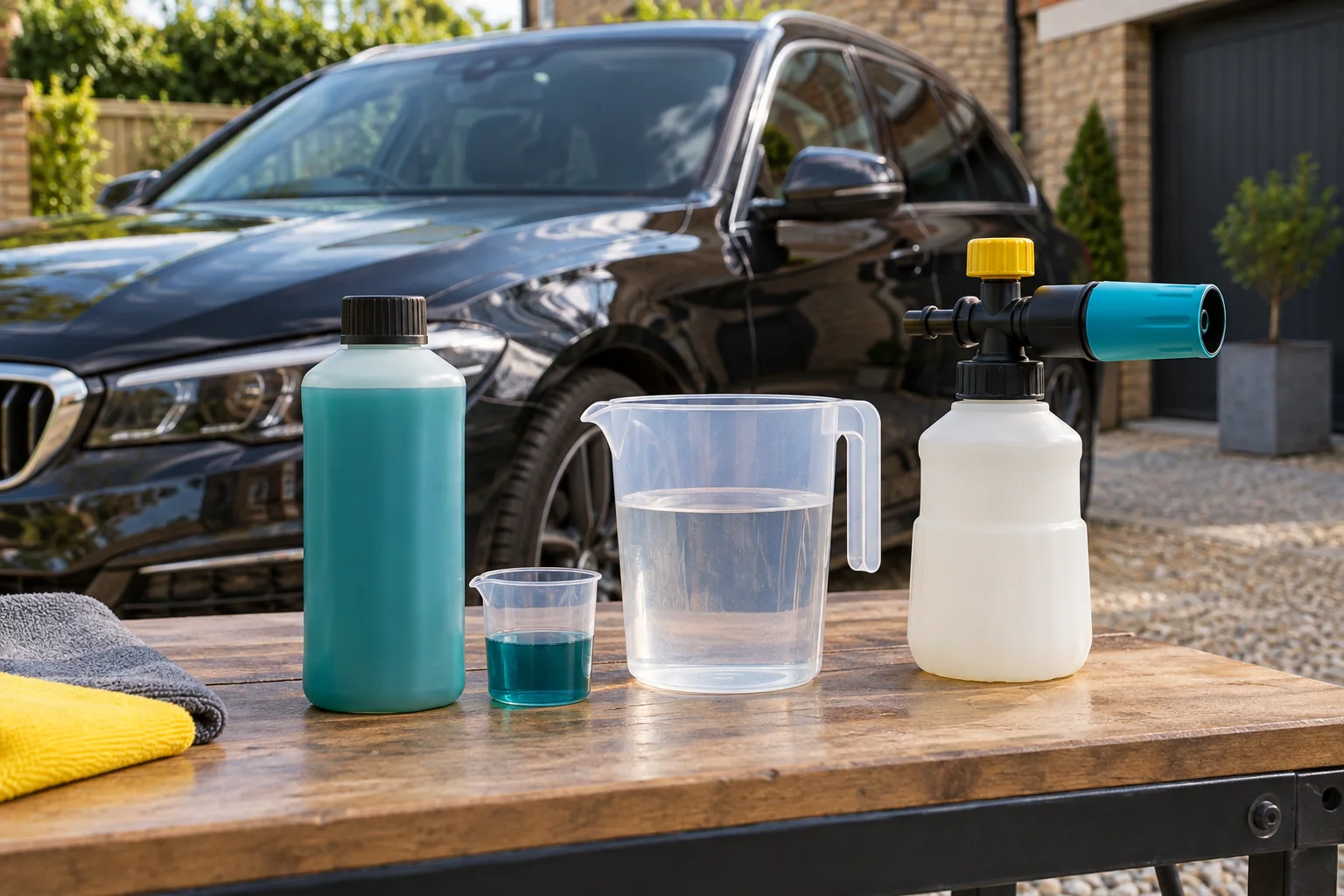
The bottle mix and the panel mix are different
A foam-lance bottle holds water and concentrate. When you pull the trigger, the pressure washer adds more water before the solution reaches the car. Panel-impact ratio, usually shortened to PIR, describes the intended concentrate proportion in that combined output. It is not simply the percentage you poured into the reservoir.
A compatible pump sprayer does not add a separate pressure-washer water stream. Its final working mixture is therefore a different calculation. Start by identifying whether the chemical label gives a bottle recipe, a final-solution percentage or a PIR target. Applying the right arithmetic to the wrong instruction still produces the wrong dose.
Measure your lance with plain water
Bilt-Hamber's method measures the complete output produced while a known reservoir fill is drawn through the lance. The important quantity is all the water leaving the nozzle during that period, not just the reservoir's contents.
- Read the washer and attachment instructions. Set up a controlled collection arrangement using a sufficiently large, open container and the normal safe handling method. Do not aim into a small bottle, sealed vessel or container likely to rebound or tip.
- Put a measured amount of plain water in the reservoir. Use water only for the calibration; you are not spraying neat chemical into a measuring jug.
- Keep the water supply, lance settings and normal operating setup consistent. Collect the entire output until the measured reservoir water has been drawn through.
- Measure the combined volume collected. Record the reservoir fill and total output as two separate quantities.
- Calculate the concentrate required at the chosen product's instructed PIR. Add water to reach the same reservoir fill used in the test.
If you cannot collect the output safely and completely, do not improvise a cramped arrangement around an active pressure jet. Resolve the setup or use an application method with a clear direct-dilution instruction. A guessed output defeats the reason for measuring.
Calculate a starting reservoir mix
The calculator follows the measured-output approach. Its default numbers are an example, not a measurement of your washer. The result assumes the same pickup behaviour and settings during use; water calibration does not prove identical performance with every concentrate viscosity or faulty pickup system.
The arithmetic is:
- Concentrate in ml = total collected output in litres × 1,000 × target PIR ÷ 100.
- Water to add in ml = measured reservoir fill − concentrate in ml.
- Bottle concentration = concentrate ÷ reservoir fill × 100%.
This separates a target concentration at the car from the stronger mixture needed in the bottle. Keep litres and millilitres consistent, and measure liquid rather than counting unmarked capfuls.
Worked example: a 1 L reservoir and 10 L collected
Assume the reservoir contains 1,000 ml of plain water and produces 10 L of total collected output before that fill is drawn through. For a 2% PIR target, 10 × 1,000 × 0.02 gives 200 ml concentrate. Add 800 ml water to make the measured 1,000 ml reservoir fill. The bottle is 20% concentrate; the intended output is 2%.
At a 4% target with those same measured volumes, the calculation gives 400 ml concentrate plus 600 ml water. The higher target is only appropriate when the exact chemical instructions call for it. Changing the arithmetic does not make that concentration suitable for another chemical.
If the same 1 L reservoir instead produces 20 L total output, a 2% target needs 400 ml concentrate plus 600 ml water. Reusing the first 200 ml dose would target just 1% under the new assumptions. That is why a bottle recipe found online cannot establish your own lance's PIR.
See how output volume changes the bottle mixture
The following scenarios all assume a measured reservoir fill of 1,000ml. Combined output is varied between 10, 20 and 40 litres to show how the same target needs a different bottle mixture. These are assumed inputs for comparison; use the output collected from your own setup in the calculator above.
| Combined output | Target PIR | Concentrate required | Water top-up | Bottle concentration | Capacity result |
|---|---|---|---|---|---|
| 10 litres | 0.5% | 50ml | 950ml | 5% | Within capacity |
| 10 litres | 2% | 200ml | 800ml | 20% | Within capacity |
| 10 litres | 4% | 400ml | 600ml | 40% | Within capacity |
| 20 litres | 0.5% | 100ml | 900ml | 10% | Within capacity |
| 20 litres | 2% | 400ml | 600ml | 40% | Within capacity |
| 20 litres | 4% | 800ml | 200ml | 80% | Within capacity |
| 40 litres | 0.5% | 200ml | 800ml | 20% | Within capacity |
| 40 litres | 2% | 800ml | 200ml | 80% | Within capacity |
| 40 litres | 4% | 1,600ml | — | — | Does not fit |
At a 2% target, doubling the assumed output from 10 to 20 litres doubles the required concentrate from 200ml to 400ml. Keeping a 200ml dose while output rises to 40 litres would give 0.5% in this model. A larger volume collected is therefore not a reason to keep the same recipe.
The 0.5% and 2% scenarios sit within Touch-Less’s published PIR range; 4% is the typical target described for Auto-Foam. They belong to their respective instructions. The table compares arithmetic, not interchangeable chemical strengths or recommended settings for every car.
A smaller reservoir can make a target impossible
Now assume a 500ml reservoir fill and 20 litres of combined output. Its arithmetic ceiling is 500 ÷ 20,000 × 100 = 2.5% PIR. The boundary is reached before a 4% target can fit:
| Target | Concentrate needed | Water top-up | Result |
|---|---|---|---|
| 2% | 400ml | 100ml | Within capacity |
| 2.5% | 500ml | 0ml | Capacity boundary |
| 4% | 800ml | — | Does not fit |
At 2.5%, all 500ml would be concentrate. That is a mathematical capacity boundary, not permission to use neat product or a target recommendation. At 4%, the required 800ml cannot fit. A dash means there is no valid water top-up under those assumptions; it does not mean that overfilling is acceptable.
Reproduce the calculation
For each row, concentrate = output litres × 1,000 × target percentage ÷ 100. Subtract it from the measured reservoir fill only if it fits. Bottle percentage = concentrate ÷ reservoir fill × 100. The model assumes unchanged pickup behaviour between water calibration and application; it does not account for a changed dial, blockage, viscosity or intermittent feed.
Download all 12 scenarios, assumptions and calculated results (CSV). Impossible fills have blank water and bottle-percentage cells. The 2.5% boundary row is labelled as arithmetic only. Use the source inputs to reproduce the results; do not round a near-capacity value into a fit.
If you change the hose, gun or lance, first resolve the connection chain, then repeat the appropriate pickup calibration rather than carrying the old bottle recipe across.
Use the target belonging to your product
Touch-Less specifies 0.5–2% PIR. Use the appropriate point in that range for the label, application and job. Its numbers should not be confused with Auto-Foam, which describes a typical 4% PIR and a broader job-dependent range.
For a measured panel concentration
Bilt-Hamber Touch-Less 5L
A pre-wash that can be applied through suitable pressure equipment or a compatible pump sprayer. The selected 5-litre listing states a 0.5–2% panel-impact-ratio range, matching the manufacturer’s guidance.
- 5-litre concentrate
- 0.5–2% stated PIR
- Lance or compatible pump application
Use the exact pack’s dose and check the finish and application equipment. A lance needs calibration; a pump sprayer uses its final working mixture. Follow the 1–5-minute instruction without allowing drying.
Auto-Foam's typical 4% figure provides a useful second example for the calculator. It is still a product-specific target. Do not keep increasing the percentage until the foam resembles a photograph; dilution, compatibility, dwell and the rinse all matter.
For a wetting pre-wash rather than foam theatre
Bilt-Hamber Auto-Foam 5L
A 5-litre pre-wash intended to wet and loosen road contamination before shampooing. Its manufacturer describes a typical 4% panel concentration and permits suitable pump application without expecting thick foam.
- 5-litre container
- Typical 4% PIR example
- Lance or suitable pump application
The technical sheet gives a 1–5% panel range according to the job. Keep dose, surface and equipment instructions together; Auto-Foam’s figures are not Touch-Less’s figures.
When the required dose will not fit
Suppose a 500 ml reservoir produces 20 L combined output. A 4% target would require 800 ml of concentrate. That cannot fit in the measured 500 ml reservoir fill even with no added water. The calculator flags this instead of returning a negative top-up volume.
Do not overfill, defeat the cap or quietly substitute a different reservoir size in the calculation. Check the measurement, pickup setting, manufacturer instructions and whether the equipment can deliver the required concentration. Do not assume a different orifice is suitable for your washer; the exact lance revision and machine requirements govern that decision.
Changing the pickup dial, nozzle arrangement, washer or water supply can change the draw ratio. Recalibrate after relevant changes or maintenance that alters pickup. Keep a short equipment note with reservoir fill, collected volume and settings so you can reproduce the calculation.
Direct sprayers and bottle ratios
For a direct pump-sprayer mixture of 1 L at 2%, use 20 ml product plus 980 ml water. Adding 20 ml to 1 L of water makes 1,020 ml in total and is not precisely a 2% final mixture. Follow the product's own preparation and sprayer-compatibility rules.
A ratio written as one part product to five parts water has six parts in total. To make 600 ml, that means 100 ml product plus 500 ml water. Autoglym uses that starting recipe for Polar Blast in a foam lance. It is not a 1:5 PIR claim and does not mean 100 ml product plus a full bottle of water of any size.
Once measured, apply the chemical on suitable cool surfaces and observe its dwell and drying limits. A correct calculation cannot make a drying film safe to leave. If pickup is intermittent, fix the lance fault before relying on a calculated dose.
Common questions
What does PIR mean for snow foam?
Panel-impact ratio describes the intended concentrate proportion in the combined liquid delivered towards the car. A foam lance adds washer water to its reservoir mixture. The percentage inside the bottle is therefore usually higher than the target output percentage.
Is 2% in a foam-lance bottle the same as 2% PIR?
No. Additional washer water dilutes that bottle mixture further. Measure the total output while a known water-filled reservoir is drawn through, then calculate the concentrate required for the chemical’s instructed target. A direct pump-sprayer mixture uses a different calculation.
How much Touch-Less should I put in my lance?
Use the instructions on your bottle and measure your setup. The selected product specifies 0.5–2% PIR. Required concentrate depends on the combined output produced while your measured reservoir fill is drawn through, so there is no single bottle dose for every washer and lance.
What if the calculated concentrate will not fit in the reservoir?
Do not overfill. Check your measurements and settings, then confirm the equipment can deliver the intended concentration within its instructions. A result requiring more concentrate than the measured reservoir fill is impossible under those assumptions and needs investigation rather than a negative water dose.
Do I need to measure again after changing the lance settings?
Recheck when changes can affect pickup, including a different washer, relevant settings, nozzle arrangement or pickup-related maintenance. Keep the test and application setup consistent. The water test is a practical dosing method, not proof that every chemical behaves identically through every lance.
Sources and product instructions
Follow the label and care instructions for the exact version and surface you own.