
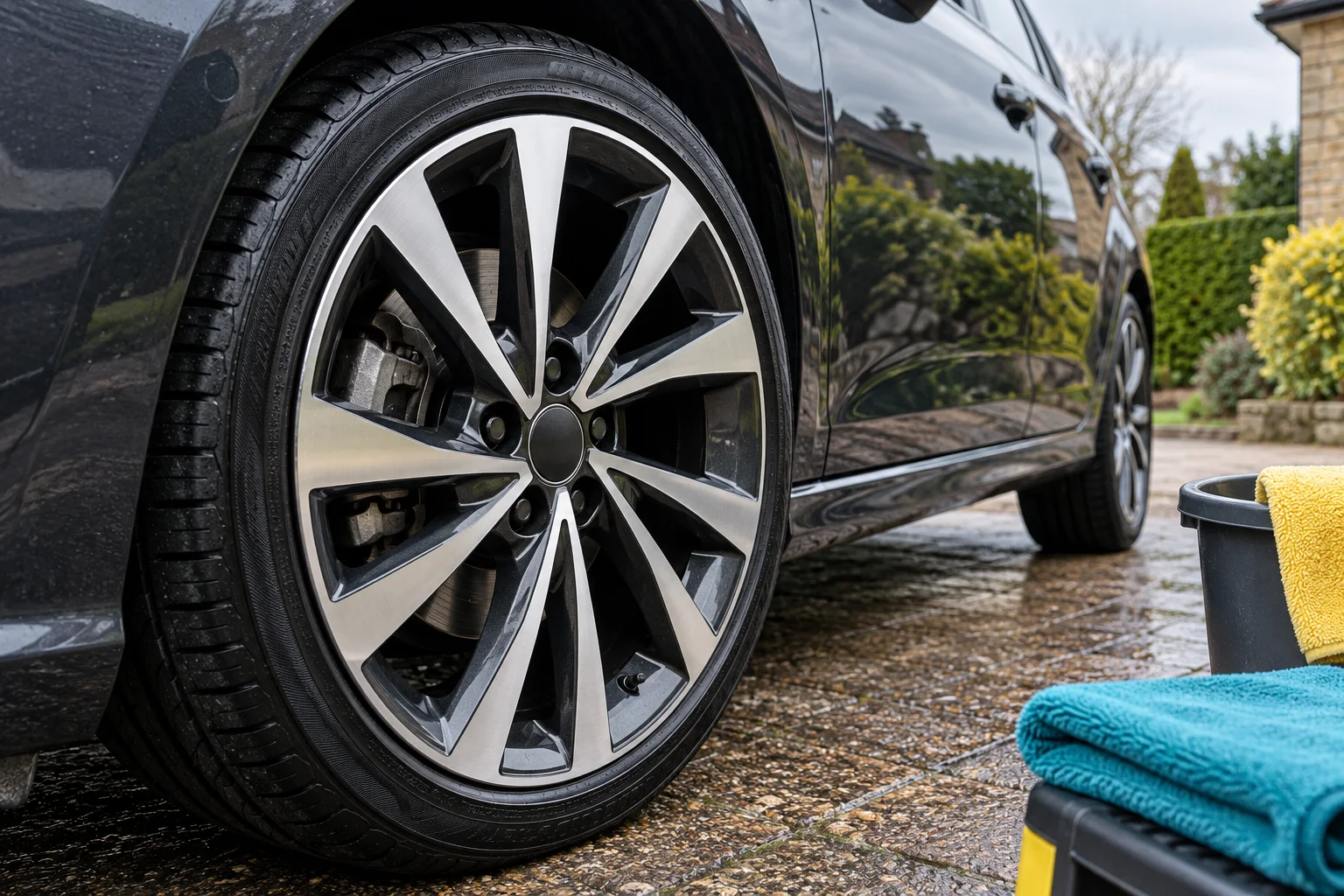
Clean the coating over the machined face
A diamond-cut wheel has a machined metallic face, often contrasted with painted recesses. RONAL describes the manufacturing step as removing a small amount from the pre-painted aluminium surface to reveal the bright, finely finished face. On a typical lacquered diamond-cut wheel, a clear coating protects that appearance.
The cleaning decision therefore starts with the coating and its condition. A shiny silver spoke is not proof of exposed metal, and it is not a reason to use metal polish. Establish the exact wheel and any refurbishment history, then follow the wheel maker's or refurbisher's care requirements.
Inspect before applying chemicals
Look around the rim edge, spoke boundaries, wheel-nut recesses and other visible areas while the wheel is cool. Identify chips, lifting lacquer, cloudy patches and corrosion-like tracks. Dirt on top of a sound coating and a mark beneath that coating need different next steps.
If the coating appears damaged, stop treating the mark as a cleaning challenge. Do not scratch it with a fingernail, abrasive pad or metal tool to see whether it comes off. A wheel specialist can assess the finish; a routine wash should not become an attempt to strip or polish through the lacquer.
Keep the scope practical: the wheel stays fitted and the vehicle remains safely parked. This guide does not require lifting the car, removing wheel fixings or attempting a repair. If safe access is limited, clean only the accessible areas using the permitted method.
Start with the wheel maker's mild routine
RONAL's care instructions recommend a neutral vehicle shampoo and water, with gentle tools and thorough rinsing. They advise against commercial wheel cleaners for their wheels. That is a useful example of a wheel maker being more restrictive than the finish list on a cleaner bottle.
A pH-neutral shampoo such as GWash is a relevant option where the exact wheel-care instructions permit it. Use the dose printed on your shampoo bottle and prepare it in a separate wheel-only setup. The choice is about a suitable wash, not a promise that every persistent deposit will disappear without further assessment.
A standalone bucket-wash shampoo
Gtechniq GWash 500ml
A concentrated, pH-neutral shampoo for a regular contact wash. A useful single-bottle choice when you already own a mitt and towels and do not need another boxed set.
- 500ml concentrate
- Bucket-wash shampoo
- pH-neutral formulation
Use the dilution on your UK bottle. This is GWash, not Ceramic GWash or a snow-foam pre-wash; follow your coating or finish supplier’s care instructions.
A controlled home-cleaning sequence
- Let the wheel cool and choose a location where the wash will not dry before you can rinse. Recent driving and direct sunlight can make the surface unsuitable.
- Read the wheel-care instructions and prepare the specified shampoo or permitted cleaner, tools and rinse supply before starting.
- Remove loose dirt using the rinse method allowed for that wheel. Follow the exact chemical's starting-surface instruction if using a dedicated cleaner.
- Clean accessible areas gently, controlling the tool so hard parts do not contact the finish. Rinse contamination out frequently.
- Rinse the wheel completely, including accessible recesses, before residue dries. Avoid an aggressive jet into damaged coating edges.
- Dry as the wheel's care directs, using a clean wheel-only cloth and a light approach. Inspect without rubbing at marks that remain.
Choose a face brush and barrel brush separately if both are needed. The long tool that reaches behind a spoke is not always the best way to clean the visible front.
Choose tools for the lacquer, including dark recesses
A two-tone wheel can include dark painted areas beside its bright machined face. That matters when a brush maker excludes dark-coloured wheels: the silver section does not cancel the restriction on the adjacent black recesses.
A soft detailing option such as ValetPRO's Large Sash Brush may help with permitted accessible detail work. Keep its handle and collar away from the coating, use light control and inspect the bristles for grit. Where the wheel maker specifies a cloth or sponge, use that instead of assuming a brush is compulsory.
For detailed work on wheel faces
ValetPRO Large Sash Brush
A soft boar-hair sash brush for gently agitating accessible spoke faces, wheel-nut recesses and other small areas. Reserve this brush for wheel use.
- Soft boar-hair bristles
- Detailing shape
- Model BRU19
Use only where the wheel’s care instructions permit brushing. Keep the handle and collar off the finish, inspect the bristles for grit and do not force them into inaccessible gaps.
Keep tyre scrubbing separate too. A stiff sidewall brush belongs on permitted tyre rubber, not on the lacquered edge immediately beside it. The wheel-tool separation guide explains how to keep these jobs distinct through washing and storage.
When a dedicated wheel cleaner is permitted
If the wheel maker allows an appropriate dedicated cleaner, check the exact product and condition of the finish. Autoglym lists diamond-cut wheels for Advanced All Wheel Cleaner, with cool-surface, application and rinse restrictions. It excludes unlacquered wheels; its name is not a blanket approval for every altered or damaged surface.
The 1 L spray below is a conditional option for a wheel whose supplier permits this kind of cleaner. If your wheel's aftercare requires shampoo only, keep to that routine. Follow the product's two-to-four-minute method without drying and have the rinse ready before spraying.
For permitted lacquered and painted wheels
Autoglym Advanced All Wheel Cleaner 1L
A pH-neutral, colour-changing wheel cleaner intended to tackle grime and iron-bearing brake dust. The selected pack is the 1-litre spray bottle.
- 1-litre spray
- pH-neutral formula
- Iron-reactive colour change
Not for unlacquered wheels or motorcycles. Use on cool wheels, preferably dry, with the instructed 2–4-minute dwell and no drying; do not use it as a tyre cleaner or spray directly onto brakes.
Do not extend dwell because one stubborn spot remains. Do not layer a second cleaner over the first. Use the finish-based cleaner comparison to check the restrictions before adding another chemical.
Recognise the point where washing stops
Cloudiness beneath the lacquer, lifting edges or a repeating corrosion-like pattern are reasons for assessment rather than harder agitation. SONAX's diamond-cut care guidance explains that moisture can reach aluminium when the clear coat is breached. Removing surface dirt cannot restore that protective barrier.
A clean-looking wheel can still have damage, and an imperfect-looking wheel is not necessarily dirty. Do not promise yourself that an iron remover, sealant or metal polish will solve every mark. Avoid polishing a matt section or using an abrasive intended for exposed metal on a coated face.
After washing, keep a simple note of any area that changes or spreads and consult the wheel supplier or a qualified refurbisher. Ask about the exact finish and aftercare rather than asking for the strongest cleaning product. Regular compatible washing is useful maintenance; repairing the coating is a separate decision.
There is no need to achieve a dramatic transformation at every wash. A controlled shampoo, gentle accessible cleaning and complete rinse are a better repeatable routine than repeated experiments on a vulnerable edge.
Common questions
Are diamond-cut wheels bare aluminium?
The bright face is machined aluminium, but typical diamond-cut car wheels have a protective clear coat over it. Confirm your exact wheel and refurbishment history. Clean the surface according to its maker’s care rather than assuming that a metallic appearance calls for bare-metal polish.
Can I use any pH-neutral wheel cleaner?
Check the wheel maker first. RONAL, for example, recommends neutral car shampoo and advises against commercial wheel cleaners for its wheels. A cleaner’s diamond-cut compatibility claim does not override a more restrictive wheel or refurbisher care instruction.
Will wheel cleaner remove milky marks under the lacquer?
A mark beneath lifting or damaged lacquer may be a coating or corrosion problem rather than removable surface contamination. Stop escalating cleaner or scrubbing pressure and obtain a wheel specialist’s assessment. Washing cannot restore a breached protective coating.
Can I use a brush meant only for light-coloured wheels on a two-tone wheel?
Do not ignore dark painted recesses beside a silver face. A restriction on dark or matt wheels still matters where the tool could contact those areas. Choose a tool permitted for the whole accessible surface and keep hard parts clear.
Should I use metal polish on the machined face?
Do not assume so. A lacquered machined face is a coated surface, and metal polish can be inappropriate for that coating. Follow the exact wheel-care instructions; uncertain damage or finish repair belongs with the wheel supplier or a qualified specialist.
Sources and product instructions
Follow the label and care instructions for the exact version and surface you own.