
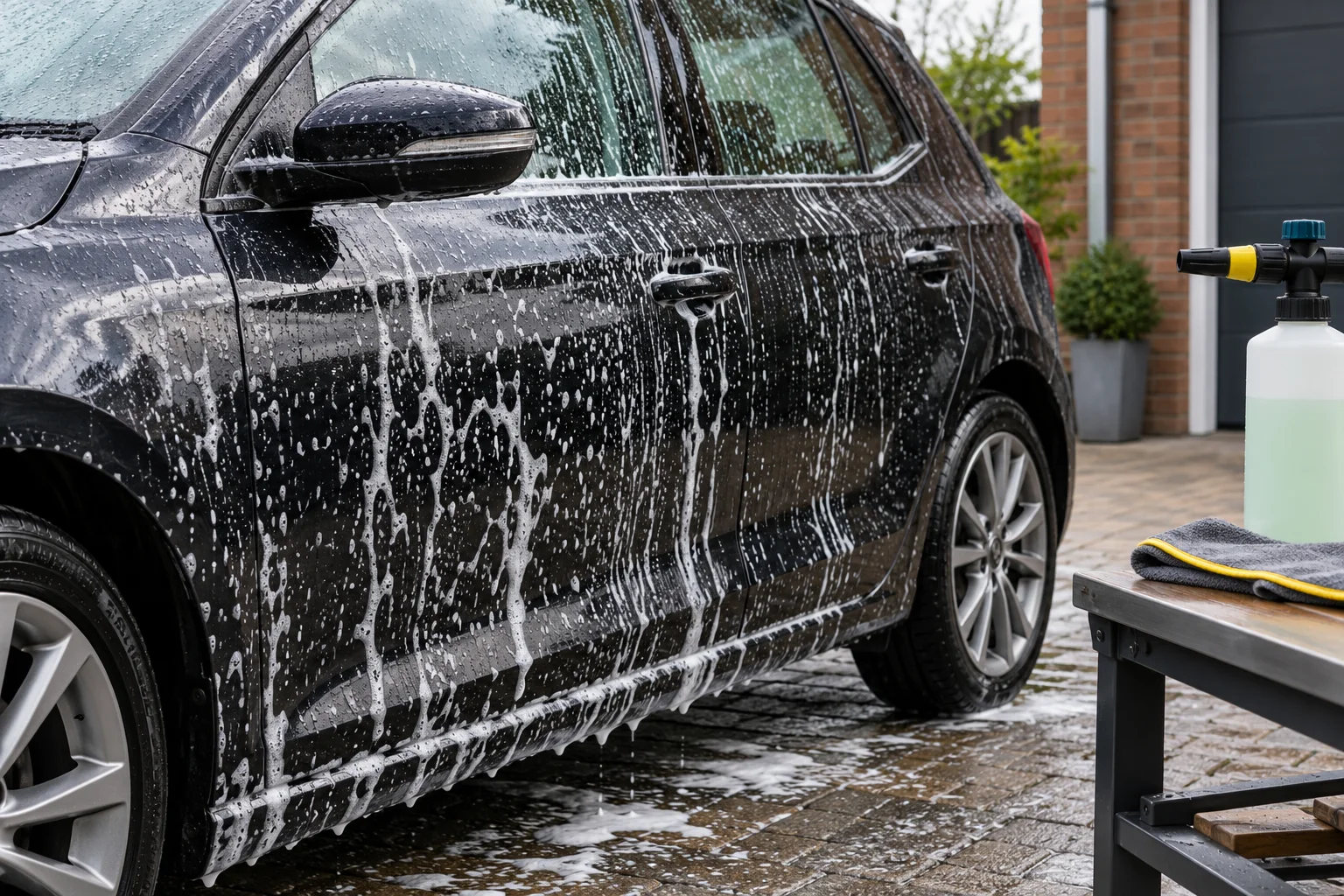
First decide whether the foam is actually wrong
Thin foam can be normal for the chemical and application. Bilt-Hamber describes Auto-Foam as a functional wetting foam, rather than a product whose success depends on a thick blanket. A wet film that drains is different from a lance suddenly delivering clear water while its reservoir stays full.
Compare against the exact product instructions and your own previous working setup. Identify whether the symptom is weak chemical pickup, an uneven fan, rapid drainage or genuinely poor cleaning after the instructed dwell and rinse. Those observations lead to different checks; adding more concentrate to every symptom can hide the real problem.
Use the symptom to choose the next check
| What you notice | First checks | Avoid |
|---|---|---|
| Reservoir level hardly changes | Pickup setting, accessible tube position and exact assembly | Increasing chemical strength to compensate for no draw |
| Foam became weak after changing product | Application instructions and dilution method | Copying the old product’s recipe |
| Spray pulses or washer supply is interrupted | Water supply, hose and washer instructions | Continuing to run through an unresolved supply fault |
| Patchy fan or degraded output after storage | Residue, accessible blockage and model-specific maintenance | Poking a nozzle with wire or forcing parts apart |
| Wet foam drains but product is drawing normally | Expected product behaviour, correct dose and dwell | Treating thickness as a cleaning measurement |
Step 1: confirm that the product belongs in the lance
A foaming bucket shampoo is not automatically a pre-wash chemical. Read the application method before judging output. Also check that you have measured the correct thing: a bottle ratio and a panel-impact ratio are not interchangeable.
Polar Blast provides a useful example of a defined lance recipe: 100 ml product plus 500 ml water as a starting point, with adjustment through the lance instructions. That makes 600 ml mixture. If you put 100 ml into a 1.2 L reservoir and then fill it completely, you have made a different starting mixture.
For a pH-neutral lance pre-wash
Autoglym Polar Blast 2.5L
A dedicated pre-wash concentrate for a pressure-washer foam gun. Autoglym gives 100ml product plus 500ml water as a starting bottle mixture before adjustment of the lance.
- 2.5-litre concentrate
- pH-neutral pre-wash
- 100ml + 500ml bottle example
The selected listing excludes soft-top convertibles. Use cool shaded surfaces and rinse before it dries. Its bottle mixture is not the concentration at the panel, and it is not a bucket-shampoo instruction.
For Touch-Less or Auto-Foam, measure the combined output and calculate the PIR. Their instructed targets differ. Check the actual bottle label if you have an older pack or a different formulation; an internet recipe for a similarly named product cannot resolve that difference.
Step 2: check the water supply and normal washer operation
Before blaming the lance, establish that the washer is operating normally according to its own manual. Check that the inlet supply is adequate, the hose is not kinked and the required inlet filter checks have been followed. Unsteady operation needs resolving at source.
Do not use more chemical to compensate for interrupted supply or a pulsing machine. Stop if equipment is leaking, damaged or behaving abnormally. Any comparison using the washer's ordinary attachment must follow its operating instructions and safe handling method; it is not an invitation to spray into small containers or test pressure on bodywork.
A machine's advertised maximum pressure alone does not tell you how well an arbitrary foam-lance head will work. Water flow, pickup behaviour and the exact attachment matter. Check the exact attachment requirements rather than choosing from pressure alone.
Step 3: inspect pickup and controls after depressurising
Stop the washer and release trapped pressure using its instructions before disconnecting or inspecting the attachment. A stopped motor does not establish that the hose and gun are pressure-free.
Check the parts accessible to the owner: is the pickup tube present, correctly seated and able to reach the liquid? Is the reservoir attached as designed? Is a visible seal damaged or missing? Follow the exact model's diagram rather than tightening every threaded part as hard as possible. Do not add sealant, drill a vent or modify a valve to make an unfamiliar assembly draw.
Read the control markings on your lance. Knob direction and adjustment range are not universal. Change one permitted setting at a time, keep a note of its effect and return to a known baseline if the change makes matters worse. Recalibrate a PIR recipe when a setting changes chemical draw.
Step 4: flush residue before ordering parts
Dried product in an attachment can disrupt its behaviour. Use the maker's routine cleaning procedure: empty and rinse the reservoir as directed, then draw clean water through the head before storage. Autoglym specifically calls for rinsing the Polar Blaster reservoir between products and flushing the head with clean water after the routine.
If the output remains poor, consult the exact model's service guidance. A foam-producing mesh can be a service part on some designs, but it is not the explanation for every weak spray. Do not soak the entire head in an improvised solvent or use a metal pin in a nozzle. A successful repair depends on the actual component and the permitted method.
The MJJC mesh kit is a targeted option for a compatible MJJC Pro, S or Lite family head. Confirm the head revision and manufacturer procedure before purchase. A brass housing that looks similar does not make this filter suitable for a Kärcher FJ 6 or Polar Blaster.
For a matching MJJC foam head
MJJC Mesh Filter Tablet Kit
A replacement 304 stainless-steel mesh filter kit listed by MJJC for its S, Pro and Lite foam-cannon families. It is an option when a matching internal filter remains blocked after appropriate care.
- 304 stainless-steel mesh
- MJJC S / Pro / Lite families
- Match the head and service guide
Confirm the exact head version and approved service method. It is not a universal tablet for every lance. Shut down and fully depressurise before removing any accessory or servicing its parts.
Step 5: check the orifice only with model-specific guidance
Some owners encounter advice to fit a smaller orifice to improve foam. Do not treat a particular bore size as a universal upgrade. The correct part depends on the lance generation, washer flow and manufacturer limits; a change may affect operation and the draw ratio.
Identify the washer and exact lance, consult the supplied documentation or manufacturer support, and use a specified compatible part if a change is required. Do not drill the existing component or keep swapping anonymous inserts until the foam looks thicker. If the head leaks, a fitting will not lock or the pressure behaviour changes unexpectedly, stop and resolve the fault before using it on the car.
Finish with a repeatable check
Use the correct chemical at its instructed starting concentration on suitable cool surfaces. Observe pickup, spray pattern and the wet film. Follow the dwell limit and rinse before drying. Inspect the result without rubbing dirt into the paint.
If the pre-wash works as instructed but leaves traffic film, the next stage may be a contact wash, not stronger foam. If it still does not draw or spray normally after the permitted checks, give the supplier your model, symptom and changes already tried. That is more useful than buying another lance without identifying what failed.
Common questions
Does watery snow foam mean the lance is broken?
No. Some pre-washes intentionally produce a wet, draining film. Check the expected product behaviour, measured dose and whether the reservoir draws normally. Sudden loss of pickup, a distorted fan or abnormal washer operation gives a more specific reason to investigate equipment.
Should I add extra concentrate until the foam is thick?
Stay within the chemical instructions. First verify the application method, bottle recipe or PIR, pickup and equipment condition. Extra concentrate can increase consumption without solving a supply or blockage fault. Visible thickness alone does not measure how much contamination is removed.
Why is my snow-foam bottle staying full?
The head may not be drawing the reservoir mixture. After stopping and depressurising, check permitted controls, accessible pickup parts and assembly against the exact manual. Do not modify vents or valves. Resolve the draw problem before relying on any calculated concentration.
Will a smaller orifice fix weak foam?
There is no universal orifice size for every washer and lance. Check the exact head revision, washer requirements and manufacturer guidance. Avoid drilling parts or installing an unspecified insert; changes may affect operation and require a fresh pickup calibration.
Can I fit a generic mesh tablet to any foam lance?
Do not assume interchangeability. The MJJC kit featured here is for specified MJJC product families, with revision and procedure checks still needed. Kärcher, Autoglym and other heads require their own compatible parts and maintenance instructions.
Sources and product instructions
Follow the label and care instructions for the exact version and surface you own.