
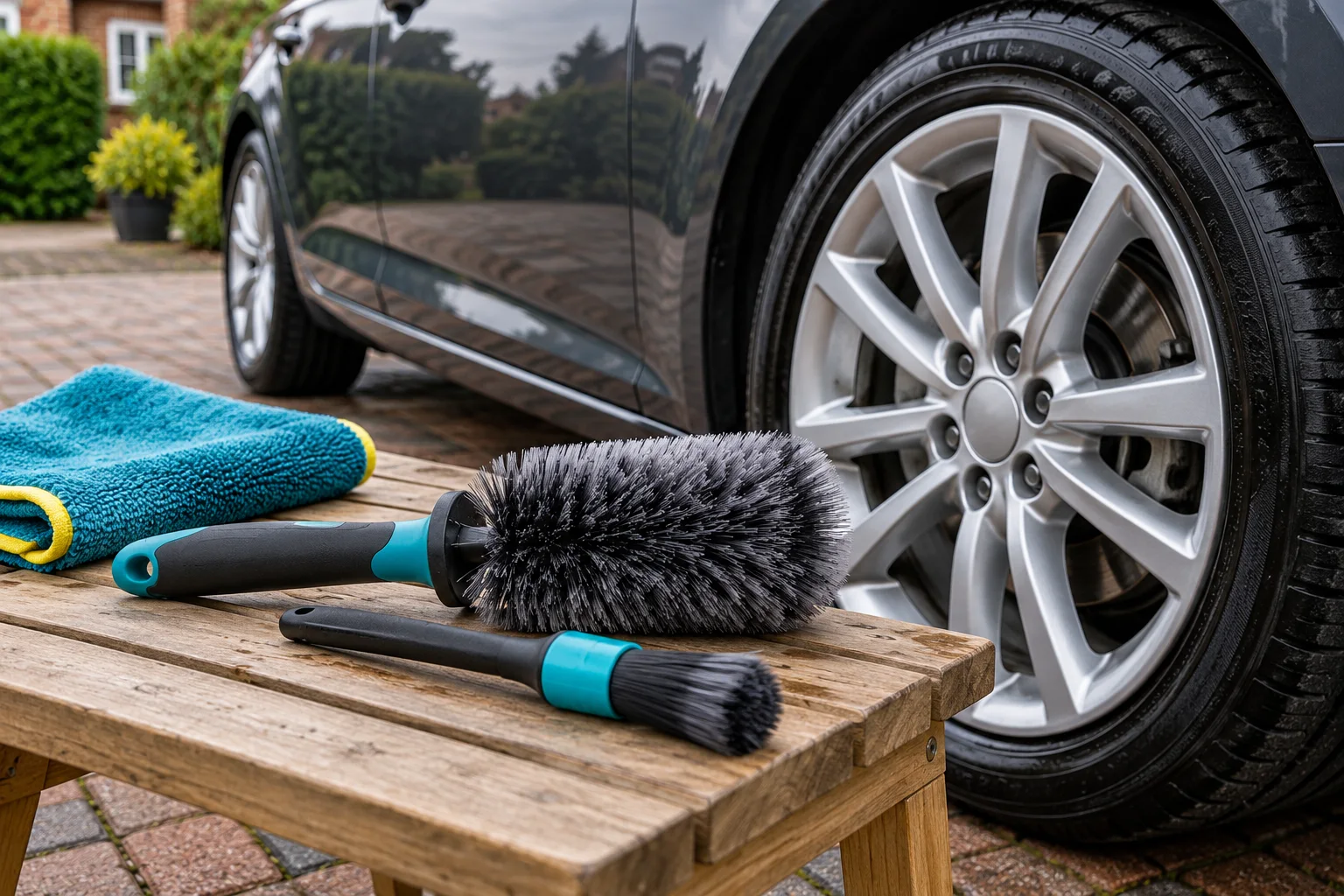
Choose for the visible face, not the deepest part of the wheel
A wheel-face brush works across accessible spoke fronts, the rim edge and recesses around wheel nuts. It needs a shape you can control without its handle or collar touching the finish. Reaching the inner barrel is a separate problem: a brush that passes behind a spoke may be awkward for a broad flat face.
Before buying, identify the wheel finish and check its care instructions. Gloss black, matt paint, clear lacquer over a machined face and exposed polished metal are different surfaces. Soft-looking bristles, a “chemical resistant” description or a reassuring product photograph cannot establish suitability for all of them.
Two face-brush options with different limits
| Option | Construction and role | Restriction to consider |
|---|---|---|
| ValetPRO Large Sash Brush BRU19 | Soft boar-hair detailing shape for accessible recesses and spoke faces | Keep the handle/collar clear; wheel-maker care still governs use |
| Autoglym Hi-Tech Wheel Brush | Metal-free synthetic bristles for controlled agitation | Manufacturer excludes dark-coloured and matt wheels |
These are choices for particular jobs, not a claim that every owner needs both. A small detailing brush can be enough for an intricate face when the rest of the wash is gentle and well controlled. If your care instructions specify a soft cloth or sponge, follow that method rather than buying a brush just because it is sold for wheels.
ValetPRO Large Sash Brush: work around the detail
ValetPRO describes BRU19 as a soft boar-hair brush used for wheel agitation and other detailing jobs. Its round detailing shape is useful when you want to address accessible nut recesses and the edges of spokes without pushing a large head across them.
Reserve one for wheels even though the maker lists other applications. Clean its bristles frequently during use and keep the harder parts away from the finish. Pressing until the bristles fold completely can bring the handle or collar much closer to the wheel than intended. Soft hair does not remove the need for light control or inspection for trapped grit.
For detailed work on wheel faces
ValetPRO Large Sash Brush
A soft boar-hair sash brush for gently agitating accessible spoke faces, wheel-nut recesses and other small areas. Reserve this brush for wheel use.
- Soft boar-hair bristles
- Detailing shape
- Model BRU19
Use only where the wheel’s care instructions permit brushing. Keep the handle and collar off the finish, inspect the bristles for grit and do not force them into inaccessible gaps.
Autoglym Hi-Tech Wheel Brush: read the finish exclusion
The Hi-Tech brush uses synthetic bristles and a metal-free construction. Those are useful details, but the deciding restriction is in the manufacturer's care guidance: it is unsuitable for dark-coloured or matt wheels. Do not choose it for a gloss-black wheel simply because the packaging says wheel brush.
For a permitted finish, use the appropriate cleaner and controlled agitation rather than treating the firm strands as a reason to scrub harder. Autoglym also specifies rinsing after use, avoiding prolonged immersion in cleaning solution and avoiding solutions above 25°C. Those are this brush's care limits, not instructions to heat a wheel wash to a particular temperature.
For permitted light-coloured wheel finishes
Autoglym Hi-Tech Wheel Brush
A metal-free brush with chemically resistant synthetic bristles for controlled agitation around spokes, recesses and wheel nuts.
- Synthetic bristles
- Metal-free construction
- Dark/matt finish exclusion
Not suitable for dark-coloured or matt wheels. Follow the wheel maker’s care; rinse after use and do not leave soaking or use cleaning solutions above 25°C.
Look at the wheel before deciding the brush shape
A simple five-spoke wheel presents larger accessible areas. A multi-spoke design creates more corners and a narrower approach to each nut recess. Look at both the bristle head and the hand position needed to use it. If the handle has to rest on the rim to reach a corner, the brush is a poor match for that job.
Separate the tasks you need to cover:
- Spoke fronts and the outer rim need controlled surface contact.
- Wheel-nut recesses may need a smaller detailing head with a clear route in and out.
- The back of spokes and inner barrel need a separate clearance assessment.
- Tyre rubber may use a stiffer tyre-only brush, kept away from the wheel finish.
Use our barrel-brush guide for the spaces behind the spokes. Do not force a face brush through a gap or scrub around brake components you cannot see properly.
Choose the cleaner separately from the brush
Chemical resistance describes the tool's materials. It does not mean that the cleaner is suitable for your wheel or that longer exposure is harmless. Check the actual chemical, finish exclusions and application sequence using the wheel-cleaner buying guide.
Prepare the rinse before applying cleaner. Work on cool wheels, use the product's prescribed sequence and keep the treated area within its permitted dwell. Brush only where the method calls for it; a reactive wheel cleaner may need less agitation on ordinary contamination than a neglected wheel, but that does not establish a universal no-touch result.
Keep the bristles wet with the appropriate working solution while following the method. Do not dry-brush brake dust across a wheel face. Rinse contamination out of the brush into a wheel-only setup and replace dirty water as needed. A gritty brush needs attention before it returns to the surface.
Inspect the whole tool, not just the tips
Before each wash, look for trapped debris, hardened residue, damaged bristles and rough or broken hard parts. A brush stored loose with abrasive tools can pick up contamination even if it was clean when put away. Do not assume a protective cap or a closed box has cleaned it.
If a brush falls onto the driveway, put it aside and clean it properly before using it again. Quickly dipping it into the wash bucket does not show that grit has gone. Keep a separate suitable cloth or sponge available so you are not tempted to continue with a contaminated tool.
After use, follow the maker's care directions, rinse residue out and let the tool dry appropriately before storage. Do not leave a brush submerged in wheel cleaner between washes. See keeping wheel equipment separate for a workable cleaning and storage arrangement.
Buy the missing shape, then stop
If you already have a soft suitable tool that reaches the face without hard-part contact, a second brush should solve a specific access problem. Choose around the recess or handling gap you can identify. Buying a set of many similar brushes does not establish that any one of them suits a delicate finish.
For diamond-cut wheels, consider the protective lacquer and any damage before the brush. If the wheel is corroding or the finish is lifting, another bristle shape will not turn a repair problem into routine cleaning. Keep the wash manageable and ask the wheel supplier about uncertain surfaces.
Common questions
Can I use the Autoglym Hi-Tech brush on black wheels?
Autoglym excludes dark-coloured and matt wheels from the Hi-Tech brush’s suitability. Do not use its metal-free construction as a reason to ignore that restriction. Choose a method permitted by the wheel maker and assess the actual finish before buying another tool.
Is a soft detailing brush enough for a wheel face?
It can be useful for accessible spoke faces and recesses where the wheel-care instructions permit it. Match the shape to the job, keep hard parts off the finish and inspect for trapped grit. A detailing brush does not automatically solve access to the inner barrel.
Does chemical resistant mean scratch-free?
No. It describes resistance of the brush materials to relevant cleaning use, rather than proving that every chemical or surface is compatible. Trapped grit, damaged parts, excessive pressure and contact from the handle or collar can still cause problems.
Can I use the same brush on tyre rubber?
Give tyre scrubbing its own tool. A stiff rubber-cleaning brush is a different choice from a controlled face brush, and residue from tyre dressing should stay out of the wheel-face routine. Keep both types separate from bodywork equipment.
Should I replace every brush after a fixed number of washes?
No universal replacement interval is established here. Inspect the bristles, residue and hard parts before use, follow the exact care instructions and replace a damaged tool. A clean appearance alone does not show that the bristles are free of abrasive contamination.
Sources and product instructions
Follow the label and care instructions for the exact version and surface you own.