
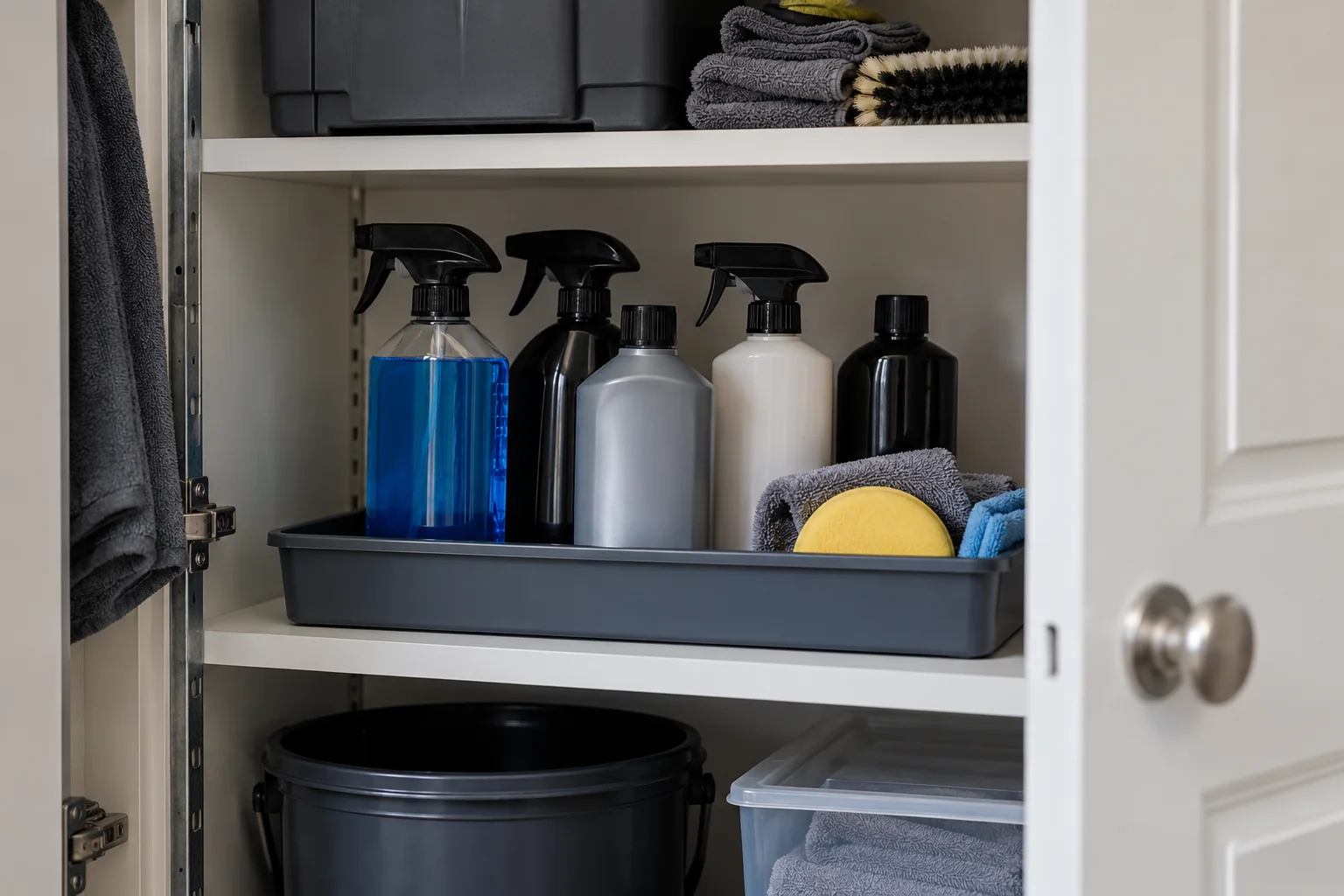
Choose storage from the product instructions
Car-care shelves often hold several different kinds of product: shampoo, wheel cleaner, solvent-containing preparations, wax, spray protection and interior cleaners. A shared use on cars does not give them shared storage requirements. The original label and current safety data sheet, where supplied, are the starting points for each container.
Read the storage and handling section alongside the hazard, accidental-release and disposal information. You are looking for practical requirements such as container type, temperature conditions, ventilation, incompatible materials and access restrictions. If you cannot establish the requirements for an unidentified bottle, do not treat it as a normal usable product.
Keep the original container and identity
Retain the original clearly labelled packaging with the correct closure. Labels allow you to identify what you are using and find the right instructions if there is a leak or other problem. Do not pour cleaners into food jars, drinks bottles or unmarked trigger bottles.
Some concentrates require a measured working mixture in a suitable sprayer. Use that arrangement only where permitted, with a chemically compatible container and clear identification of the product and dilution. It is a working setup, not a reason to replace the original concentrate container or assume a diluted mixture stores indefinitely.
Do not top up one product with another because the bottles look similar. A “wheel cleaner” or “pre-wash” description is not a chemical identity. Combining residues also makes the resulting contents harder to identify for safe use and disposal.
An ordinary shampoo still has specific directions
Autoglym Foaming Car Wash is included as a concrete example of why even a familiar routine product deserves its own instructions. Its GB safety data sheet addresses original-container storage in cool, ventilated conditions. Read the received label and relevant SDS for your exact version rather than borrowing an unrelated product’s temperature limit.
If you already own a suitable shampoo, this is a storage check, not a reason to replace it. Keep its label legible and closure sound, and make sure the storage location remains suitable through changes in season or household use.
For a clean-rinsing bucket wash
Autoglym Foaming Car Wash 1L
A pH-neutral shampoo without added finishing film. The 1-litre bottle is a separate purchase when you already own your wash tools or prefer a separate wax or sealant step.
- 1 litre concentrate
- No added finishing film
- Two capfuls per 10 litres
Autoglym specifies two capfuls in 10 litres of water. Keep panels cool, rinse thoroughly and do not let the solution dry. Check the label and safety data sheet for your pack.
A shampoo example cannot establish the requirements for a solvent product, aerosol, acidic cleaner or protective coating. Check each separately. Where products have conflicting needs, the solution may be separate suitable locations rather than a single convenient shelf.
Assess the actual location
| Issue | What to establish | Common assumption to avoid |
|---|---|---|
| Access | A suitable secure location out of children’s reach, with readable labels | A low garage shelf is safe because it is indoors |
| Heat and cold | Conditions within the exact product’s requirements | Every detailing liquid has the same storage temperature |
| Stability | Upright containers on a stable suitable surface with sound closures | A trigger sprayer will never leak in any position |
| Compatibility | Required separation and container/material compatibility from the SDS | Similar-looking products can share any container or tray |
| Air and ignition conditions | Product-specific ventilation and ignition-source precautions | A shut cupboard or ordinary lidded box is automatically suitable |
Garages, sheds and vehicles can become much hotter or colder than the room where a product was purchased. Do not use “indoors” as a substitute for checking actual conditions. Keep away from heating equipment, direct sun and other sources excluded by the particular instructions.
An ordinary dry-textile box is not a verified chemical-containment system. A tray or cupboard also needs to suit the products, load and required segregation. If specialist storage is required, choose equipment for those actual requirements rather than relying on a generic car-accessory organiser.
Separate storage from transport to the wash area
Use the compact-kit organisation guide to plan carrying and shelf space, and keep clean textile storage distinct from chemical storage. Neither a cloth box nor an ordinary caddy establishes chemical containment or temperature suitability.
Carry only the products needed for the job, closed and upright in a suitable stable arrangement. Keep them away from clean textiles and protect against tipping during movement. A portable caddy can assist handling, but does not change the chemical’s storage instructions.
Do not make the car boot the default long-term chemical store. Temperatures, movement, passenger access and potential leaks may make it unsuitable. Follow any transport instructions that apply to the product and return containers to appropriate storage after use.
At the car, keep bottles clear of children, pets, walkways and equipment that can knock them over. Close containers promptly as directed. An open bottle sitting beside a wash bucket can be contaminated or tipped before you notice.
Respond to leaks through the right instructions
If a container leaks, identify the product and consult its label or SDS before handling the spill. Keep people away from the affected area and avoid spreading material into clean tools or other containers. Use only the specified suitable protection and cleanup approach.
Do not assume paper towels, sawdust, water or a general absorbent are appropriate for every chemical. Do not combine collected residues or return spilled material to the original bottle. Where you cannot manage the situation safely, contact the manufacturer or an appropriate local service for advice.
For exposure or ingestion, follow the product’s emergency instructions and seek the indicated urgent help; have the container or label available. A general storage article cannot replace the chemical-specific response.
Check condition without inventing an expiry date
Inspect closures, bottles and labels during the kit reset. Isolate damaged packaging or unexplained changes such as persistent separation, unusual thickening or a failed container. Some products require shaking normally, so compare against the manufacturer’s description rather than diagnosing by appearance alone.
If a product has frozen, overheated or been stored outside its requirements, ask the maker whether it remains usable. Warming it up or making it look mixed again does not prove performance or suitability. Avoid a universal “use within one year” rule when the product gives different or no such instruction.
Dispose of unwanted product through a suitable route
Use the product’s disposal guidance and the relevant local waste service’s instructions. Establish what they accept and how containers should be presented before travelling. Keep contents identifiable; do not mix leftovers to reduce the number of bottles.
Do not pour unwanted chemicals into drains, onto the ground or into another cleaner. Empty packaging can have its own requirements where residues remain. A smaller, identifiable collection in suitable storage is easier to manage than a shelf of old mixtures with lost labels.
Common questions
Can car-cleaning chemicals stay in the garage?
Only if the actual conditions meet each product’s instructions. Garages can experience heat, frost and temperature changes. Check labels and SDS requirements and choose another suitable secure place when the garage cannot meet them.
Can I decant shampoo into a drinks bottle?
No. Keep the original clearly labelled container. A drinks bottle can be mistaken for a beverage and loses the product’s identity and instructions. Only use a purpose-designed, compatible, properly labelled working container where the product directions permit it.
Is a plastic storage box enough for chemical storage?
Not by itself. An ordinary box does not establish chemical compatibility, segregation, ventilation, fire protection or spill capacity. Follow the product label and SDS, and do not describe a general storage box as a chemical cabinet.
Can I mix leftovers from two similar cleaners?
Do not mix cleaners or combine leftovers unless the exact manufacturer directions explicitly require that combination. Similar names or purposes do not establish compatible chemistry. Keep products identifiable in their original containers.
How long do detailing chemicals last?
There is no single shelf life for all products. Follow the maker’s specific storage, expiry or after-opening guidance and ask about a product that has frozen, overheated or changed unexpectedly. Do not invent a disposal deadline or assume normal appearance proves suitability.
Sources and product instructions
Follow the label and care instructions for the exact version and surface you own.