
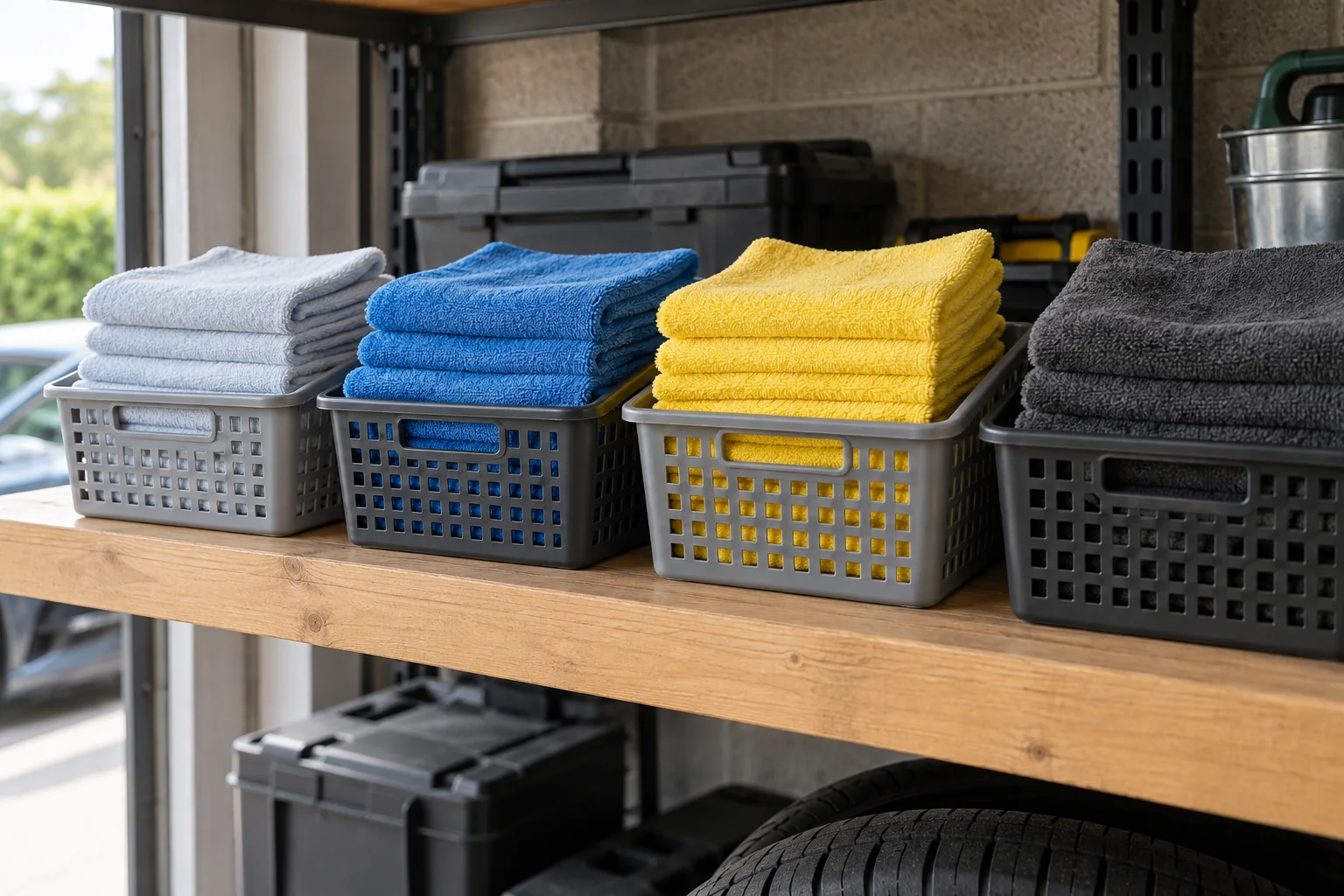
Give each towel a role before its first use
Microfibre is used for drying, glass, interior cleaning, polishing residue and protective products. Those jobs leave different contamination behind. A cloth that removed tyre dressing or gritty wheel film has a different history from one used only on clean rinsed paint, even if they are the same colour and size.
Assign roles when the towels enter the kit. Keep packaging or note the maker’s care requirements, especially where a towel has a specific detergent or temperature limit. The aim is a system that remains clear after several washes, not a colour chart that only makes sense while the new packets are open.
| Task group | Keep dedicated | Why it deserves separation |
|---|---|---|
| Bodywork drying | Suitable drying towels, with drying-aid use identified | Wax, oil and abrasive dirt can undermine clean drying |
| Glass | Glass-cleaning cloth and a separate finishing cloth where needed | Oily residue and lint can spread smears across clear glass |
| Paint finishing | Separate polishing, wax and spray-protection textiles | Different products and abrasive residues should not be mixed casually |
| Interior | Cloths appropriate for the actual permitted surface | Dressings and dirt should not migrate to glass or delicate trim |
| Wheels and utility | Clearly marked dirty-task textiles | Brake dust, grit and grease do not belong in bodywork equipment |
Keep cloths used for cold stainless-steel exhaust-tip cleaning in the dirty-task group. Soot and metal-polish residue should not move onto glass or paint, even when a cloth has the same colour as a cleaner-task towel.
Use labels as well as colour
Choose colours that help you remember the groups, but do not present them as an industry standard. Add a simple task label to the compartment or bag. If two products arrive with identical cloths, assign one by a durable permitted label or keep them in clearly distinct storage.
Avoid attaching anything that could scratch during use. A tag, marker or labelling method must suit the textile and remain clear of the working surface. When that cannot be arranged sensibly, label the container and keep the towel within its group.
Tell anyone who helps clean the car what the system means. “Blue is glass” is only useful if a second blue cloth has not quietly been used for tyre dressing. Previous use overrides colour every time.
Keep glass away from finishing oils
Glass is particularly good at revealing cross-contamination: a cloth that looks clean may redistribute an oily film across a window. Use appropriate glass textiles and a clean finishing face or second cloth as required by the glass-cleaner method. Keep dashboard dressings, polish and wax away from that group.
Gtechniq MF5 is a dedicated fishscale-weave glass cloth example. Its role and weave are useful distinctions, rather than evidence that it can compensate for a dirty or oil-loaded laundry stream. Check tint and surface instructions before choosing the cleaner as well.
A cloth reserved for glass
Gtechniq MF5 Power Glass Cloth
A 40 × 40cm microfibre cloth with a fishscale weave intended for glass cleaning. Keep it apart from wax and tyre-dressing textiles so residues do not travel onto the windows.
- 40 × 40cm
- Fishscale weave
- Single glass cloth
This listing is one cloth. A second clean cloth can help with a final buff. Wash as directed and check tint-film or display instructions before treating those surfaces like ordinary glass.
If glass still smears, inspect product loading, surface conditions and cloth cleanliness before increasing the dose. A separate clean finishing cloth may address residue transfer more directly than another bottle. The interior-glass guide covers the full method.
Keep drying towels out of the finishing pile
A towel used solely for drying clean paint should not be stored alongside cloths loaded with wax or spray sealant. Where a drying aid is used, identify the product so subsequent washing reflects that residue. Do not assume the phrase “drying towel” describes a towel’s entire contamination history.
Care limits differ too. Gtechniq MF2 specifies non-biological detergent and a 50°C maximum, while Autoglym’s Ultra-Soft towel specifies separate washing up to 40°C. Choosing a lower temperature does not necessarily resolve different detergent requirements or cross-contamination.
Drying-towel washing explains the complete process. Retain the actual instructions rather than trying to remember one universal microfibre programme.
Collect used textiles without mixing them back in
During the job, maintain separate used collection points for the main groups. Keep them clear of the ground and away from clean supply boxes. A towel should move from clean storage to its task, then to used collection, then through cleaning and drying before returning.
Do not seal damp textiles away and forget them. Collection is temporary; clean and dry promptly through suitable methods. Keep cloths with hardened coating residue or unidentified chemicals apart from ordinary laundry until their treatment or disposal is established.
Group laundry by two questions
First ask what is on the cloth. Then ask what care the textile permits. A compatible wash group needs acceptable answers to both. Same-colour towels can have incompatible contamination, and different-colour towels can share care requirements without necessarily belonging in the same load.
GYEON Q²M TowelWash is a dedicated cleaner for suitable textile residues with defined dosing. It does not turn every textile into a common-temperature load or make a heavily contaminated cloth safe for a more sensitive task. Its exclusion for coating towels is a clear limit.
For washing detailing textiles
Gyeon Q²M TowelWash 500ml
A dedicated detergent for cleaning reusable microfibre towels and compatible wash accessories. Useful for a growing textile kit when you want one clearly identified wash product.
- 500ml bottle
- Dedicated microfibre detergent
- No added fabric softener
Follow the textile’s care label and the detergent bottle for dose and cycle. Do not add softener or bleach. Detergent does not make hardened coating towels suitable for paintwork again.
Remove loose particles before washing, use a permitted detergent without softener and rinse effectively. Inspect after cleaning and again before use. Clean appearance alone cannot prove that grit, cured material or heat damage is absent.
Store only the fully dry, ready-to-use group
A covered compartment helps protect clean towels from dust. The standard 9-litre Really Useful Box is a small dry-storage option where its usable dimensions fit your folded cloths. Use separate labelled boxes or suitable separate compartments instead of creating a mixed “clean enough” pile.
For storing clean, fully dry cloths
Really Useful Box 9 Litre — Clear
A clear lidded box for a small collection of folded towels and applicators. Labelling it “glass” or “bodywork” makes a separate clean-textile space easy to identify.
- 9 litre capacity
- 395 × 255 × 155mm external
- Clear box with lid
Dry everything before closing the lid. This is an organiser, not a drying container or a chemical-safety cabinet. Check shelf space and keep chemical storage separate.
The box is not a drying chamber or chemical cabinet. Dry fully elsewhere before closing the lid, and keep leaking bottles and wheel tools away. Leave enough room to remove one towel without dragging the rest over a dirty shelf or container edge.
Retire by condition, with a deliberate next role
A towel with persistent hard material, damaged pile, melted fibres or uncertain contamination should leave sensitive paint work. It may be suitable for a particular less demanding utility task, but assess that task rather than assuming every downgrade is safe. Glass, screens and trim can still be delicate.
Update the label immediately or remove the towel from the working kit. A retired cloth returned to the wrong box defeats the system more quickly than choosing an imperfect colour code. The useful habit is preserving a known history from first use to final retirement.
Common questions
Is there a standard colour code for car microfibre towels?
No universal colour code should be assumed. Choose a system you can remember and add task labels, especially when cloths share a colour. The previous use and care requirements matter more than the shade.
Can wheel cloths become paint cloths after washing?
Keep them assigned to wheel or utility work. Washing does not establish that every hard particle or contaminant has been removed. Do not promote a dirtier-task cloth back to sensitive paint contact just because it looks clean.
Can all clean-looking microfibres share one wash?
No. Consider both contamination and care limits. Glass cloths, drying towels and oily finishing cloths may need separate loads, while different temperature or detergent requirements can also prevent combining them.
What should I do with cloths used for ceramic coating?
Keep them separate and follow the coating maker’s instructions. Hardened coating residue can make them unsuitable for sensitive surfaces. GYEON’s TowelWash guidance excludes coating towels from reuse; do not assume detergent can reset them.
When should a towel be retired?
Retire or replace it when hard residue, embedded particles, damaged fibres or uncertain cleanliness make its assigned task unsuitable. A downgrade still needs a compatible new task; it is not permission to use it on any interior or glass surface.
Sources and product instructions
Follow the label and care instructions for the exact version and surface you own.