
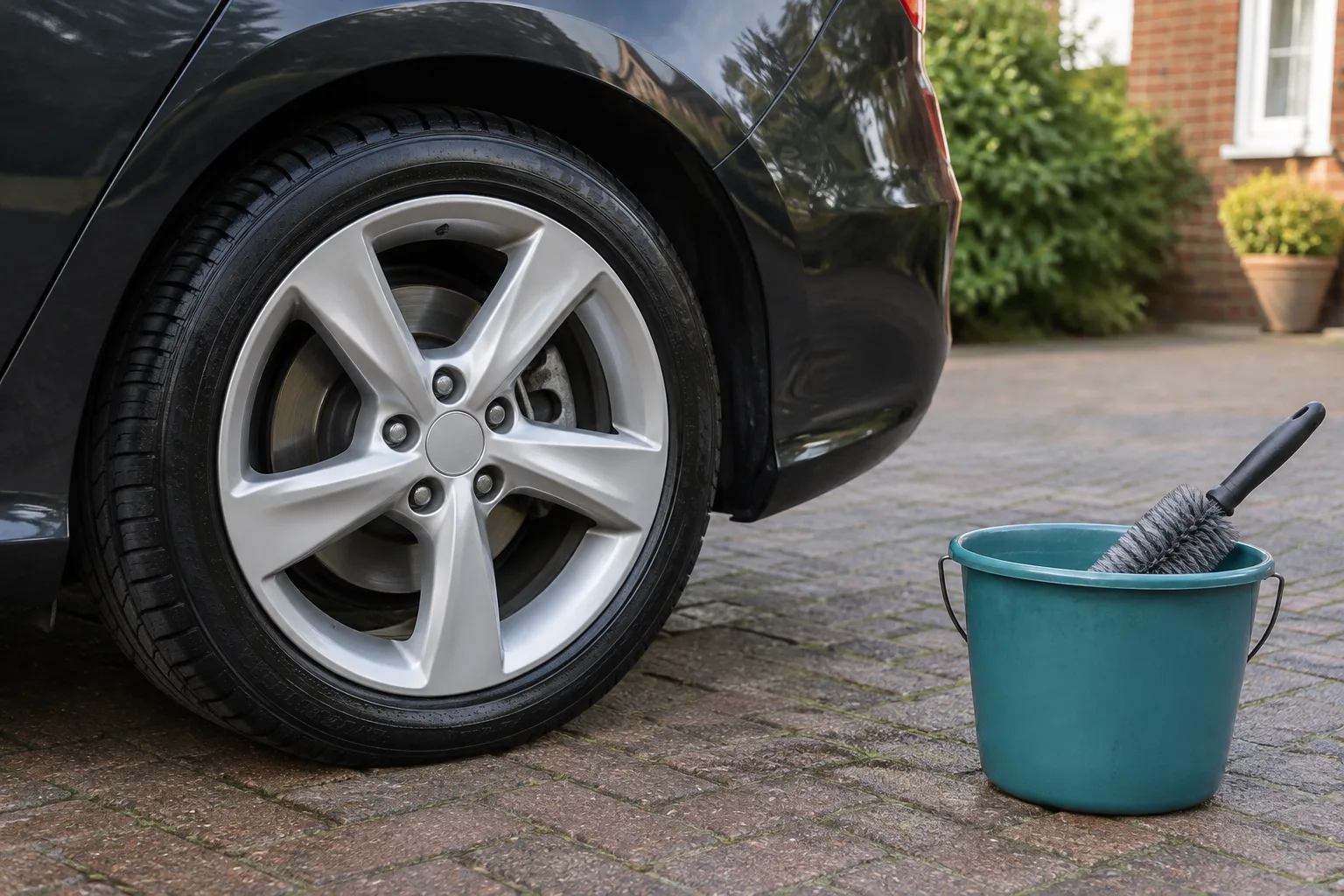
Identify the wheel before the cleaner
Wheel-cleaning products are not interchangeable. Painted and lacquered alloys, exposed metal, diamond-cut finishes and refurbished wheels can come with different care instructions. Find out what is on your car before picking a chemical.
If lacquer is lifting, the finish is damaged or you cannot identify it, check with the wheel or vehicle supplier. A cleaner cannot repair a failing finish, and a bottle’s broad suitability claim does not settle every damaged or aftermarket surface.
Choose a wheel-care starting point
The useful first distinction is between dirt that can be washed away and a finish that needs assessment. Start with the wheel material and condition, then choose access tools and a compatible cleaner. Sidewall cleaning and optional dressing come afterwards, using separate equipment. A larger chemical collection cannot resolve an unknown finish or a brush that will not fit.
| Your next job | Start here | What to establish first |
|---|---|---|
| Unknown or specialist wheel finish | Choose cleaner by finish | Wheel-maker restrictions, refurbishment and damaged lacquer |
| Diamond-cut alloys | Follow the surface-care guide | Lacquer condition and the wheel supplier’s instructions |
| Routine brake dust | Use a controlled wheel wash | Cool surfaces and a complete application-and-rinse method |
| A cleaner or an iron remover? | Compare their roles | Overlapping formulas and exact finish approval |
| Brown or dirty tyre sidewalls | Clean before dressing | Tyre-maker permission and a separate rubber-cleaning tool |
| Dressing specks on the bodywork | Check dressing sling | Preparation, excess product and the required finish or drying stage |
Choose tools and chemicals for your wheels
- Choose a wheel-face brush: bristle shape, finish exclusions and controlled detail work.
- Choose a wheel-barrel brush: medium, large and flexible-head options with clearance checks.
- Choose a wheel cleaner by finish: coated, exposed-metal and specialist surfaces, including adjacent trim.
Put the wheel and tyre routine together
- Cleaning diamond-cut wheels: preserve the lacquer and recognise damage that washing cannot repair.
- Remove brake dust during a routine wash: follow one compatible, supervised method through rinsing.
- Wheel cleaner versus iron remover: understand formulas that overlap before adding another stage.
- Keep wheel tools separate: organise wash water, textiles, cleaning and storage.
- Clean tyre sidewalls: follow tyre-maker care and separate rubber tools from wheel-face brushes.
- Compare tyre-dressing spray and gel: wet/dry preparation and controlled finishing where permitted.
- Diagnose tyre-dressing sling: check excess, preparation, timing and other sources of specks.
Give each tool a job
A face brush needs to reach the spokes without hard parts contacting the finish. A barrel brush needs enough clearance behind them. Look at the spaces on your wheels before buying a large brush that cannot pass through the gaps.
Keep wheel tools and rinse water away from bodywork equipment. Store them so you can tell them apart at a glance: a separate tub or a clear label is more useful than relying on memory when everything is wet.
For a first kit, a separate wheel tool may be enough to fill the gap. The beginner cleaning-kit comparison shows which boxed set includes a wheel product and which tools you still need.
A brush for the gaps
The medium Supreme Wheel Brush is a separate wheel-only tool with a microfibre head. Compare its shape with the spaces behind your spokes; a smaller useful brush beats a larger one that cannot pass through.
For the wheel barrel and spokes
Meguiar’s Supreme Wheel Brush — Medium
A thick microfibre wheel brush without wire or metal parts. The medium version is worth considering when a cloth cannot reach comfortably behind the spokes.
- Medium X1902EU
- Microfibre head
- No metal parts
Check the clearance around spokes and brake components before choosing a size. Never force it into a tight gap, and keep this brush out of the bodywork wash bucket.
Follow the bottle, including the small print
Work on cool wheels and follow the product’s directions for application, agitation and rinsing. Check its label and safety data sheet for protective equipment. Do not let a product dry on a surface unless its instructions explicitly require that application method.
Autoglym’s Custom Wheel Cleaner page illustrates why the detailed instructions matter: its overview lists split rims, but its FAQ recommends Bodywork Shampoo instead because cleaner can be difficult to rinse from the bonded surfaces. For split rims, follow that specific instruction and the wheel supplier’s guidance.
“Acid-free” does not mean that every finish or application is suitable. Check the particular formulation against your wheel-care guidance; do not substitute a stronger product or longer dwell time when ordinary cleaning does not remove a mark.
Buy the cleaner separately when that is all you need
Custom Wheel Cleaner is the same product type discussed above, available as an individual spray. It avoids buying another exterior collection just to replace the wheel bottle. The split-rim restriction still applies.
A separate wheel-cleaner refill
Autoglym Custom Wheel Cleaner 500ml
An acid-free, alkaline cleaner for brake dust and road grime. Buying the individual 500ml spray is useful when wheel cleaner is the gap in an otherwise complete kit.
- 500ml spray
- Acid-free, alkaline
- Wheel finish check required
Work on cool wheels and rinse thoroughly. For split rims, Autoglym’s FAQ recommends Bodywork Shampoo instead. Check damaged, refurbished and specialist finishes with their supplier.
Tyre dressing is a finishing choice
A dressing changes the appearance of tyre sidewalls. It is an optional finishing step, not a substitute for washing. Follow its application instructions and keep it away from surfaces where grip is needed, including the tread, pedals and driving controls.
A mark that remains after normal washing might need a different assessment rather than more scrubbing. Corrosion, damaged coatings and finish repair are reasons to speak to a specialist.
A controlled sidewall finish
Instant Tyre Dressing can be applied with a sponge to control overspray. Use it only after cleaning, and choose the sheen by following the bottle’s wipe-off directions. Skip it if the clean, undressed appearance is what you prefer.
An optional sidewall finishing step
Autoglym Instant Tyre Dressing 500ml
A spray dressing for cleaned car-tyre sidewalls, used on wet or dry rubber. Leave it to dry for a light sheen or remove excess as directed for a more muted finish.
- 500ml spray
- Wet or dry sidewalls
- Optional finishing product
Use only if your tyre maker permits dressing. Keep off tyre tread and braking surfaces; not for motorcycle tyres. A sponge controls overspray. Dressing is cosmetic and cannot repair cracked or worn rubber.
Common questions
Can I use any wheel cleaner on my alloys?
Check the exact wheel finish and the cleaner’s exclusions. Refurbished, damaged, polished and specialist finishes may need advice from their supplier.
Should the wheels be cool?
Follow the product’s cool-surface instructions and do not let cleaner dry on the wheel. Recent driving or strong sun can make the surface unsuitable for starting the job.
Can I use the bodywork mitt on wheels?
Keep wheel brushes, cloths and rinse water separate from bodywork equipment. Do not return a wheel-contaminated textile to painted panels during the wash.
How do I choose a wheel brush?
Check clearance around spokes and the brake assembly, as well as the brush’s suitability for the finish. Do not force a tool into a gap it cannot reach safely.
Where should tyre dressing go?
Keep dressing on the area specified by its label, away from tread and braking surfaces. Apply with controlled equipment and remove excess as directed.
Sources and product instructions
Follow the label and care instructions for the exact version and surface you own.