
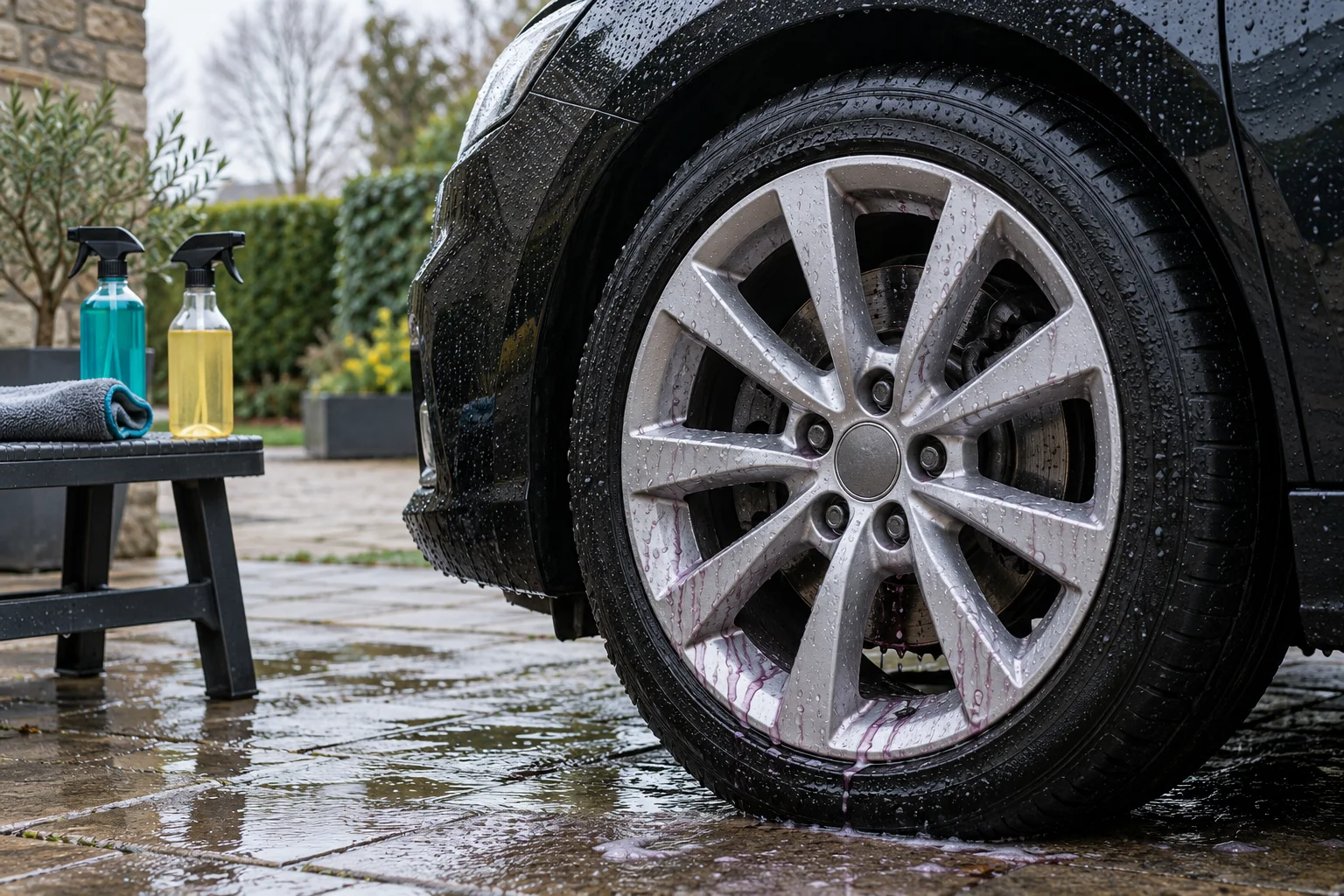
The names describe overlapping jobs
A wheel cleaner is chosen to clean a wheel; an iron remover targets iron-bearing contamination. Those descriptions can overlap. Some wheel cleaners contain iron-reactive ingredients as well as cleaning agents for grime, while a fallout remover may also have a permitted wheel application.
The useful question is therefore what the exact formula is intended to remove and where it can be used. Do not build a compulsory two-bottle routine from the names alone. If one suitable product already covers the task, another stage may add cost and exposure without addressing a new problem.
Separate the contamination from the product category
| Observation or task | Relevant question | Do not assume |
|---|---|---|
| Ordinary dirty wheel with road film | Does the wheel’s permitted routine or cleaner remove it? | Every dark deposit is bonded iron |
| Iron-bearing dust or fallout | Is an iron-reactive product appropriate for this finish? | Every wheel needs a separate fallout stage at each wash |
| Colour-changing wheel cleaner | Does the formula combine grime cleaning and iron reaction? | The wheel-cleaner label means it lacks iron-removal action |
| Sticky dark spot or persistent dull patch | Can the mark and surface condition be identified? | Iron remover treats tar, mineral deposits and damaged lacquer equally |
| Unknown or restrictive finish | What does the wheel maker permit? | pH-neutral or acid-free overrides the wheel’s care instructions |
Brake dust and road contamination are mixtures. An iron reaction can be relevant to part of the deposit without explaining everything on the surface. Rinse, inspect and identify what remains before deciding on more treatment.
Custom Wheel Cleaner: a detergent-led wheel routine
Autoglym describes Custom Wheel Cleaner as an acid-free alkaline formula. Its method centres on applying to cool suitable wheels, agitating and rinsing thoroughly. That is distinct from choosing a product because you want to observe an iron-reactive colour change.
Acid-free does not mean neutral or universally compatible. The product's specific split-rim FAQ recommends Bodywork Shampoo instead because cleaner can remain in difficult-to-rinse joints. Follow the wheel maker and that restriction rather than using the broad specialist-wheel description to settle an unidentified finish.
A separate wheel-cleaner refill
Autoglym Custom Wheel Cleaner 500ml
An acid-free, alkaline cleaner for brake dust and road grime. Buying the individual 500ml spray is useful when wheel cleaner is the gap in an otherwise complete kit.
- 500ml spray
- Acid-free, alkaline
- Wheel finish check required
Work on cool wheels and rinse thoroughly. For split rims, Autoglym’s FAQ recommends Bodywork Shampoo instead. Check damaged, refurbished and specialist finishes with their supplier.
If the permitted wheel wash removes the ordinary contamination, inspect and finish rather than automatically adding a separate fallout remover. A more complicated routine should solve a particular remaining task.
Advanced All Wheel Cleaner: a wheel cleaner that reacts with iron
Autoglym's Advanced formula demonstrates why the categories overlap. It is marketed as a wheel cleaner, is pH-neutral and changes colour when reacting with iron-bearing brake dust. Its grime-cleaning and reactive functions are part of the same product choice.
The exact restrictions still matter: it excludes unlacquered wheels and motorcycles, is not intended as the tyre-wall cleaner and should not be sprayed directly onto brakes. Use its cool-wheel, preferably dry-surface method, the instructed two-to-four-minute dwell and a complete rinse without drying.
For permitted lacquered and painted wheels
Autoglym Advanced All Wheel Cleaner 1L
A pH-neutral, colour-changing wheel cleaner intended to tackle grime and iron-bearing brake dust. The selected pack is the 1-litre spray bottle.
- 1-litre spray
- pH-neutral formula
- Iron-reactive colour change
Not for unlacquered wheels or motorcycles. Use on cool wheels, preferably dry, with the instructed 2–4-minute dwell and no drying; do not use it as a tyre cleaner or spray directly onto brakes.
A dedicated iron remover after this stage is not automatically necessary. If contamination remains, first establish what it is and whether another treatment is permitted. The number of bottles is not a measure of how carefully a wheel was cleaned.
Magma: a fallout-removal stage with its own preparation
Autoglym Magma targets iron particles on suitable external surfaces, including wheels. The selected 500 ml pack's instructions begin with shampooing and removing excess water, followed by application on cool surfaces out of direct sunlight, a three-to-five-minute reaction and the instructed agitation and rinse.
That preparation should not be replaced by the dry-wheel starting condition of another formula. The broad exterior-surface language is also narrowed by an explicit non-clear-coated-surface exclusion and a FAQ that does not recommend wrapped vehicles. A different product name does not remove finish checks.
For a permitted iron-removal stage
Autoglym Magma 500ml
A pH-neutral, colour-changing iron fallout remover for suitable clear-coated surfaces and wheels. Its instructed preparation includes shampooing first and removing excess water.
- 500ml spray
- Targets iron particles
- Clear-coat restriction
Not suitable for non-clear-coated surfaces; Autoglym also excludes wrapped vehicles. Follow the 500ml pack’s 3–5-minute method and rinse fully. Broad surface claims do not override these exclusions.
Use the method on the bottle you receive and keep it within the surface supplier's care. Product pages can describe many uses; the narrower exclusion is the relevant limit where it applies. Do not choose a fallout remover as a way around a wheel maker's shampoo-only routine.
What the colour change can and cannot show
A red or purple reaction can indicate interaction with iron-bearing contamination. It is not a calibrated test of wheel cleanliness, a measure of remaining coating thickness or proof that the surface is safe. A dramatic result in a photograph does not establish a better application for your wheel.
Likewise, little visible reaction does not prove that the wheel needs a stronger concentration or longer dwell. Check whether the contamination is of the type the product targets, whether the permitted preparation was followed and whether the product is drawing or spraying correctly.
Complete the instructed rinse and inspect under useful light. Do not wait for the strongest possible colour while the film approaches dryness. The reaction belongs within a controlled cleaning method; it is not a target to maximise independently.
Use one product at a time
Never combine concentrates in a spray bottle or apply a second cleaner over the first to make a stronger mixture. Separate formulations and compatibility claims do not establish how a mixture behaves. Where two stages are genuinely instructed and suitable, complete and rinse one before preparing the next.
Keep chemical directions separate too. A ready-to-use product is not automatically a concentrate, and one bottle's dwell range should not be copied onto another. Use the label's protective equipment and handling directions, with the rinse supply prepared before application.
Wheel-maker care can be stricter than any of these product lists. RONAL, for example, recommends neutral vehicle shampoo and advises against commercial wheel cleaners for its wheels. That instruction takes priority for the relevant wheel, even when a chemical brand lists lacquered alloys broadly.
A practical choice after the routine wash
- Identify the finish and its permitted cleaning method.
- Carry out that method with separate clean wheel tools and a full rinse.
- Inspect any remaining mark without dry-rubbing it.
- If an iron-removal stage addresses the identified contamination and is permitted, follow that exact product's preparation and limits.
- If the mark is uncertain, sticky, beneath lacquer or associated with damage, stop and obtain suitable advice before escalating chemicals.
For the complete sequence, see routine brake-dust removal. For deciding between the actual bottles, use choosing a wheel cleaner by finish. On diamond-cut wheels, preserving the clear coating remains more important than removing an unexplained mark at any cost.
Keep bodywork treatment a separate decision
For metallic deposits on paint, use the bodywork fallout-removal method and bodywork product selection. A wheel-cleaner recommendation does not automatically establish suitability for every painted panel or finish.
Common questions
Do wheel cleaners and iron removers do completely different jobs?
Their functions can overlap. Some wheel cleaners combine grime cleaning with iron-reactive ingredients, and some fallout removers also permit wheel use. Read the exact formula’s purpose, preparation and finish restrictions rather than assuming two names always require two separate stages.
Do I need iron remover after Advanced All Wheel Cleaner?
Not automatically. Advanced already has an iron-reactive function. Rinse and inspect, identify any remaining contamination and follow the wheel maker before adding treatment. A second product should solve an appropriate remaining task, not simply complete a two-bottle checklist.
Can Magma be used on any wheel finish?
Do not rely on broad all-surface wording. Autoglym explicitly excludes non-clear-coated surfaces and does not recommend wrapped vehicles. The wheel maker may impose stricter care. Follow the exact product and surface instructions before considering its wheel application.
Does a darker purple reaction mean better cleaning?
Colour change is not a calibrated cleanliness or safety measurement. Follow the instructed preparation, application and rinse, and inspect the result. Do not increase strength or extend dwell simply to create a more dramatic reaction.
Will iron remover remove tar or corrosion under lacquer?
Do not assume it will address either problem. Iron-bearing particles, sticky organic deposits and coating damage need different assessment. Identify the mark and the finish before further treatment; a routine cleaner cannot rebuild damaged lacquer.
Sources and product instructions
Follow the label and care instructions for the exact version and surface you own.
- Autoglym Custom Wheel Cleaner: wheel and tyre directions, split-rim exception
- Autoglym Advanced All Wheel Cleaner: finish and use restrictions
- Autoglym Magma: iron removal, preparation and clear-coat restriction
- Auto-Wheel technical sheet: plated plastic and testing exclusions
- RONAL and SPEEDLINE CORSE wheel-care instructions