
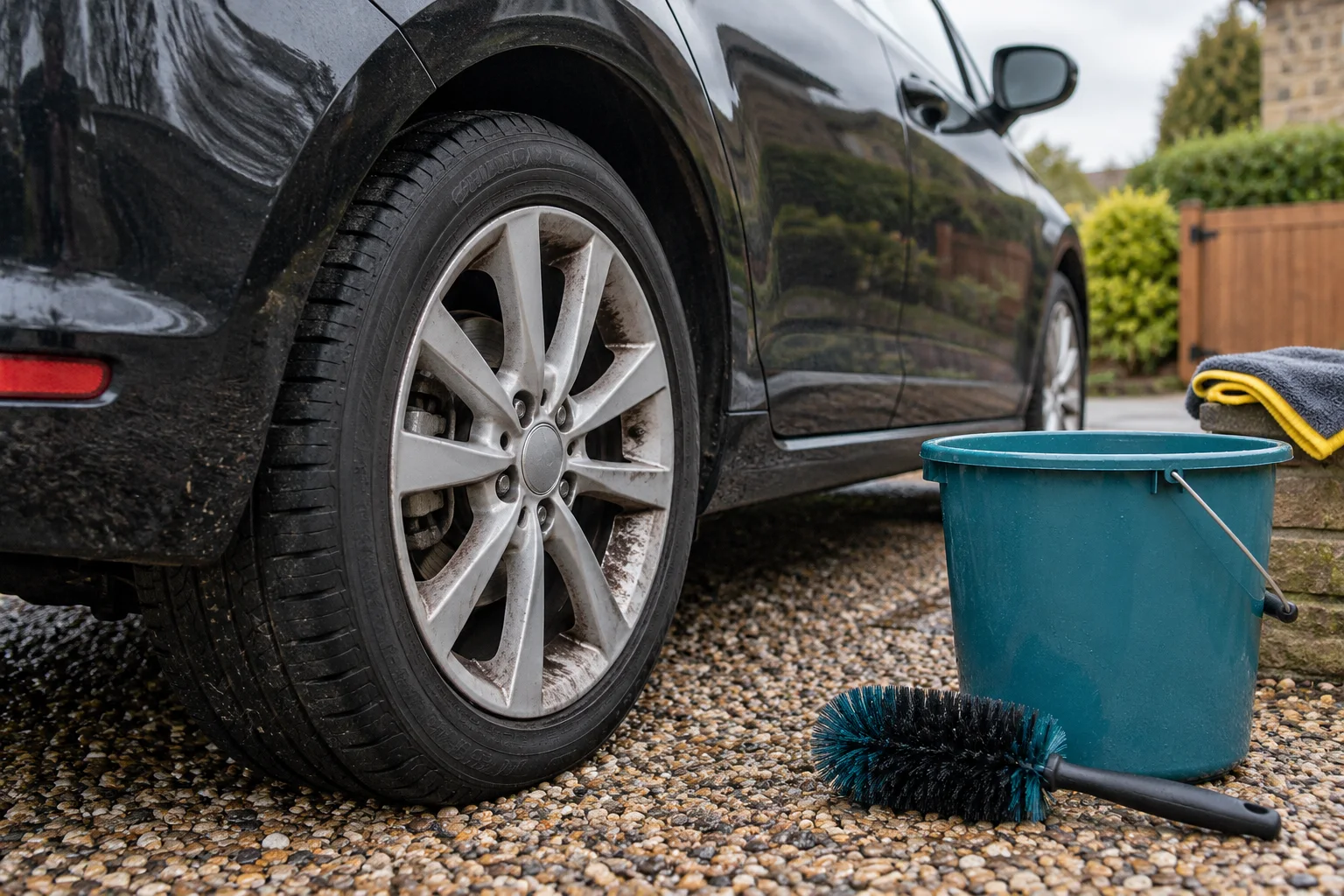
Remove what the routine can handle without chasing every mark
Brake dust arrives alongside road film, mud and other contamination. Some of the deposits contain iron-bearing particles, but a dark wheel is not a diagnosis of iron alone. Start with the wheel's finish and approved care, then choose a routine for the dirt you can actually see.
A regular compatible wash is easier to control than waiting for a heavy build-up and trying to remove everything in one aggressive session. The aim is to rinse away loosened contamination without damaging the finish. A persistent spot after washing may need identification, rather than another round of stronger chemical or harder brushing.
Prepare the wheel stage before the bodywork wash
Park safely, allow wheels and brakes to cool and choose conditions in which the chemical will not dry before you can rinse. Have the water supply ready before applying a cleaner. Follow the vehicle and equipment instructions for any pressure rinse; do not aim a concentrated jet at tyres, valves or damaged coating.
Set out wheel-only brushes, wash or rinse water and cloths. Keep the bodywork mitt and drying towel away from the wheel stage. Separating the tools is useful only if it continues through the rinse water and storage, not just the first few minutes of the wash.
Inspect the finish before starting. Lifting lacquer, exposed repairs, an unfamiliar chrome-look cap or a specialist brake assembly can change the permitted method. Use the finish-based cleaner guide before applying an uncertain product.
Choose a permitted cleaning route
Where the wheel maker specifies neutral shampoo, use that method first. If a dedicated cleaner is permitted and needed, follow its exact starting-surface, agitation and rinse instructions. There is no need to combine several cleaners merely because brake dust is present.
Auto-Wheel is one reactive option for suitable surfaces. Bilt-Hamber combines iron-particle release with degreasing, and describes a colour change as part of that process. The important restrictions include avoiding direct centre-cap spraying and keeping the product off plated chrome-look plastic and conductive decorative films.
For suitable wheels with iron-bearing dust
Bilt-Hamber Auto-Wheel 1L
A pH-adjusted reactive wheel cleaner that combines iron-particle release with degreasing. This selection is the 1-litre pack, separate from the 5-litre refill.
- 1-litre pack
- Iron-reactive formula
- Centre-cap/plated-plastic limits
Avoid direct centre-cap spraying and keep it off chrome-look plated plastic and conductive decorative films. Follow the exact label, cool-surface and small-area checks; wheel-maker restrictions still apply.
Follow the label on the pack for reaction time and rinsing, alongside the wheel maker's care. Do not apply a generic five-minute timer to every product and every condition. An iron-reactive colour change is an application cue, not proof that the surface is compatible or the entire wheel is clean.
A step-by-step routine for ordinary brake dust
- Identify the finish and choose the approved shampoo or cleaner. Read its instructions and prepare the required protective equipment.
- Follow its starting-surface directions. Some methods begin with a loose-dirt rinse; others specify a dry wheel for application. Keep those complete methods separate.
- Apply to the permitted area, avoiding excluded trim and direct spraying of components that should not receive it.
- Allow only the instructed working time and watch the surface. Keep the rinse ready and do not extend the treatment into drying.
- Where agitation is required, use a suitable wet brush or permitted wash tool with controlled light movements. Rinse dirt out of it frequently.
- Rinse fully, including accessible corners where cleaner can collect. Inspect before deciding whether any further treatment is needed.
- Finish and put wheel equipment aside before returning to the bodywork routine with its separate clean kit.
Work in a sequence you can supervise. Treating every wheel at once can leave the first application sitting too long while you reach a difficult rear spoke. One complete wheel at a time is often more manageable when the product method calls for that approach.
Use the brush to reach, not to compensate for the wrong chemical
Choose access and finish compatibility before brushing. The medium Supreme Wheel Brush can help with accessible barrel areas where its microfibre head fits. It has no wire or metal parts, but trapped grit and handle contact still need controlling.
For the wheel barrel and spokes
Meguiar’s Supreme Wheel Brush — Medium
A thick microfibre wheel brush without wire or metal parts. The medium version is worth considering when a cloth cannot reach comfortably behind the spokes.
- Medium X1902EU
- Microfibre head
- No metal parts
Check the clearance around spokes and brake components before choosing a size. Never force it into a tight gap, and keep this brush out of the bodywork wash bucket.
Do not force the head behind a close caliper or use the rim as a lever. Keep your movements visible and controlled, and stop if the head catches. A separate face brush or permitted cloth can handle spoke fronts rather than making one tool do every job.
Dry brushing is not a useful shortcut for a dirty wheel. Keep to the chosen washing method and rinse contamination out of the head. If the brush hits the ground or its protection is damaged, put it aside until properly cleaned or replaced.
When a separate iron remover might be relevant
If normal cleaning leaves contamination consistent with iron, a suitable iron-removal stage may be useful where the wheel maker permits it. It is not compulsory after an iron-reactive wheel cleaner, and it is not a treatment for every remaining tar-like spot, mineral mark or damaged area.
Magma is a separate example with its own preparation: Autoglym's 500 ml method shampoos first, removes excess water, then applies the product on cool surfaces out of direct sun. It describes a three-to-five-minute reaction followed by the instructed agitation and rinse. The explicit exclusion for non-clear-coated surfaces still applies, despite broad wording elsewhere on the product page.
For a permitted iron-removal stage
Autoglym Magma 500ml
A pH-neutral, colour-changing iron fallout remover for suitable clear-coated surfaces and wheels. Its instructed preparation includes shampooing first and removing excess water.
- 500ml spray
- Targets iron particles
- Clear-coat restriction
Not suitable for non-clear-coated surfaces; Autoglym also excludes wrapped vehicles. Follow the 500ml pack’s 3–5-minute method and rinse fully. Broad surface claims do not override these exclusions.
Use wheel cleaner versus iron remover to decide whether the extra stage adds a useful function. Never pour the products together or apply one on top of un-rinsed residue from another. Each stage needs its own compatibility and method.
Assess what remains once the wheel is rinsed
Look without rubbing a dry cloth over an uncertain deposit. Surface dirt, a sticky dark speck, roughness and cloudiness beneath lacquer are different observations. If you cannot identify the finish or the mark, stop escalating the treatment and ask the wheel supplier or a suitable specialist.
Diamond-cut wheel care explains why coating damage should not be treated as stubborn dirt. A cleaner cannot rebuild lacquer or repair corrosion beneath it. A small cosmetic imperfection is not a reason to keep scrubbing until the surface changes.
Repeat compatible routine care as required by the wheel's use and instructions, and clean the tools afterwards. Keeping ordinary contamination manageable is a more sustainable home routine than pursuing a dramatic chemical reaction at every wash.
Common questions
Do I need iron remover every time I wash the wheels?
No universal interval applies. Follow the wheel maker and inspect the contamination after a suitable routine wash. A reactive wheel cleaner may already address iron-bearing deposits. A separate iron-removal stage should have a clear purpose and its own finish compatibility.
Does a purple reaction mean the wheel is fully clean?
No. Colour change can indicate a reaction with iron-bearing contamination, but it does not measure all road grime or establish finish safety. Complete the instructed agitation and rinse, then inspect. Some remaining marks may be unrelated to iron or may be beneath damaged lacquer.
Should I rinse before applying wheel cleaner?
Use the exact product’s starting-surface instruction. A shampoo routine and a cleaner designed for a dry wheel may begin differently. Prepare the rinse in advance and follow the complete method, rather than combining isolated steps from several bottles.
Can I scrub harder if brake dust remains?
First check the method, permitted tool and actual remaining mark. Greater force can bring grit or hard brush parts against the finish. Persistent spots may need a different assessment, especially on damaged lacquer, rather than repeated aggressive brushing.
Can I use the bodywork mitt to finish the wheels?
Keep a separate wheel-only tool and water setup. Wheel contamination and cleaner residue should not return to painted panels on the same mitt. Separation continues through cleaning, drying and storage, not just while the wheel stage is in progress.
Sources and product instructions
Follow the label and care instructions for the exact version and surface you own.
- Bilt-Hamber Auto-Wheel: application and centre-cap restriction
- Auto-Wheel technical sheet: plated plastic and testing exclusions
- Meguiar’s Supreme Wheel Brush Medium X1902EU
- Autoglym Magma: iron removal, preparation and clear-coat restriction
- RONAL and SPEEDLINE CORSE wheel-care instructions
- Kärcher K 5 Power Control: model-specific pressure restrictions