
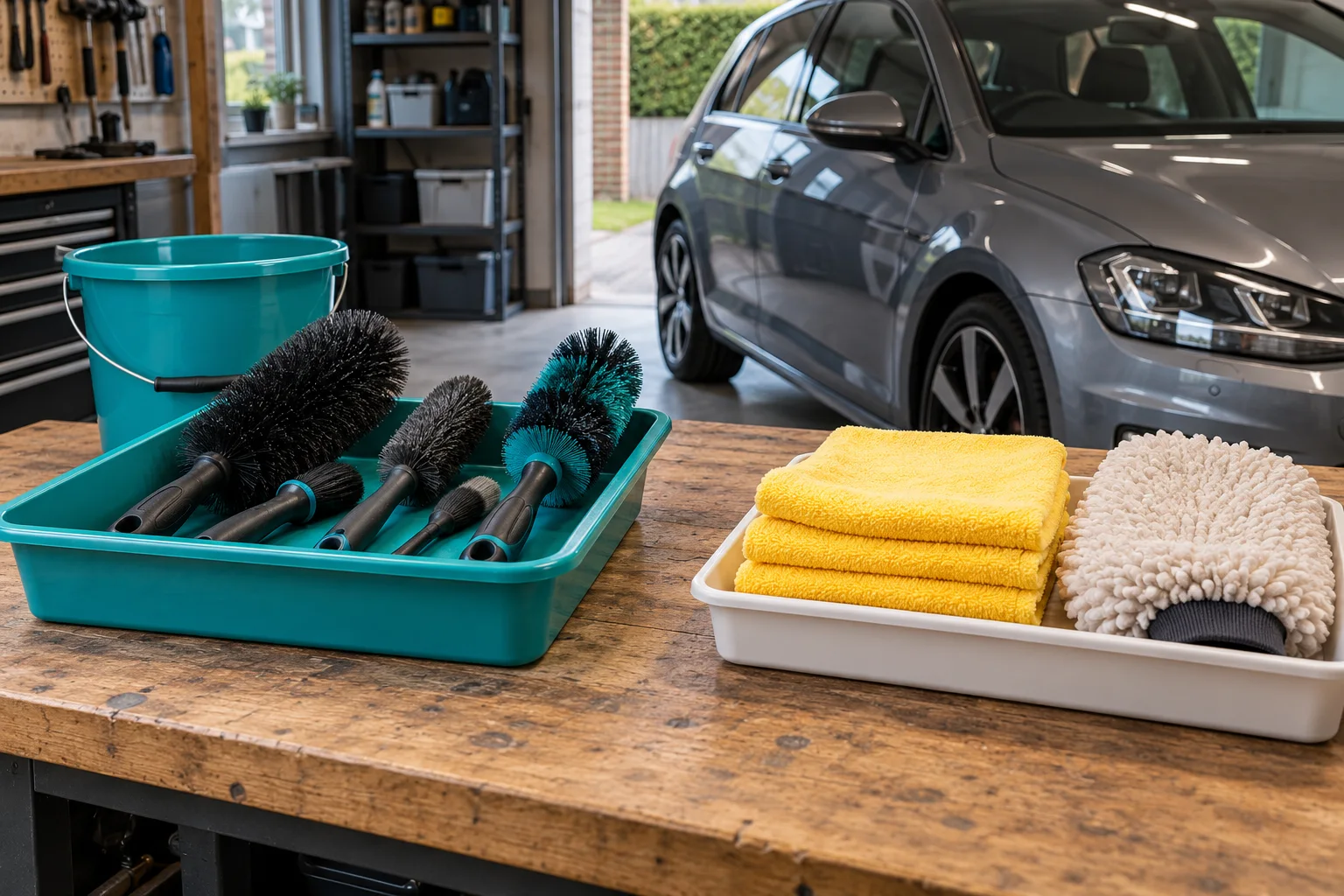
Keep contamination from travelling with the tools
Wheel brushes, tyre scrubbers and dressing applicators collect different residue from a bodywork mitt. A wheel tool can carry brake dust and cleaner; a dressing pad can remain oily after the tyre looks finished. Keeping those tools separate reduces the chance of returning that material to painted panels during the next stage.
Think beyond owning two buckets. Separation includes the wash water, the place you put a used brush, the cloth used for wheel drying and the way equipment is cleaned and stored. A coloured handle helps identification, but it does not prove that the tool has stayed in the right group or is clean enough to use.
Give each group a clear job
| Group | Typical equipment | Keep away from |
|---|---|---|
| Wheel face and barrel | Suitable brushes, permitted wheel cloths and wheel-only water | Bodywork shampoo/rinse buckets and paint mitts |
| Tyre cleaning | Rubber-only scrubbing brush and permitted cleaner | Delicate wheel finishes, bodywork and dressing pads |
| Tyre dressing | Dedicated foam applicator and any wipe-off cloth | Paint-polish applicators, clean towels and wash water |
| Bodywork washing | Clean paint mitt, wash/rinse buckets and drying towel | Wheel rinse water, tyre residues and dirty staging areas |
| Glass and finishing | Task-specific clean cloths and applicators | Unidentified chemical residue or gritty tools |
The groups do not require five complete expensive kits. They require you to recognise the job and prevent contaminated items crossing into another one. Start with the equipment you already own, assign it clearly and add only a missing tool or practical container.
Set up a wheel-only working area
Before the wash, put the wheel tools beside their own water supply or bucket and keep paint equipment in a separate clean place. Avoid resting a used wheel brush on the bench area reserved for a drying towel. Once a surface has received dirty runoff, treat it as part of the wheel stage until properly cleaned.
The medium Supreme brush is a useful example of a tool to assign clearly to wheels. Even though it has a soft microfibre head, its material does not make it suitable to move straight onto bodywork after cleaning a barrel. Give it a wheel-only identity from its first use.
For the wheel barrel and spokes
Meguiar’s Supreme Wheel Brush — Medium
A thick microfibre wheel brush without wire or metal parts. The medium version is worth considering when a cloth cannot reach comfortably behind the spokes.
- Medium X1902EU
- Microfibre head
- No metal parts
Check the clearance around spokes and brake components before choosing a size. Never force it into a tight gap, and keep this brush out of the bodywork wash bucket.
Choose the brush shape for the actual wheel access and finish. If you also need a face brush, store both with the wheel group rather than allowing the smaller brush to become a general-purpose paint detailing tool midway through the wash.
Keep the water separate too
Do not dip a wheel-contaminated brush into the bodywork shampoo bucket to make it look clean. Use the wheel-only rinsing arrangement and change water when it carries visible contamination or no longer supports the cleaning method. A grit guard does not establish that dirty water is suitable for another stage.
Likewise, a pressure rinse does not authorise putting the brush back onto paint. A quick spray may remove some residue without showing that the head is free of embedded grit or dressing. Keep the tool in its assigned job and inspect it before further use.
If you have used a bucket for wheel chemicals, do not quietly reuse it as the paint wash bucket in the same routine. Keep a consistent assignment. For the bodywork stage, use the two-bucket method with its own clean equipment and appropriate shampoo.
Have a place for used items
A simple open tray or clearly identified collection area helps when everything is wet. Put used wheel cloths and brushes there, away from the clean kit. Keep dressing pads separate from both groups because their residue can transfer to nearby fabric even when no loose dirt is visible.
Do not rely on appearance to distinguish two identical cloths after use. Use durable labels on containers, different colours where practical and a repeatable position on the shelf. Assign the colour consistently, but inspect the item as well: a yellow cloth is not automatically a paint cloth if someone used it on a tyre.
If an item drops onto the driveway, set it aside for proper cleaning before re-use. Do not put it on the clean pile while deciding what to do. That small staging habit is easier to follow than trying to remember which one of several wet cloths touched the ground.
Wash according to the item, not one universal cycle
Follow each textile or brush maker's instructions. Some wash media are hand-wash only, while different microfibres permit different cycles and drying methods. A brush with a glued head or a dressing pad should not be put in a washing machine merely because a microfibre towel can be washed there.
A dedicated detergent such as TowelWash can be useful for compatible textiles. Follow the detergent dose and the textile care label, avoid softener and bleach, and keep wheel/dressing residue out of the clean paint-towel batch. Detergent does not establish that a damaged or hardened coating cloth is fit for paintwork again.
For washing detailing textiles
Gyeon Q²M TowelWash 500ml
A dedicated detergent for cleaning reusable microfibre towels and compatible wash accessories. Useful for a growing textile kit when you want one clearly identified wash product.
- 500ml bottle
- Dedicated microfibre detergent
- No added fabric softener
Follow the textile’s care label and the detergent bottle for dose and cycle. Do not add softener or bleach. Detergent does not make hardened coating towels suitable for paintwork again.
Rinse brush heads as their maker directs and remove trapped debris. Do not leave them submerged in a strong cleaner between washes. After cleaning, inspect for grit, broken hard parts and damaged core protection; cleaning cannot repair a physically damaged tool.
Store clean, fully dry equipment in identified spaces
Let equipment dry by its permitted method before closing it in a container. A lidded box protects a clean dry group from fresh dust; it is not a drying chamber. Keep bottles upright and stored according to their own requirements, rather than loose against absorbent cloths.
The clear 9 L Really Useful Box below is a practical option for folded dry textiles or smaller items. Check the internal usable space before choosing it for a long brush. Its external dimensions do not promise that a Large barrel brush will fit, and it is not a chemical-safety cabinet.
For storing clean, fully dry cloths
Really Useful Box 9 Litre — Clear
A clear lidded box for a small collection of folded towels and applicators. Labelling it “glass” or “bodywork” makes a separate clean-textile space easy to identify.
- 9 litre capacity
- 395 × 255 × 155mm external
- Clear box with lid
Dry everything before closing the lid. This is an organiser, not a drying container or a chemical-safety cabinet. Check shelf space and keep chemical storage separate.
Label the contents by job, not just owner or purchase date. A shelf with “clean bodywork”, “wheel only” and a separate dressing-pad space is easier to use consistently than one box called car cleaning. Keep the used-item tray separate until its contents have been cleaned and dried.
If a tool crosses into the wrong group
Stop using it on the cleaner surface, identify what it touched and clean or replace it as appropriate. Do not assume one rinse has reversed the transfer. Inspect the affected surface without rubbing more grit across it, and obtain advice if damage or an uncertain chemical reaction is visible.
Before the next wash, review the point where the mix-up happened. A second tray, clearer label or better placement may solve the practical problem without buying another full kit. Separation works best as a simple habit carried through the entire wash.
Extend separation to the textile shelf
Give exhaust-soot cloths their own marked role too. The stainless-steel exhaust-tip guide limits polishing to an identified suitable finish; neither a metal-polish cloth nor a wheel brush belongs in the clean bodywork kit.
Use task-labelled microfibre groups for glass, drying, finishing and wheel work. A compact kit layout gives clean and used equipment distinct routes.
Common questions
Can I use my bodywork mitt on the wheels if I rinse it afterwards?
Keep a dedicated wheel tool. Wheel contamination and cleaner residue should not return to bodywork on the same mitt during the wash. A rinse does not establish that trapped grit or product residue has been removed sufficiently for painted panels.
Do different tool colours guarantee separation?
No. Colour is an identification aid, not evidence of cleanliness or previous use. Assign tools consistently, label the containers and keep used items in a separate staging area. Inspect each item before it returns to a sensitive surface.
Can wheel cloths go in the same wash as drying towels?
Keep contamination groups separate and follow each textile’s care instructions. A detergent does not make every mixed load appropriate. Wheel-cleaner and tyre-dressing residue should not be introduced into the batch reserved for clean bodywork drying towels.
Should I close damp brushes in a storage box?
Dry equipment by the permitted method before enclosed storage. A lidded box is an organiser for clean dry items, not a drying chamber. Keep dressing pads, chemical bottles and clean absorbent textiles in distinct spaces.
Will the 9 L box fit every wheel brush?
No. Check the item’s actual size against the box’s internal usable space. The listed external dimensions and capacity do not establish clearance for a long barrel brush. It can be more useful for folded dry cloths or smaller assigned tools.
Sources and product instructions
Follow the label and care instructions for the exact version and surface you own.