
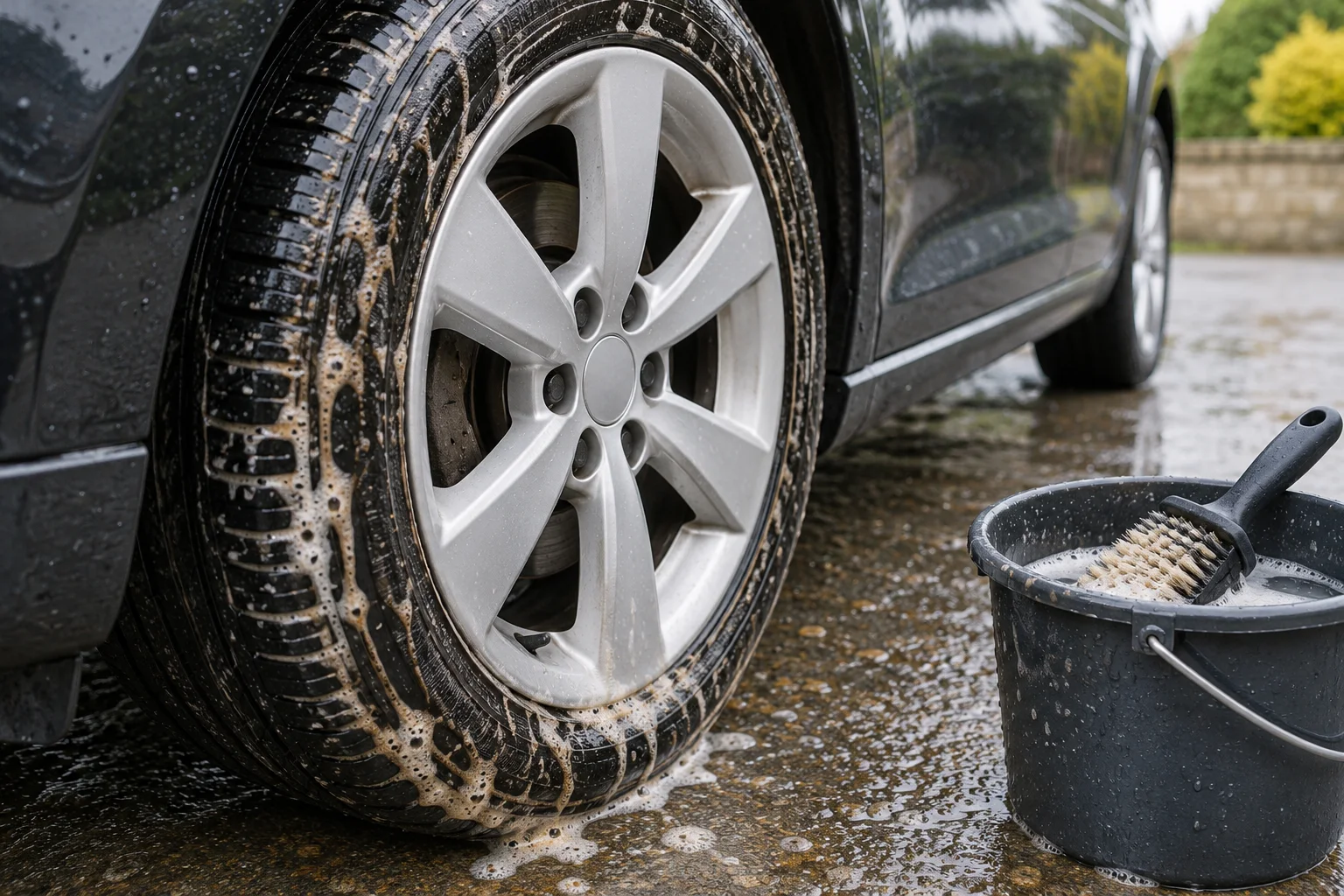
Begin with the tyre maker's care requirements
Cleaning a sidewall is a surface-care task, not a way to restore damaged rubber. Check the tyre maker's instructions before using a dedicated cleaner or adding a dressing afterwards. If those instructions call for a simpler wash or exclude a product type, follow them rather than a cleaner's broad claim about all rubber.
Michelin's sidewall guidance, for example, advises avoiding cleaning products, particularly silicone-containing products, and calls for attention to cuts, cracks and bulges. That is more restrictive than many detailing labels. The chemical options below are conditional choices for tyres whose care permits them; a clean, undressed sidewall is a valid result.
Inspect before scrubbing
With the car safely parked, look at the accessible sidewall for damage and anything beyond ordinary dirt. A cut, bulge or significant cracking needs professional tyre advice. Do not use dressing to conceal the appearance or keep scrubbing an affected area in pursuit of an even black finish.
You cannot see the entire tyre by walking around the car, and a cosmetic wash is not a roadworthiness inspection. If you suspect damage, address it through a tyre professional rather than deciding it is safe because the cleaned outer sidewall looks better.
Allow the wheel and tyre to cool. Prepare the rinse supply and keep the tyre brush separate from the wheel-face and bodywork tools. If using a pressure washer for the permitted rinse, follow the exact machine and vehicle restrictions, including its tyre-related limits.
Decide whether a dedicated tyre cleaner is appropriate
Where permitted, a tyre cleaner can remove old dressing and accumulated residue before a new optional finish. It should solve a preparation problem, not become a requirement to strip the rubber at every wash. Use the exact label method and the tyre maker's limits together.
GYEON Q²M TireCleaner is a dedicated option in a 500 ml spray. The selected listing specifies application to wet tyre rubber, agitation with a tyre brush and thorough rinsing without allowing it to dry. It is different from Tire Express dressing, despite the similar brand and bottle style.
For tyre-cleaning instructions that permit it
GYEON Q²M TireCleaner 500ml
A dedicated tyre and rubber cleaner intended to remove old dressing and accumulated contamination before any optional new finish. This is the 500ml spray, not Tire Express dressing.
- 500ml cleaner
- Removes old dressing
- Separate from Tire Express
Check tyre-maker care before using cleaning chemicals. Follow the selected label’s wet-sidewall, brush and thorough-rinse method; do not let it dry, and keep the tyre brush off wheel finishes.
Do not make the spray stronger or mix it with another cleaner. Follow its own instructions and restrict it to the permitted working area. Product compatibility with a coated rim does not authorise scrubbing that rim with the stiff tyre tool.
Use a rubber-only brush with controlled movements
A tyre brush has a different role from a soft face brush. The GYEON TireBrush uses stiff synthetic bristles and a chemical-resistant handle for rubber cleaning. Its rounded edges help handling, but the tool is intended for the tyre, not delicate wheel finishes.
For permitted rubber-sidewall scrubbing
GYEON Q²M TireBrush
A tyre-only brush with stiff synthetic bristles and a chemical-resistant handle. It is intended to work on rubber, rather than delicate wheel faces or bodywork.
- Stiff synthetic bristles
- Chemical-resistant handle
- Rubber-sidewall tool
Keep the bristles and handle away from the wheel finish and use controlled pressure. Follow tyre-maker care and inspect for damage instead of trying to scrub a cracked or cut sidewall back to a cosmetic finish.
Keep the brush and its handle clear of the rim edge. On a low-profile tyre, use smaller controlled movements rather than dragging the head across the whole wheel-and-tyre boundary. If the brush is too large for the available sidewall, choose a more manageable method instead of increasing pressure.
Do not use a wire brush, abrasive kitchen pad or an improvised solvent treatment to speed the job. The aim is to remove permitted surface contamination without adding damage. Keep your hands and working position controlled, with the protection specified by the product instructions.
A practical sidewall-cleaning sequence
- Identify the tyre's care requirements and inspect its visible condition. Resolve suspected damage before a cosmetic routine.
- Prepare the permitted wash or cleaner, a tyre-only tool and a ready rinse supply. Keep the wheel-face brush and paint mitt separate.
- Follow the cleaner's starting-surface directions. For the selected TireCleaner listing, begin with wet tyre rubber.
- Apply and agitate only as instructed, working within an area you can keep under control. Avoid brushing the rim finish or forcing tools into inaccessible spaces.
- Rinse thoroughly before product dries. Clear loosened residue from the permitted area rather than leaving it while treating other tyres.
- Inspect the result without immediately adding more chemical. Repeat only where needed and within the directions; stop if the surface or residue is uncertain.
- Dry as required for the next permitted step, or leave the clean tyre undressed. Put its tools aside before handling clean bodywork equipment.
Work one manageable tyre area at a time. Fetching a different brush or connecting the hose after the cleaner is already applied creates avoidable delay. Finish the chemical-and-rinse stage before assessing an optional dressing.
A dual-purpose bottle may avoid buying another cleaner
Autoglym's Custom Wheel Cleaner also has explicit tyre-wall instructions: application, brush agitation and a complete rinse. Where the tyre maker and the wheel finish permit it, that can be an alternative to a separate tyre bottle.
It is still an alkaline cleaner with its own restrictions. Its permission for tyre walls should not be transferred to Advanced All Wheel Cleaner, whose guidance separates that job. For split rims or restrictive wheel aftercare, the adjacent wheel may make the overall application unsuitable even where the rubber is the intended target.
A separate wheel-cleaner refill
Autoglym Custom Wheel Cleaner 500ml
An acid-free, alkaline cleaner for brake dust and road grime. Buying the individual 500ml spray is useful when wheel cleaner is the gap in an otherwise complete kit.
- 500ml spray
- Acid-free, alkaline
- Wheel finish check required
Work on cool wheels and rinse thoroughly. For split rims, Autoglym’s FAQ recommends Bodywork Shampoo instead. Check damaged, refurbished and specialist finishes with their supplier.
Choose one permitted route rather than applying both cleaners as a routine sequence. Buying a second bottle is useful only when its job and compatibility are clear. Our wheel-cleaner guide helps check the neighbouring finish and trim.
Do not use foam colour as the only stopping rule
GYEON describes repeating its cleaning step if needed until the foam is white. Treat that as part of its process guidance, not proof that every brown trace requires endless scrubbing or that white foam establishes the tyre's condition.
If repeated permitted cleaning still leaves an uneven colour, stop increasing chemical or force. Old products, ordinary residue and changes in the rubber's appearance need different assessment. A tyre professional or the tyre maker can advise where the cause is uncertain; another dressing layer cannot answer that question.
Separate cleaning from the optional finish
If a dressing is permitted, read its preparation carefully. Some sprays allow wet or dry rubber; the featured gels in our spray-versus-gel comparison require dry preparation. Clean does not automatically mean ready for every finishing product.
Keep any dressing off tread and braking surfaces, control excess and follow its settling instructions. If specks appear later, use the tyre-dressing sling checks to distinguish excess product, preparation and other contamination. If your tyre maker excludes the treatment, finish with the compatible wash instead. Clean and dry the tyre tool separately afterwards, using a clear wheel-tool storage routine.
Common questions
Do I need a dedicated tyre cleaner at every wash?
Not automatically. Follow the tyre maker’s care and use a dedicated product only where permitted and needed for the contamination or old dressing. Some tyre advice is more restrictive than detailing labels. A compatible basic wash and an undressed finish can be sufficient.
Can I use wheel cleaner on tyre sidewalls?
Only where the exact product and tyre maker permit it. Autoglym Custom Wheel Cleaner has explicit tyre-wall instructions, while Advanced All Wheel Cleaner separates that job. Permission for one formula does not apply to every wheel cleaner or adjacent finish.
Can I use the stiff tyre brush on the rim?
Keep it on the permitted rubber surface. The GYEON TireBrush is intended for tyres, rather than delicate wheel faces. Rounded edges do not establish that its stiff bristles are suitable for lacquer, gloss black paint or a machined face.
Should I keep scrubbing until every trace of brown foam disappears?
Follow the selected product’s repeat-if-needed instructions, but do not use foam colour as a guarantee of tyre condition or a reason for endless stronger treatment. Stop if repeated permitted cleaning leaves an uncertain result, and seek tyre-maker advice rather than escalating force.
Can dressing cover cracks or sidewall damage?
No. Dressing is cosmetic and cannot repair damaged rubber. Cuts, bulges or significant cracking need professional tyre advice. Do not treat an improved black appearance after washing or dressing as evidence that the tyre is safe.
Sources and product instructions
Follow the label and care instructions for the exact version and surface you own.
- GYEON Q²M TireCleaner: purpose and sidewall method
- GYEON Q²M TireBrush: stiff synthetic bristles for tyre rubber
- Autoglym Custom Wheel Cleaner: wheel and tyre directions, split-rim exception
- Michelin: sidewall damage and cleaning-product cautions
- Kärcher K 5 Power Control: model-specific pressure restrictions