
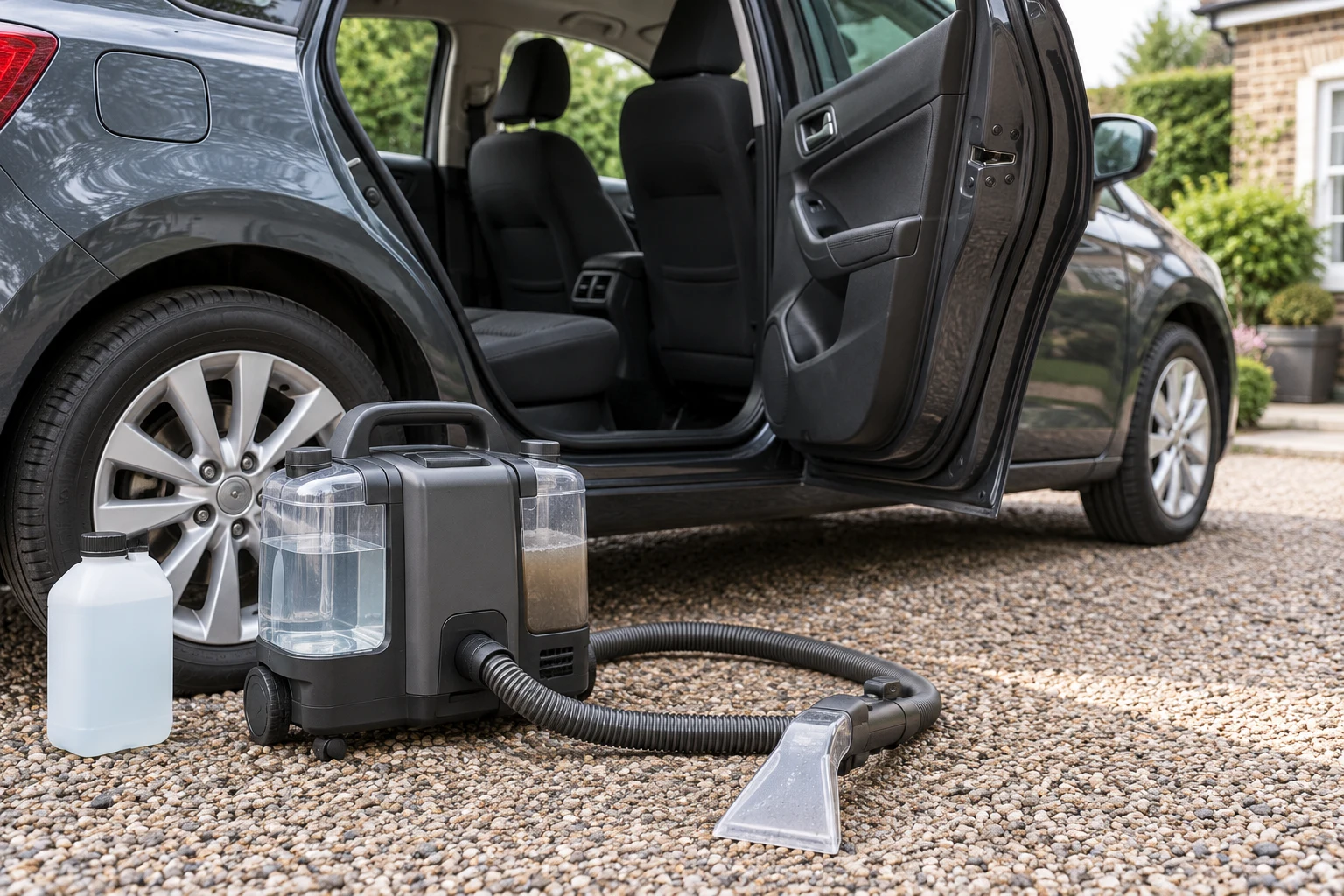
Establish whether the seats may be extracted
An upholstery extractor applies a permitted cleaning solution and recovers dirty liquid through a suitable hand tool. It can be useful for compatible textile seats, but it is not an automatic upgrade for every interior. Check both the covering and seat assembly before buying: heating, ventilation, occupancy sensors, seams, adhesives and airbag areas can restrict liquid cleaning.
If the vehicle permits only a controlled surface wipe, follow that method. A machine listing showing car seats does not override the handbook. Fabric-seat cleaning covers the lighter routine, while suede-like and synthetic-leather care need their own material checks.
The next question is the complete system: machine, suitable hand tool, correct detergent, dry pre-cleaning and a realistic drying plan. A low purchase price or a larger tank is not enough if the nozzle is awkward in the seat, the required formula is unclear or the car must be used before it can dry.
Two extractor systems and their detergents
| Feature | Kärcher SE 3 Compact Home | BISSELL SpotClean Pro 1558E |
|---|---|---|
| Role | Portable spray extraction | Portable spray extraction |
| Clean tank | 1.7L | 2.8L |
| Tools | Upholstery and crevice spray-extraction nozzles in the selected Home pack | Hose and upholstery/stain-tool system; check the exact pack |
| Detergent route | Compatible Kärcher SE detergent such as RM 519 | Formula family specified by the actual 1558E instructions |
| Dry debris | Separate dry vacuum first | Separate dry vacuum first |
| Main ownership question | Compact setup, hose access and system flushing | Tank size, hand-tool access and correct Pro formula |
Kärcher SE 3 Compact Home with RM 519
The selected UK Home system uses separate 1.7L fresh and 2.9L waste-water tanks with a 1.9m combined spray/suction hose. Its upholstery and crevice extraction nozzles give different shapes for compatible accessible areas. It is the mains model, separate from an SE 3-18 battery machine or a larger floor-cleaning bundle.
For a compact upholstery spray-extraction system
Kärcher SE 3 Compact Home
A corded spray extractor with separate 1.7L fresh and 2.9L waste-water tanks, a 1.9m spray/suction hose and upholstery and crevice extraction nozzles. The UK Home pack lists a 100ml RM 519 starter supply.
- 1.7L fresh / 2.9L waste tanks
- 1.9m spray/suction hose
- Dry vacuum needed separately
The machine has no dry-vacuum function. Confirm seat approval before wet cleaning; follow the received machine, detergent and nozzle instructions. Do not confuse this mains model with the SE 3-18 battery version or assume larger floor tools are included.
The machine has no dry-vacuum function. A suction-only pass during extraction means recovering liquid without spraying more; it does not turn the extractor into a crumb vacuum. Keep dry pre-cleaning in the equipment plan, and check the manual’s after-use system-cleaning process before deciding where it will be stored.
RM 519 is a compatible Kärcher extraction-detergent option. The selected one-litre bottle is separate from the starter quantity in the Home pack. Follow the received detergent and machine instructions together, including filling limits; do not copy a hand-spray interior-cleaner dilution into the tank.
For the compatible Kärcher SE extraction system
Kärcher RM 519 Carpet Cleaner 1L
A one-litre concentrate listed by Kärcher for compatible SE spray-extraction cleaners and suitable textile surfaces. It is a machine detergent, separate from an ordinary hand-applied interior spray.
- 1L concentrate
- RM 519 / 6.295-771.0
- Dose for the approved SE system
Use the exact bottle and machine dosing directions together and confirm the seat covering and assembly permit extraction. Do not use neat, substitute into the BISSELL system automatically or assume low residual moisture means a dry cushion.
BISSELL SpotClean Pro 1558E with its specified formula family
The 1558E provides a 2.8L clean tank and a portable hose-and-hand-tool format. Consider where the machine will stand and how the tool will meet the seat, rather than assuming the larger clean tank guarantees better cleaning or a drier cushion. The selected model is distinct from ProHeat and other SpotClean machines with similar names.
For a portable spray extractor with a 2.8L clean tank
BISSELL SpotClean Pro 1558E
A mains-powered portable spot and upholstery cleaner with a 2.8L clean tank, hose and hand-tool system. It applies a permitted cleaning solution and recovers dirty liquid; loose dry debris must be vacuumed separately first.
- Model 1558E
- 2.8L clean tank
- Separate dry pickup first
Use the formula family and filling directions specified for the actual 1558E. Its manual differs from some smaller SpotClean models; generic bundles and similarly named formulas are not compatibility proof. Seat, temperature and drying limits still apply.
Formula compatibility needs particular attention. The UK 1558E guide lists BISSELL 2X formula families, including Wash & Protect, rather than a universal recipe for all SpotClean machines. The selected Wash & Protect Pro 1089N 1.5L is a matching formula-family option. Use the directions supplied with the actual machine and bottle to confirm concentration and dosing; an online bundle alone does not establish compatibility.
For the specified SpotClean Pro formula family
BISSELL Wash & Protect Pro 1.5L
A 1.5L concentrated extraction formula. BISSELL’s 1558-series instructions specify the Wash & Protect full-size formula family; this selected bottle is 1089N, not the 1084 Spot & Stain formula.
- 1.5L bottle
- Formula 1089N
- Match the 1558E instructions
Follow the actual machine fill marks and received formula directions. Do not transfer a portable-SpotClean recipe to the Pro or use the bottle in another brand merely because it is described as carpet shampoo. Confirm upholstery approval.
Do not assume every BISSELL formula, an ordinary hand-cleaning spray or the Kärcher detergent is interchangeable. Product names such as “Spot”, “Pro”, “Oxy” and “Pet” identify different formulas and ranges. A larger bottle with similar branding is not necessarily the same solution at a different size.
Model fills without treating tank size as cleaning performance
The UK SE 3 Compact Home specification, 1.081-534.0, lists a 1.7-litre fresh tank. The selected BISSELL 1558E listing linked in its card above states 2.8 litres. Those nominal capacities can support a planning calculation, but they are not permission to pour that amount of finished mixture into either machine.
| Total solution required Assumed | SE 3 Compact, nominal 1.7L Calculated fills / refills | SpotClean Pro, nominal 2.8L Calculated fills / refills |
|---|---|---|
| 4 litres | 3 fills / 2 refills | 2 fills / 1 refill |
| 6 litres | 4 fills / 3 refills | 3 fills / 2 refills |
| 8 litres | 5 fills / 4 refills | 3 fills / 2 refills |
Method: fills = assumed required ml ÷ nominal tank ml, rounded up; refills = fills minus the initial fill. For the assumed 6-litre total, the 1.7-litre model gives three nominal full fills plus a final 0.9 litre; the 2.8-litre model gives two nominal full fills plus a final 0.4 litre. These are ideal arithmetic arrangements, not filling instructions.
Use the actual machine’s permitted water/formula sequence and fill marks. BISSELL’s UK 1558E guide, for example, describes a water line followed by formula addition; it does not establish that a headline tank figure is a universal ready-mix fill. The received 1558E guide and matching formula control its actual use; follow its specific addition sequence rather than treating nominal capacity as a dosing recipe. A lower usable fill, retained solution or separate rinsing/flushing increases the number of fills beyond this model.
The assumed 4, 6 and 8 litres are not recommendations to apply that much solution to seats. Neither tank size nor this table establishes seats per fill, safe wetting, water recovery or drying time. Stop to empty the waste tank at its own limit, regardless of the fresh tank. Download the six nominal-capacity scenarios and assumptions (CSV).
Allow space for the machine and access around it
Kärcher’s UK Home dimensions are 450 × 225 × 260mm. The selected 1558E Amazon product summary gives 25cm depth × 36cm width × 35.6cm height. For the calculation, depth is treated as length; all values below use length × width × height. The SE 3 listing’s part field and dimensional summary should be matched to the received model, rather than relying on the short SE 3 title alone.
| Machine | Published / listed dimensions L × W × H | Flat rectangle Calculated | Example space Calculated with clearance |
|---|---|---|---|
| Kärcher SE 3 Compact | 45 × 22.5 × 26cm | 1,012.5cm² | 55 × 32.5 × 31cm |
| BISSELL SpotClean Pro | 25 × 36 × 35.6cm | 900cm² | 35 × 46 × 40.6cm |
Method: nominal flat rectangle = length × width. The example space adds an assumed 5cm on each of the four horizontal sides and 5cm above the machine: add 10cm to length and width, and 5cm to height. This is a planning allowance, not the maker’s required clearance or a guarantee of cupboard fit.
The BISSELL rectangle is smaller under those listed dimensions, while the Kärcher is lower. Neither observation settles storage by itself. Hoses, wrapped cables, extra tools, handles, door openings and the way you lift or remove a tank can need more room. Do not force a hose around a tighter bend to make the rectangle fit. Clean and dry the system before storage; the compact-kit guide covers keeping wet equipment separate from clean dry supplies.
Download the dimension inputs, source URLs, footprints and clearance model (CSV). The Amazon dimension source is identified separately from the manufacturer specification; the figures are nominal, not measurements of a stored setup.
Price the complete system around equipment you already own
Both routes need suitable dry pre-cleaning. Keep an adequate existing vacuum in the plan at zero new purchase cost; add one only if it is missing. Also include the actual permitted hand tools, compatible detergent, delivery and a workable cleanup arrangement.
| Situation | SE 3 route Calculated purchase total | 1558E route Calculated purchase total |
|---|---|---|
| Suitable dry vacuum already owned | £156.00 | £188.00 |
| Add a hypothetical £55 dry vacuum | £211.00 | £243.00 |
The assumed SE 3 inputs are £140 for the machine, £12 for a full compatible formula bottle, £0 extra tools and £4 delivery. The assumed 1558E inputs are £170, £18, £0 and £0 respectively. Totals are therefore £156 and £188. If both need the same hypothetical £55 dry vacuum, totals rise to £211 and £243; the £32 difference remains unchanged.
Method: setup total = machine + needed formula + missing tools + dry-precleaning purchase + delivery. Suitable included tools are assumed in these examples, and no value is deducted for an unspecified sample bottle. If a sample covers your actual first task or a suitable formula is already owned, adjust the purchase rather than automatically buying another full bottle.
These prices are deliberately hypothetical and do not rank performance or predict running costs. Seats, stains, compatible methods and hand-tool access still decide whether either system is appropriate. No fixed drying time, number of cleanings per machine or detergent dose is invented from tank size. Download all budget inputs and calculated totals (CSV), and use the complete-basket method when comparing actual offers.
Compare hand-tool access before tank capacity
A car seat is smaller and more shaped than a room carpet. Check whether the included tool can make suitable contact on the approved covering without catching piping, seams or controls. A broad floor head may be useful in a house but awkward between a seat bolster and centre console.
Plan hose access from a stable machine position. It should not need to sit on the seat, balance on a sill or hang from a strained hose. Keep the hose and cable route clear enough that moving around the car does not pull the machine over or drag a dirty hose across clean upholstery.
Check replacement and optional tools by exact model, including both the suction and solution connections. A tool that appears to fit the hose diameter may still lack the correct spray connection or locking mechanism. Do not force a borrowed nozzle onto the machine.
Keep the three cleaning roles distinct
Dry pickup removes crumbs and loose grit before any solution is applied. Liquid pickup recovers permitted moisture with an appropriately configured wet-capable system. Spray extraction combines controlled solution delivery and recovery according to the extractor’s method. These are related jobs, but they are not interchangeable labels.
The two extractors here need separate dry pre-cleaning. If you only need ordinary debris removal, start with the car-vacuum guide. If the task is liquid recovery rather than solution spraying, compare wet-and-dry vacuums. Buying the machine for the actual task avoids building an unnecessarily complicated kit.
Detergent, temperature and drying affect the decision
Read the full filling process before purchase. Some machines use a specified dose; others have formula and water marks, and different concentrations can change the instructions. Use the limits on the actual machine and formula, with the vehicle’s narrower surface limits taking priority. A machine’s maximum water temperature is not a target temperature for every seat.
Low-foam machine detergent is not a reason to add washing-up liquid, solvent or an all-purpose cleaner. Too much foam or an unsuitable chemical can interfere with the recovery system. Do not mix formulas to improve scent or stain removal.
Drying needs space and time as well as suction. Arrange secure ventilation in suitable weather and keep the seat unused until properly dry. There is no universal short drying promise from tank size, motor power or the appearance of the dirty-water tank. Dark recovered water is not a cleanliness score, and water leaving the nozzle does not prove the padding underneath is dry.
Include cleanup in the ownership cost
After each use, the waste tank, tools and hose need the prescribed cleaning and drying. Kärcher’s system-flushing process and BISSELL’s tank/tool care are part of the work, not optional maintenance for later. Check that you have an appropriate place for it before buying a machine that will otherwise be stored damp.
For occasional work, consider whether a professional clean of suitable upholstery is more manageable than owning and maintaining the complete system. If you do buy, choose around material approval, usable tools and a routine you can finish. The extraction how-to sets out the preparation, recovery and drying decisions before the first wet pass.
Common questions
Can an extractor replace my dry car vacuum?
Not the two portable models selected here. Remove loose dry debris with a suitable dry vacuum first. Suction-only recovery on an extractor means recovering liquid without spraying more, not dry debris pickup.
Does a larger clean tank mean better cleaning?
A nominal tank figure helps model possible refill counts, but it does not establish the permitted finished-mixture fill, cleaning performance or seats per tank. Follow the actual fill marks, formula sequence and waste-tank limit; retained liquid and system flushing can add fills beyond an ideal calculation.
Can I use any carpet shampoo in these extractors?
No. Use the formula approved for the exact machine. Kärcher RM 519 and the specified BISSELL 1558E formula family are separate choices; ordinary interior sprays are not automatic tank detergents.
Are heated or ventilated seats suitable for extraction?
Only if the exact vehicle and seat instructions permit the method. Approval of the textile alone does not settle the sensors, heating, ventilation, seams and other parts underneath.
How quickly will extracted seats dry?
There is no universal time. Liquid applied, covering, padding, recovery and ventilation all matter. Arrange enough unused time and confirm proper drying rather than relying on a quick-dry claim.
Sources and product instructions
Follow the label and care instructions for the exact version and surface you own.
- Kärcher SE 3 Compact Home UK 1.081-534.0: tanks, nozzles and RM 519
- Kärcher SE 3 Compact Home manual: no dry pickup, extraction and system cleaning
- Kärcher RM 519 1L: product identity and compatible SE machines
- BISSELL SpotClean Pro 1558E user guide: preparation, extraction and machine care
- BISSELL Wash & Protect Pro 1089N 1.5L: formula identity