
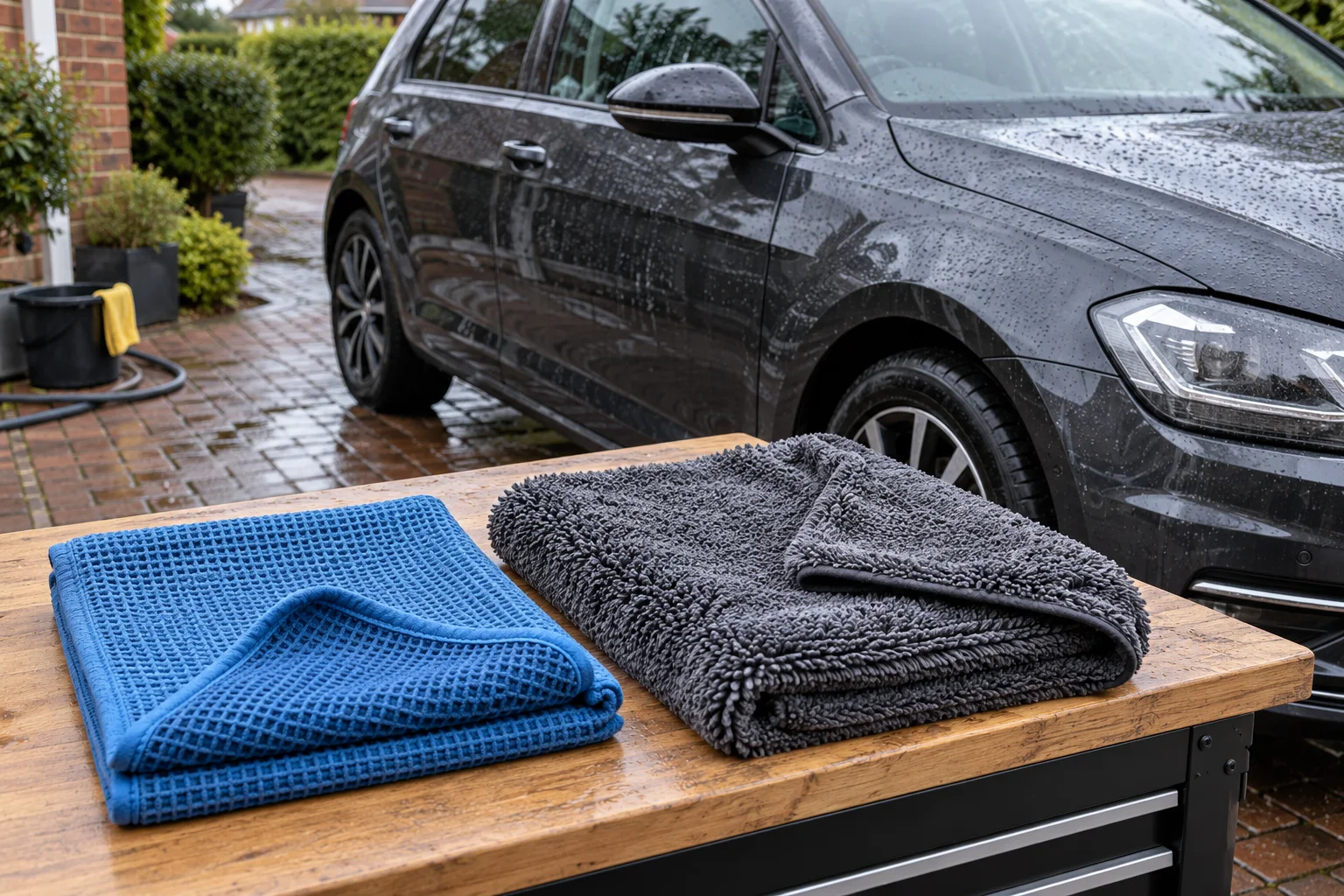
Choose a car-drying towel by its size, construction and care requirements, then ask whether you can control it comfortably around your car. GSM describes fabric mass per square metre. It does not independently tell you how much water a towel will collect, how quickly it dries between uses or how easy it is to handle.
A dedicated towel removes rinse water after the car is clean. It is not the same job as buffing wax, removing polish or wiping tyre dressing. Keep those tasks separate even if the cloths are all sold as microfibre.
Size comes before an impressive density figure
A longer towel gives you more working area but also more fabric to keep clear of the driveway. On a compact car, a manageable medium towel and a smaller clean finishing cloth can be easier than an oversized textile. On a large vehicle, a second clean drying towel may be more useful than expecting one saturated towel to do everything.
Check the dimensions of the exact variant. Fold the stated size in your mind and consider how much fabric you can support while reaching lower doors or curved panels. A towel that touches the ground must leave the drying routine until cleaned, however expensive it was.
Compare towel area and estimated fabric mass
A 1200gsm towel is not automatically a larger towel. We put the three selected sizes on the same basis below: the flat rectangle counted once, followed by an approximate fabric mass where the maker supplies GSM. The final column shows the footprint after folding once along each dimension, useful when considering what you can support in your hands or lay on a shelf.
| Towel and published inputs | Flat area Calculated | Fabric mass Estimated | Folded footprint Calculated |
|---|---|---|---|
| Gtechniq MF2 60 × 90cm; 450gsm | 0.54m² | About 243g | 30 × 45cm |
| Autoglym Ultra-Soft 80 × 60cm; GSM not stated | 0.48m² | Not calculated | 40 × 30cm |
| Meguiar’s Duo Twist 50 × 90cm; 1200gsm | 0.45m² | About 540g | 25 × 45cm |
The MF2 has 20% more flat area than the Duo Twist (0.54 versus 0.45m²), while the Duo Twist has about 2.22 times the calculated fabric mass (540 versus 243g). Those are different buying considerations: the larger rectangle is not the denser textile. Neither result establishes which holds more water or dries a panel faster.
Where the numbers come from
- Gtechniq’s MF2 specification supplies 60 × 90cm and 450gsm.
- Autoglym’s 80 × 60cm size comes from the selected Amazon listing linked in its product card below. Autoglym’s own page identifies twisted-loop construction but supplies no numerical GSM for this comparison, so its mass stays uncalculated.
- Meguiar’s X210400EU specification supplies 50 × 90cm and 1200gsm. Match that model rather than a different Meguiar’s towel.
Method: flat area in m² = width in cm × length in cm ÷ 10,000. Estimated fabric mass in grams = area × GSM. We count the rectangle once, not once per side. The mass is derived from nominal textile specifications; edging, labels, construction details and manufacturing tolerances mean the complete towel can differ. It is not a packaged-item weight.
Folding each dimension in half reduces the footprint to a quarter; it does not remove fabric, reduce its mass or create extra total area. The folded sizes exclude thickness, edge bulges and shrinkage, so allow clearance rather than treating them as exact storage-box dimensions. Keep a towel fully dry before enclosing it, as explained in our compact-kit guide.
Download the specification inputs, calculations and source links (CSV). Missing GSM and mass values are blank rather than zero; calculated numbers retain up to 12 significant digits.
Three drying towels with useful differences
Match the model and size in the comparison to the exact Amazon option. The product cards explain where each construction fits; the calculations above describe nominal specifications rather than a performance ranking.
Gtechniq MF2: a less dense large towel
The MF2 provides a large surface at a published 450gsm. That is a useful specification when you prefer not to start with a very dense towel. It is not evidence that it will outperform or underperform another construction. Check its wash instructions and use a light touch on a properly rinsed car.
For drying clean bodywork
Gtechniq MF2 Drying Towel
A 60 × 90cm, 450gsm microfibre towel intended for car drying. Its larger area gives you a dedicated drying tool instead of relying on a small polish-buffing cloth.
- 60 × 90cm
- 450gsm microfibre
- Dedicated drying towel
Use a light touch on clean bodywork after completing the chosen wash method. Inspect for grit, wash after use and follow the textile’s care label. A drying towel cannot make a dirty surface safe to wipe.
Autoglym Ultra-Soft: a broad twisted-loop option
The selected listing is the 80 × 60cm version. Autoglym publishes care directions covering separate washing and tumble drying, which is useful if you want to know how the towel will fit your laundry routine before buying it. Keep the edge supported near lower panels.
For an 80 × 60cm twisted-loop towel
Autoglym Ultra-Soft Drying Towel
A dedicated twisted-loop drying towel, listed at 80 × 60cm. Its shape offers a broad drying area without moving up to an especially long towel.
- 80 × 60cm
- Twisted-loop construction
- Dedicated car-drying towel
Wash separately before use and follow the care label. Current manufacturer directions allow machine washing up to 40°C without softener and recommend tumble drying; check the supplied drying setting.
Meguiar’s Duo Twist: a dense, longer rectangle
The Duo Twist’s 1200gsm figure describes a dense textile, not an independent capacity measurement. Its 90cm length may suit someone who likes folding a towel into manageable working sections. Consider wet handling and the drying space available at home as well as the softness of a new towel.
For a dense 50 × 90cm drying towel
Meguiar’s Duo Twist Drying Towel
A 1200gsm duo-twist microfibre towel, with a longer rectangular shape. Consider it if you want a dense textile and can comfortably control that length around lower panels.
- 50 × 90cm
- 1200gsm microfibre
- 87% polyester / 13% polyamide
Follow its own wash and drying label. Density is not an independent absorbency test and does not guarantee one-towel drying for every car. Keep the trailing edge clear of the ground.
Calculate the price per square metre
Once the construction, handling and care suit you, price per square metre can show how much fabric area a purchase buys. Use the delivered price for the exact towel and pack count. This is an area comparison, not an absorbency or quality score.
Delivered cost per m² = delivered pack price ÷ (number of identical towels × one towel’s flat area). For single towels, the delivered price giving the same cost per m² as an MF2 is: MF2 delivered price × candidate area ÷ 0.54.
| Towel | Price at equal cost per m² As a percentage of MF2 price | Hypothetical delivered price |
|---|---|---|
| Gtechniq MF2 | 100% | £18.00 |
| Autoglym Ultra-Soft | 88.89% | £16.00 |
| Meguiar’s Duo Twist | 83.33% | £15.00 |
These are calculated examples, not Amazon offers. If an MF2 cost £18 delivered, a single Ultra-Soft at £16 or Duo Twist at £15 would have the same £33.33 per m² when rounded to pennies. Below its threshold, a candidate has lower cost per flat area; above it, higher. Percentages are rounded for display and the threshold uses unrounded areas. A lower area cost does not establish better drying value across different constructions.
One towel or a main towel and backup?
Two MF2s provide 1.08m² of flat textile and about 486g of calculated fabric mass, compared with 0.45m² and about 540g for one Duo Twist. At the hypothetical £18 per MF2, buying two would cost £36. This shows why towel count, density and total area need separate attention: two pieces give you a clean replacement if one becomes saturated or touches the ground, but the figures do not establish their combined water capacity.
A backup is also only useful if it is clean, dry and available. If you already own a suitable one, do not add an unnecessary second purchase to the comparison. Two separate towels mean two pieces to launder and store; neither mass nor area predicts drying time or laundry energy use. Our complete-basket comparison explains how to price only genuine gaps.
The comparison CSV includes the areas, price multipliers and hypothetical inputs so you can substitute your own delivered prices. For mixed-size packs, add the individual areas instead of multiplying by one assumed size. Compare pack quantities consistently and keep wheel or chemical-use cloths outside the bodywork-drying allocation.
What GSM, weave and fibre content can tell you
GSM is one useful comparison when the products are otherwise similar. Across different constructions, the shape of the loops, finishing, size and condition also matter. The calculated mass above makes density and total fabric quantity easier to distinguish.
Waffle and twisted-loop describe different textile structures. A waffle texture has a visibly patterned surface; twisted-loop towels use loops designed for collecting water. Neither label excuses poor cleaning or rubbing a contaminated panel. Use the specified construction of the exact model rather than choosing by a general photograph.
You do not need to buy a towel on the strength of a claim that it dries a whole car. Vehicle size, remaining rinse water, conditions and technique all change the job. A second clean towel is a practical fallback when the first becomes saturated.
Read the care method before you choose
Check whether the care method fits your home before choosing. A large towel needs enough space to dry fully; footprint and GSM do not tell you how long that will take. Use the supplied care label for your exact towel and detergent rather than combining the easiest parts of different instructions.
| Towel | Published care guidance | Buying implication |
|---|---|---|
| Gtechniq MF2 | Non-biological detergent; no bleach or softener. Natural drying or low tumble drying. Regional pages give different maximum wash temperatures. | Natural drying is an expressly listed option. Use the maximum on the received label. |
| Autoglym Ultra-Soft | Wash before first use and separately, up to 40°C; no softener. Tumble drying recommended. | Allow separate-wash capacity and follow the supplied drying setting; the cited page does not specify a dryer temperature. |
| Meguiar’s Duo Twist | The cited UK specification page supplies no washing temperature or drying programme. | Use its supplied care label; the MF2 or Ultra-Soft settings do not establish the Duo Twist’s limits. |
Gtechniq’s global MF2 page gives a maximum of 40°C; its UK MF2 page gives 50°C. That regional difference is a reason to follow the received label, not to raise a towel labelled 40°C to 50°C. Autoglym’s own directions provide the Ultra-Soft instructions in the table. Do not infer a missing GSM from a retailer’s packaged weight, or a missing care limit from a similar-looking towel.
After use, inspect for grit, keep the towel away from wheel cloths and let it dry fully before storage. A towel that leaves lint or feels contaminated deserves investigation before another pass over the bodywork. Follow the drying-towel washing guide for detergent selection and task separation.
Buy around your wash and finishing routine
For a normal shampoo rinse, the drying towel is the next tool. If you choose a wet-applied wax, its instructions may call for separate spreading and buffing cloths while the car is still wet. A dry-panel finishing spray has a different starting point again.
Do not buy a towel expecting it to remove persistent mineral deposits. Drying promptly helps prevent rinse water being left to evaporate, but an established water mark is a separate cleaning problem. Our water-spot guide explains the next steps without treating a towel as a corrective tool.
A practical buying checklist
- Match the towel dimensions to what you can hold clear of the ground.
- Compare construction and care alongside GSM.
- Keep a clean backup available for a large car or finishing drips.
- Reserve the towel for drying rather than mixed chemical tasks.
- Replace or reassign a towel if trapped grit, damage or hardened residue makes it unsuitable for paint.
If the towel you own is clean, effective and manageable, a higher GSM is not automatically an upgrade. Improve rinsing and handling first. See how to dry a car for the actual sequence and kit care for storage and separation.
Protect the towel’s working surface
Use drying-towel washing for the actual detergent and temperature limits. Keep textiles separated by task so wax or wheel residues do not migrate into the drying routine.
Common questions
What GSM should a car-drying towel be?
There is no single necessary figure for every car. GSM means fabric mass per square metre, not total towel weight or water capacity. Using published dimensions, the 450gsm MF2 has about 243g of calculated fabric mass and the smaller 1200gsm Duo Twist about 540g. Compare construction, handling and care alongside those figures.
Will one towel dry the whole car?
It depends on the towel, remaining water, vehicle size and conditions. A manufacturer’s whole-car claim is not a guarantee for your wash. Keep a second clean towel available rather than pressing harder with a saturated first towel.
Can I use a small polishing cloth for drying?
A small clean cloth may handle a few drips, but it is not a direct replacement for a towel intended to collect rinse water across the car. Finishing cloths may also contain product residues. Reserve separate textiles for drying and chemical application.
Should I use fabric softener on microfibre?
Follow the towel’s specific care instructions. The selected MF2 and Autoglym Ultra-Soft guidance excludes fabric softener. Do not assume that a household laundry routine or a detergent already containing softener is suitable for detailing textiles.
Is a heavier towel always better?
No. Higher GSM does not automatically mean more flat area, better absorbency or easier handling. Our size comparison separates nominal fabric area from estimated mass. Choose dimensions you can support, follow the exact care label and keep a clean backup available when needed.
Sources and product instructions
Follow the label and care instructions for the exact version and surface you own.