
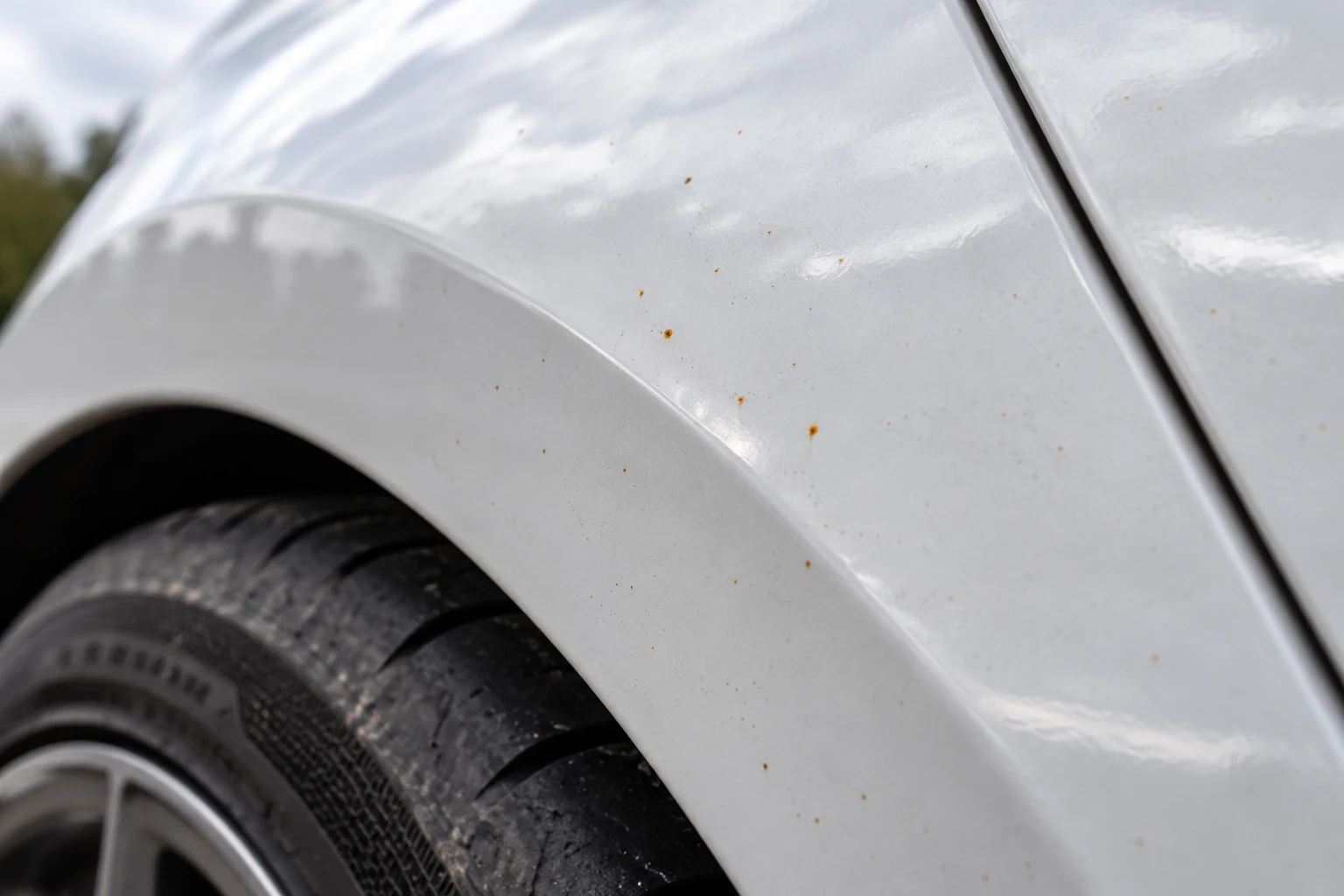
Identify a bodywork-cleaning job, not a repair
Iron-bearing airborne particles can settle on paint and remain after an ordinary wash. Fine orange-brown specks may be particularly noticeable on pale panels. That observation can justify checking for fallout, but it does not prove that every orange mark is a removable particle.
Inspect clean paint before treating it. A mark beside a chip, bubbling lacquer, exposed metal or a damaged repair needs a different assessment from a surface deposit on sound paint. Iron remover cannot rebuild a paint layer or establish that corrosion has been repaired.
Choose a product approved for the actual bodywork and finish. A wheel-cleaner label, colour-changing formula or pH description alone does not establish paint suitability. Keep the wheel-cleaner comparison for that separate selection problem.
Step 1: wash and inspect the paint
Remove loose dirt through the compatible routine before judging the remaining contamination. Keep wheel tools separate and avoid feeling gritty paint aggressively. Where a clean-surface check is permitted, use very light contact rather than repeatedly rubbing a rough patch.
Check the finish history: ordinary clear-coated paint, matt/satin paint, a wrap, film, existing coating and a repaired panel can have different restrictions. If a finish supplier requires a specific maintenance system, reconcile that with the cleaner instructions before use.
Work on suitable cool panels with the required rinse access ready. If sun, wind or temperature make drying difficult to prevent, change the conditions or postpone treatment. Do not extend dwell to compensate for an unsuitable setting.
| Observation | Appropriate decision | What it does not establish |
|---|---|---|
| Fine suspected metallic deposits on sound clean paint | Check a suitable bodywork fallout remover | That every visible speck has the same cause |
| Dark sticky raised spots | Investigate tar or another deposit | That stronger iron reaction will dissolve tar |
| Rust associated with a chip or lifting paint | Arrange bodywork assessment | That a colour-changing cleaner repairs corrosion |
| Paint feels acceptable after treatment | Proceed with the next suitable finishing step if needed | That clay is compulsory after every chemical treatment |
Step 2: follow Korrosol’s reaction-and-rinse method
Bilt-Hamber Korrosol is intended for metallic contamination on compatible painted and lacquered bodywork. The maker lists a trigger for the one-litre format; confirm the supplied sprayer and closure with the exact pack. Its instructions require cool surfaces and a discreet compatibility test, followed by treatment within its temperature-dependent reaction method.
Keep the actual product instructions available instead of choosing a generic five-minute timer for every fallout cleaner. The reaction may develop at different rates according to conditions. Complete the prescribed removal while the process remains controlled.
For metallic fallout on compatible bodywork
Bilt-Hamber Korrosol 1L
A bodywork fallout remover in a one-litre bottle. Its iron reaction allows loosened contamination to be rinsed away before deciding whether any mechanical decontamination is needed. Confirm the supplied sprayer and closure with the exact pack.
- 1L bottle
- Bodywork fallout remover
- Product-specific reaction method
Test on cool suitable paint and follow the temperature-dependent reaction instructions. Exclude chrome-plated plastic, chrome plastic and chrome films. It is not a general rust-repair or all-contaminant cleaner.
Korrosol excludes chrome-plated plastic, chrome plastic and chrome films because conductive surface material can be affected. Check badges, decorative pieces and adjacent finishes before application. Manufacturer guidance about brushing flash corrosion on non-painted material should not be transferred to rubbing painted panels.
Step 3: use Magma’s selected pack instructions separately
Autoglym Magma 500ml has a defined wash-first method: shampoo, remove excess water and then treat suitable cool surfaces. Its instructions include the specified reaction interval, permitted damp soft-tool agitation and a thorough rinse.
The selected 500ml pack matters because the maker presents different instructions for another pack size. Read the version you own rather than copying a method solely from the shared Magma name. Keep the soft bodywork tool separate from any wheel agitation equipment.
For a permitted iron-removal stage
Autoglym Magma 500ml
A pH-neutral, colour-changing iron fallout remover for suitable clear-coated surfaces and wheels. Its instructed preparation includes shampooing first and removing excess water.
- 500ml spray
- Targets iron particles
- Clear-coat restriction
Not suitable for non-clear-coated surfaces; Autoglym also excludes wrapped vehicles. Follow the 500ml pack’s 3–5-minute method and rinse fully. Broad surface claims do not override these exclusions.
Magma excludes non-clear-coated surfaces and wrapped vehicles in its guidance. A broad paint, trim or exterior-surface statement does not cancel those narrower restrictions. Where finish approval is unclear, choose advice before chemical treatment.
Step 4: observe the process without chasing colour
A red or purple reaction can be useful evidence that the product is interacting with iron-bearing contamination. It is not a calibrated score, a reason to keep the chemical on longer, or proof that the entire panel is compatible.
Little visible colour does not automatically mean a higher dose or stronger product is needed. Check the contamination, preparation and application first. Likewise, a dramatic reaction does not show that tar, mineral deposits, wax residue or other contaminants have been removed.
Follow any prescribed agitation with the exact suitable tool and light controlled contact. Some methods include it; others emphasise spray and rinse. Do not turn a product-specific sponge step into a universal instruction to scrub every treated panel.
Step 5: rinse completely and reassess
Complete the remover’s rinse method with suitable clean water. Use pressure-washer technique only within the vehicle and equipment guidance; a chemical reaction does not justify a close aggressive jet around paint edges or damaged material.
Do not apply a second cleaner over the first. If another permitted treatment is needed, finish and remove the first stage before preparing the next. Separate product claims cannot establish a compatible mixture.
Inspect once the required cleanup and suitable drying are complete. If the suspected deposit remains, check whether repeat treatment is supported and whether the diagnosis still makes sense. Persistent staining or damage needs assessment, not indefinite chemical dwell.
Decide whether anything else is needed
A clean surface may be ready for compatible protection without clay or polish. If suitable bonded contamination remains, assess the least intrusive permitted process. Clay-bar use explains lubrication, inspection and marring risk rather than treating mechanical decontamination as a compulsory finishing ritual.
Check the existing coating’s guidance before adding wax or sealant. Water behaviour alone cannot measure the protective layer or prove it has been removed. Use the actual product history and maintenance requirements to select the next step.
Clean up without transferring contamination
If bonded contamination remains and the finish permits mechanical treatment, compare clay bars and clay mitts before choosing a tool. Do not add clay merely because an iron-remover stage has finished.
Remove product residue from tools by their permitted method and keep chemical-use textiles separate from ordinary drying and glass cloths. Follow the label for handling, storage and disposal; do not put an unlabelled mixture back on the shelf.
Reassess at a future ordinary wash rather than adopting an unsupported frequent fallout schedule. The purpose is to address identified contamination on suitable paint, with controlled chemical contact and complete removal.
Common questions
Are orange specks on white paint always iron fallout?
No. Appearance alone is not a complete diagnosis. Deposits, staining and corrosion associated with damaged paint can look similar. Wash and inspect first, and seek assessment where a mark is connected to a chip, bubbling or failing finish.
Does the purple reaction mean the car is completely clean?
No. Colour change indicates a reaction with suitable contamination, not removal of every kind of dirt or proof of surface compatibility. Complete the instructed rinse and inspect the actual finish afterwards.
Should I use iron remover before or after washing?
Follow the selected product’s instructions. Washing first removes loose dirt and supports inspection; the featured Magma 500ml method explicitly requires shampooing and removing excess water. Different products can have different starting conditions.
Can iron remover fix rust beneath chipped paint?
Do not treat corrosion beneath damaged paint as an ordinary fallout-cleaning task. A bodywork assessment may be needed. A product’s ability to react with iron does not replace missing paint or establish a durable repair.
Do I have to clay after iron removal?
No. Rinse, inspect and decide whether suitable bonded contamination remains. Clay adds mechanical contact and possible marring. If the paint is acceptably clean for its next permitted step, an extra clay stage may be unnecessary.
Sources and product instructions
Follow the label and care instructions for the exact version and surface you own.