
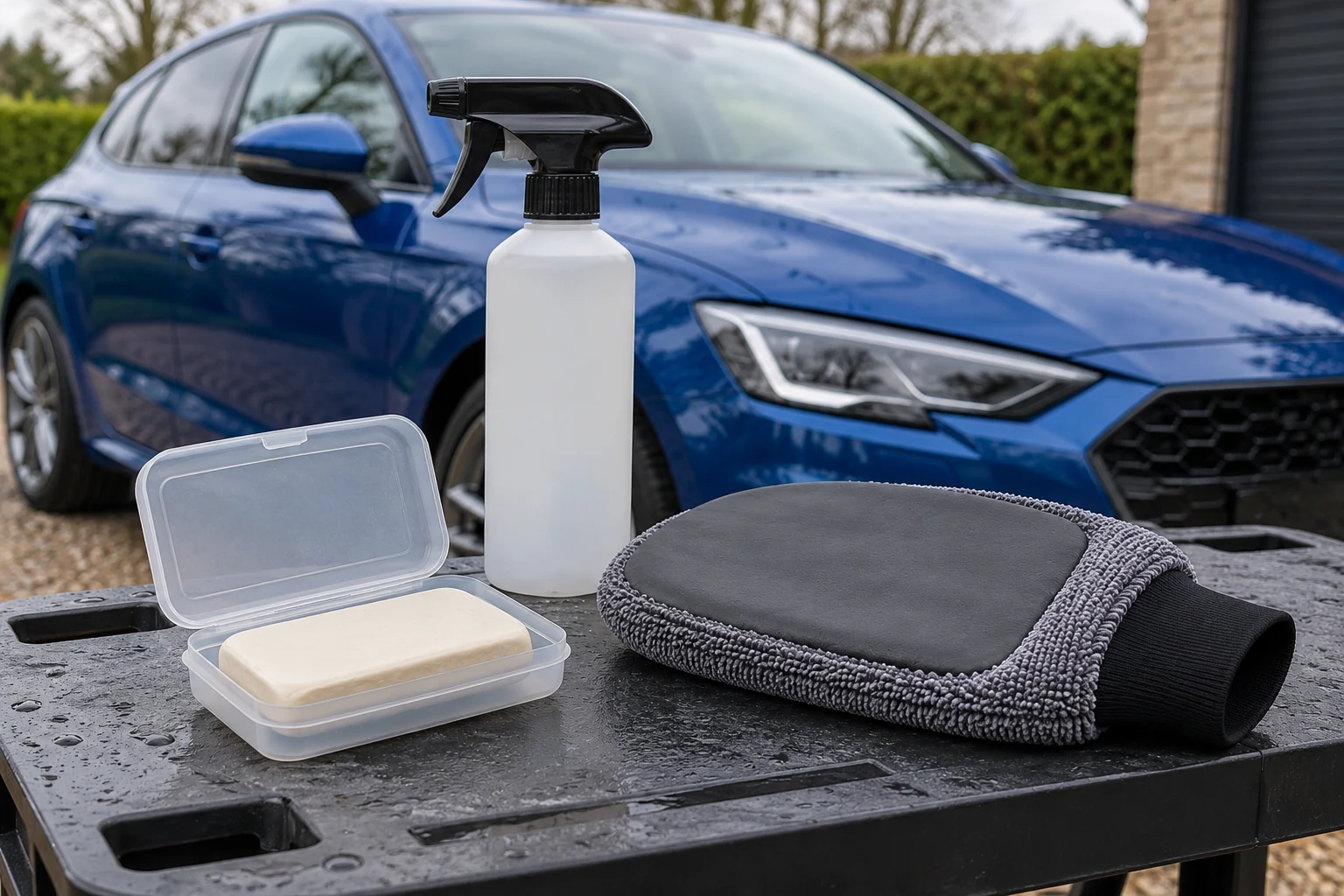
Compare the working systems rather than a speed claim
A clay bar and a synthetic-clay mitt can remove suitable bonded contamination after cleaning. They handle contamination differently: a bar can be portioned and folded, while a mitt has a larger reusable polymer working face. The choice is about the system you can use and inspect correctly on the actual finish.
Neither is a compulsory purchase for routine washing. If compatible washing and an appropriate targeted chemical leave the paint acceptably clean, extra mechanical contact may be unnecessary. A tool that removes deposits can still introduce marring if grit, pressure or poor lubrication enters the process.
This comparison covers selection and ownership. For the detailed preparation and stop decisions, use the clay-bar practical guide, and follow the exact maker’s method for whichever tool you choose.
| Decision | Clay bar | Synthetic-clay mitt |
|---|---|---|
| Working face | A small shaped portion can be folded or kneaded to expose a usable face | A larger polymer surface must be kept clean and inspected |
| Lubrication | Use the exact bar maker’s approved liquid; some kits include it | Use the exact mitt maker’s approved detailer or shampoo method |
| Contamination management | Inspect frequently and discard irretrievably dirty or dropped portions | Rinse and inspect according to the model’s care; embedded debris still rules out use |
| Handling | Useful where a small controlled working portion fits the job | Larger contact area may suit accessible panels but still needs control |
| Ownership cost | Include lubricant, cloths and replacement working portions | Include lubricant, cleaning, drying and eventual polymer-face replacement |
| Paint risk | Can mar through contamination or unsuitable technique | Can also mar; reusability is not a scratch-free guarantee |
Bar option: Meguiar’s Quik Clay Starter Kit
The selected kit contains an 80g clay bar and 473ml Quik Detailer. This gives a defined bar-and-lubricant pairing rather than leaving the liquid choice to guesswork. Check the received package and have a suitable clean wiping cloth available separately.
A bar can suit an owner who wants to manage a small working portion and regularly expose a clean face. That does not make it immune to grit. If the working piece falls onto a dirty surface, discard it instead of folding the contamination away and continuing.
For a clay bar and its specified lubricant
Meguiar’s Quik Clay Starter Kit
A kit containing one 80g clay bar and 473ml Quik Detailer. It provides a matched lubricant and bar for removing suitable bonded contamination after washing.
- 80g clay bar
- 473ml Quik Detailer
- Wiping cloth separate
Add a clean suitable wiping cloth if needed; do not assume it is included. Keep clay and paint lubricated, fold to a clean face and discard dropped or irretrievably contaminated clay. Claying can still mar paint.
Do not confuse this starter kit with another Meguiar’s clay system that contains additional bars, a cloth or a storage box. Exact contents matter when comparing what you need to buy. Older pack information can also describe a different clay weight, so match the selected 80g version.
Mitt option: Farécla G3 Pro Deep Clean Clay Mitt
The G3 Pro 7191 has a dedicated polymer working face and a cloth side. Farécla directs washing the surface first, lubricating both the work area and mitt, then using the appropriate sides within its method. It is separate from the ordinary mitt used to collect loose wash dirt.
The larger working face changes handling and cleanup. You cannot simply fold it like a clay bar to hide a dirty section. Keep track of the full contact surface, rinse as directed and stop if hard particles or damage remain.
For a reusable polymer-face decontamination tool
Farécla G3 Pro Deep Clean Clay Mitt
A dedicated clay mitt with a polymer working face and cloth side. Farécla specifies G3 Pro Rapid Detailer, Rapid Detailer 2.0 or its approved shampoo solution for lubrication.
- Model 7191
- Polymer face and cloth side
- Compatible lubricant required
This is not an ordinary wash mitt. Clean paint first, keep the face lubricated and inspect for grit or damage. Maker-permitted rinsing after a drop does not prove every contaminated mitt is fit to reuse.
Farécla permits thorough rinsing if its mitt is dropped. Treat that as model-specific care advice, alongside inspection. A rinse is not proof that every fragment has left a damaged or uncertain surface, and the rule does not extend automatically to every synthetic-clay product.
Matching liquid: G3 Pro Rapid Detailer 2.0
The current 7258 Rapid Detailer 2.0 is an explicitly approved pairing for the G3 mitt. It is a separate bottle, so include it in the purchase if you do not already have a permitted lubricant. Follow the method that wets both the washed work area and the mitt and maintains lubrication during use.
Check the version rather than buying solely from a similar product name. The current 2.0 formula and older Rapid Detailer listings have different codes. There is no need to borrow a performance or time-saving claim to explain the useful feature: a documented tool-and-liquid combination.
For the specified G3 clay-mitt lubricant
Farécla G3 Pro Rapid Detailer 2.0 500ml
The current 7258 formula is explicitly listed by Farécla for lubricating its Deep Clean Clay Mitt. Spray both the washed work area and mitt, keep them lubricated and remove residue with a suitable clean cloth.
- 500ml bottle
- Formula 2.0 / code 7258
- Approved G3 clay-mitt pairing
The bottle is separate from the mitt. Do not assume any quick detailer, water alone or a solvent tar remover is an interchangeable lubricant. Confirm finish approval and use the received directions.
The maker also permits its specified shampoo method. That does not approve every shampoo, dilution, tar solvent or plain-water mixture. A liquid feeling slippery is not evidence that it will preserve a polymer face or provide suitable lubrication through the job.
Make suitability the first purchase check
Check the vehicle finish, any film or wrap, previous repairs and coating maintenance requirements. Conventional gloss-paint advice does not establish permission for matt or satin paint. If approval is uncertain, resolve that before selecting a tool.
Then identify the contamination. A clay tool is not a scratch eraser or a repair for peeling lacquer. If deposits are tar or iron-bearing particles, a compatible targeted chemical may reduce the mechanical work needed. Finish chemical removal before moving to clay unless a specific system supports otherwise.
For an occasional small job, a manageable bar portion and included lubricant may be sufficient. A reusable mitt may appeal for accessible larger areas, but only if you can clean, inspect, dry and store its face properly. Neither choice needs a full-car treatment every time it leaves the box.
Compare care and storage as well as initial contents
Keep unused clay separate from the working piece. Discard clay that cannot provide a clean usable face and do not leave it where grit can reach it. Use the product’s own storage method rather than an unwashed reused container.
For the G3 mitt, follow the maker’s rinse, natural-drying and protected-storage instructions. Let it dry before closing it away. Keep the polymer face away from surfaces or chemicals the maker has not approved, and inspect before every return to paint.
Keep chemical-use cloths and decontamination tools separate from clean drying and glass textiles. A neatly stored tool can still be unsuitable if its contamination history is unknown.
Choose the simplest suitable setup
Avoid comparing the options through advertised maximum lifespans alone. Actual use, contamination, care and the condition of the working face affect replacement. Without measured consumption and use, there is no dependable cost-per-car figure here.
Choose a documented compatible system, start with a controlled suitable test area and inspect the result. Stop at drag, debris, marring or an unfamiliar surface change. The useful decision is the tool you can manage carefully for identified contamination, including the decision that the paint does not currently need either one.
Common questions
Is a clay mitt safer than a clay bar?
Neither tool guarantees damage-free work. Suitability, preparation, trapped particles, lubrication, pressure and inspection matter. A larger reusable surface is a different handling arrangement, not proof that it cannot mar paint.
Can I use a clay mitt as my normal wash mitt?
Treat it as a dedicated mechanical-decontamination tool. Farécla directs cleaning the surface first and keeping the polymer face lubricated with an approved product. It should not be used to scrub ordinary loose dirt from an unwashed car.
Can both tools use the same lubricant?
Only if the exact makers approve that pairing. The Meguiar’s kit supplies Quik Detailer; the G3 mitt permits specified G3 detailer or shampoo methods. Bilt-Hamber’s water-lubricated bar is a separate formulation and does not establish a water-only rule for other tools.
What if I drop the bar or mitt?
Discard the dropped clay-bar working piece. Farécla permits rinsing its dropped mitt thoroughly, but inspect carefully and do not return it to paint if hard debris, damage or uncertainty remains. That permission should not be generalised to every polymer tool.
Which is better value for occasional use?
Compare the complete system: tool, approved lubricant, any cloths and whether you can keep it clean between uses. No measured lifespan or cost-per-car comparison is established here. A suitable kit you can manage may be more useful than a claimed maximum reuse count.
Sources and product instructions
Follow the label and care instructions for the exact version and surface you own.
- Meguiar’s Quik Clay kit: 80g bar and 473ml Quik Detailer
- Meguiar’s UK catalogue: Quik Clay G1116EU and required Quik Detailer lubricant
- Farécla G3 Pro Deep Clean Clay Mitt: lubrication, cleanup and storage
- Farécla G3 Pro Rapid Detailer 2.0: version, contents and clay-mitt application
- Farécla paint-cleaning guide: approved clay-mitt lubrication
- Bilt-Hamber Auto-Clay: its specific water-lubrication and dropped-bar directions