
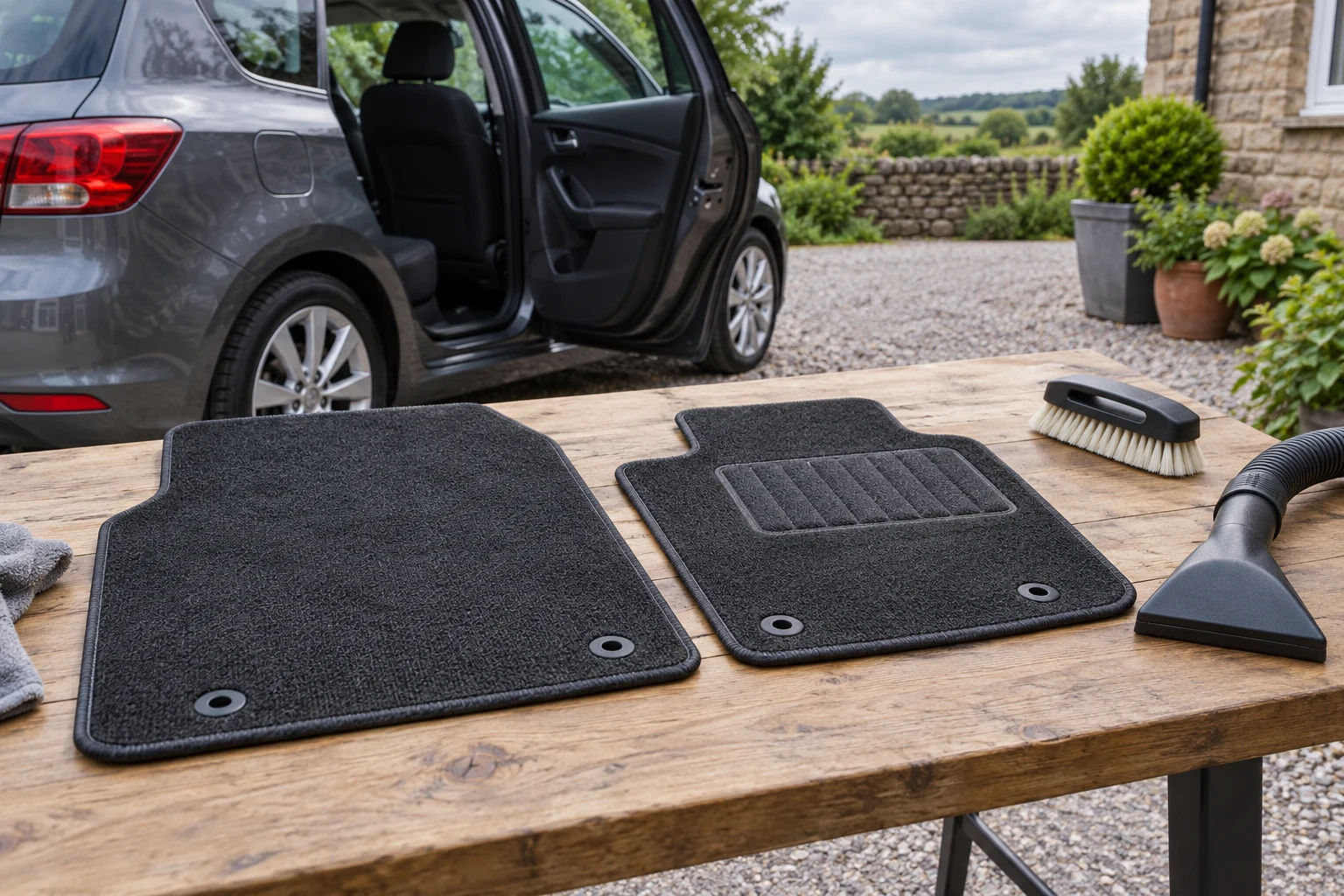
Remove the mat before adding cleaner
For a removable rubber mat, follow the rubber-mat method instead. Fabric pile, backing and rubber surfaces do not share an automatic detergent, soaking or drying permission.
Removable fabric car mats are easier to clean and inspect outside the footwell. You can reach the edges, keep dirt away from the seat runners and give the backing a proper drying opportunity. First check the mat instructions and vehicle handbook: being removable does not mean a mat is machine-washable, pressure-washable or suitable for soaking.
Identify the construction. A carpet face may sit over a rubberised backing, with stitched edges, adhesive layers, a heel pad and retention eyelets. Each can limit the permitted amount of water and agitation. If the backing is separating, the edge is curling or the fixing is damaged, cleaning does not solve the fitting problem. Replace or obtain advice on an unsuitable mat before using it in the driver’s footwell.
This method covers loose dry debris and a permitted hand clean. Floodwater, sewage, extensive mould or a persistently wet vehicle floor needs a different assessment. Do not treat a saturated mat as the only problem if the fixed carpet underneath is also damp.
1. Release the fixings and lift the dirt out carefully
Park and follow the vehicle’s instructions for releasing the mat retainers. Keep the mat reasonably level as you lift it out, so crumbs and grit are not tipped into the pedals or seat tracks. Do not pull hard on a clipped mat or cut a fixing to make removal easier. Put the mat on a clean stable surface where the dirty face cannot contaminate your finishing cloths.
Check the exposed footwell while it is accessible. Remove loose objects and vacuum ordinary dry debris with suitable attachments. Keep tools away from wiring and moving seat mechanisms. If you move a seat, withdraw hands and equipment first. Our interior routine gives the wider sequence.
2. Vacuum the mat while it is dry
Remove large debris by hand where safe, then vacuum the carpet face using a tool suited to it. Work along the pile and around accessible edges without dragging a hard nozzle corner over the heel pad. Check the reverse side separately, keeping dirt from the backing away from the already cleaned face.
The BLACK+DECKER 12V Pivot is a dry-pickup option for a kit already built around the car’s permitted power socket. Follow its operating and socket instructions. It cannot recover water from a washed mat; a liquid-capable vacuum is a separate equipment choice.
For cleaning from a suitable 12V socket
BLACK+DECKER 12V Pivot Car Vacuum
A corded car vacuum with a pivoting nose, built-in extendable crevice tool and upholstery brush. The five-metre cable provides reach without charging a separate vacuum battery.
- 12V car socket
- 5m power cable
- Pivoting nozzle
Check the vehicle socket rating and power-management instructions. This 12V cable-powered model is not cordless despite wording in the Amazon title. Choose it for dry debris, not seat extraction.
For embedded hair, use the pet-hair guide on compatible carpet before wet cleaning. Adding liquid to loose dusty material makes it harder to see the actual stain and can consume clean cloth faces before they reach the soiling you intended to remove.
3. Test the chosen cleaner and tool
Use a product allowed by the mat manufacturer and suited to its fabric. Test discreetly on the same material and assess the test after drying for colour transfer, water marking, texture change or backing problems. A test on a nearby plastic sill does not establish colourfastness of the mat.
Autoglym Interior Shampoo is a hand-cleaning option where the mat permits it. The maker’s fabric method uses light application and clean tools with residue removal. It should not be poured into an extractor tank or strengthened with another cleaner.
For fabric seats and removable mats
Autoglym Interior Shampoo 500ml
A ready-to-use cleaner for compatible interior fabrics and hard surfaces. Useful for local cleaning after vacuuming, without introducing an extraction machine.
- 500ml spray
- Fabric and carpet cleaning
- Use after vacuuming
Vacuum first and apply lightly on compatible fabric. Not suitable for displays or infotainment. Autoglym permits leather use through a soft clean cloth, rather than direct spraying; vehicle material care still governs use.
A dedicated SONAX Textile & Leather Brush can help on a mat whose face tolerates gentle agitation. Test the tool as well as the liquid, keep it clean and avoid forcing bristles into stitched edging. A firm tool that suits hard-wearing mat carpet should not move straight onto a delicate seat insert.
For suitable removable fabric mats and upholstery
SONAX Textile & Leather Brush
A single hand brush intended for permitted dry or wet textile cleaning. The maker specifies a material test and removing the loosened dirt and cleaner with a damp suitable cloth.
- One brush
- Item 04167410
- Test material compatibility
Use only if the mat and cleaner allow agitation. Keep the brush clean and dedicated to interior textiles; a brush suitable for a hard-wearing mat is not automatically appropriate for a delicate suede-like seat insert.
4. Clean a manageable defined area
Follow the selected product’s application route and use controlled moisture. Work a defined part of the mat so that you can remove the loosened soil rather than just spread it into a wider damp area. Avoid grinding one concentrated mark until the pile changes. If the stain’s cause is known, check the cleaner’s specific advice instead of adding a household remedy.
Turn or replace cloths as they become dirty. If the cleaner calls for a firm sponge, brush or damp cloth, choose the permitted tool for this mat rather than combining every available accessory. More foam is not evidence that more dirt is being removed.
Do not automatically hose through the whole mat. Some removable mats tolerate a rinse; others have construction or backing restrictions. Follow the actual mat’s instructions, including the permitted treatment of the reverse face. Keep an approved rinse controlled and away from the vehicle interior.
5. Remove residue and dry both sides
Complete the cleaner’s residue-removal step with clean materials. Continuing with a dirty wet cloth can redistribute soil or leave a film. If the face feels sticky after drying, reassess dose and removal rather than covering it with fragrance.
Arrange the mat so air can reach it without folding, distorting the edge or exposing it to unsuitable heat. Check the carpet face, heel pad, edges and backing before refitting. There is no reliable universal “ready in an hour” drying time. Weather, construction and the amount of water used all affect the result.
A wet-and-dry vacuum may recover permitted liquid in the correct configuration, but pickup does not prove every layer is dry. A spray extractor adds another method and should be used on mats only where their construction and machine instructions permit it. Do not buy one simply to justify soaking a mat that could have been hand-cleaned.
6. Refit and check the driver’s footwell
Return only a fully dry, correctly fitting mat to the correct position. Follow the vehicle’s retaining method and check every applicable fixing. Do not stack a second mat on top to protect the cleaned one. A loose or curled mat is not made acceptable by pushing it further under the pedals.
Before driving, make sure the mat cannot shift into the pedal area and that pedals have their required clear movement. Remove cleaning tools, bottles and loose objects from the footwell. Ford’s cited fitting guidance illustrates these checks; your own handbook determines the exact fixing arrangement.
Troubleshoot before repeating the wash
- A pale ring remains: let the mat dry, then reassess uneven wetting, residue and the cleaner’s defined-area method.
- Colour transfers or the pile changes: stop and seek material-specific advice.
- The backing remains damp: continue suitable drying outside the car; do not trap it against fixed carpet.
- Odour returns: inspect the mat and vehicle floor for retained moisture or deeper contamination.
- The edge curls or fixings fail: address the mat’s fit and condition before reuse.
Keep a lighter dry-vacuum routine between wet cleans. Removing grit while it is loose makes future cleaning easier to judge and reduces the temptation to repeat a full wet treatment for every small patch of dirt.
Common questions
Can removable fabric car mats go in a washing machine?
Only if the mat maker expressly permits it. Removable mats can contain backing, adhesives, heel pads and fixings that do not tolerate machine washing. Follow the mat’s own washing and drying instructions.
Can I use a dry car vacuum after washing the mat?
No. A dry-pickup vacuum must not collect water. Use it before wet cleaning. Any permitted liquid recovery requires a wet-capable machine in its correct configuration, followed by proper drying.
How dry must the mat be before it goes back in the car?
Fully dry, including the face, edging and backing. A surface that looks dry does not prove that the reverse or inner layers are ready. Do not trap a damp mat against the fixed carpet.
Should I use a drill brush on carpet mats?
Do not assume powered agitation is allowed. It can distort pile, edging or backing. Start with the mat-approved hand method and only use a tool the mat construction and cleaner permit.
Can I put another mat over the clean driver’s mat?
Do not stack mats. Use the correctly fitting mat, secure its retention devices and check pedal clearance according to the vehicle handbook before driving.
Sources and product instructions
Follow the label and care instructions for the exact version and surface you own.