
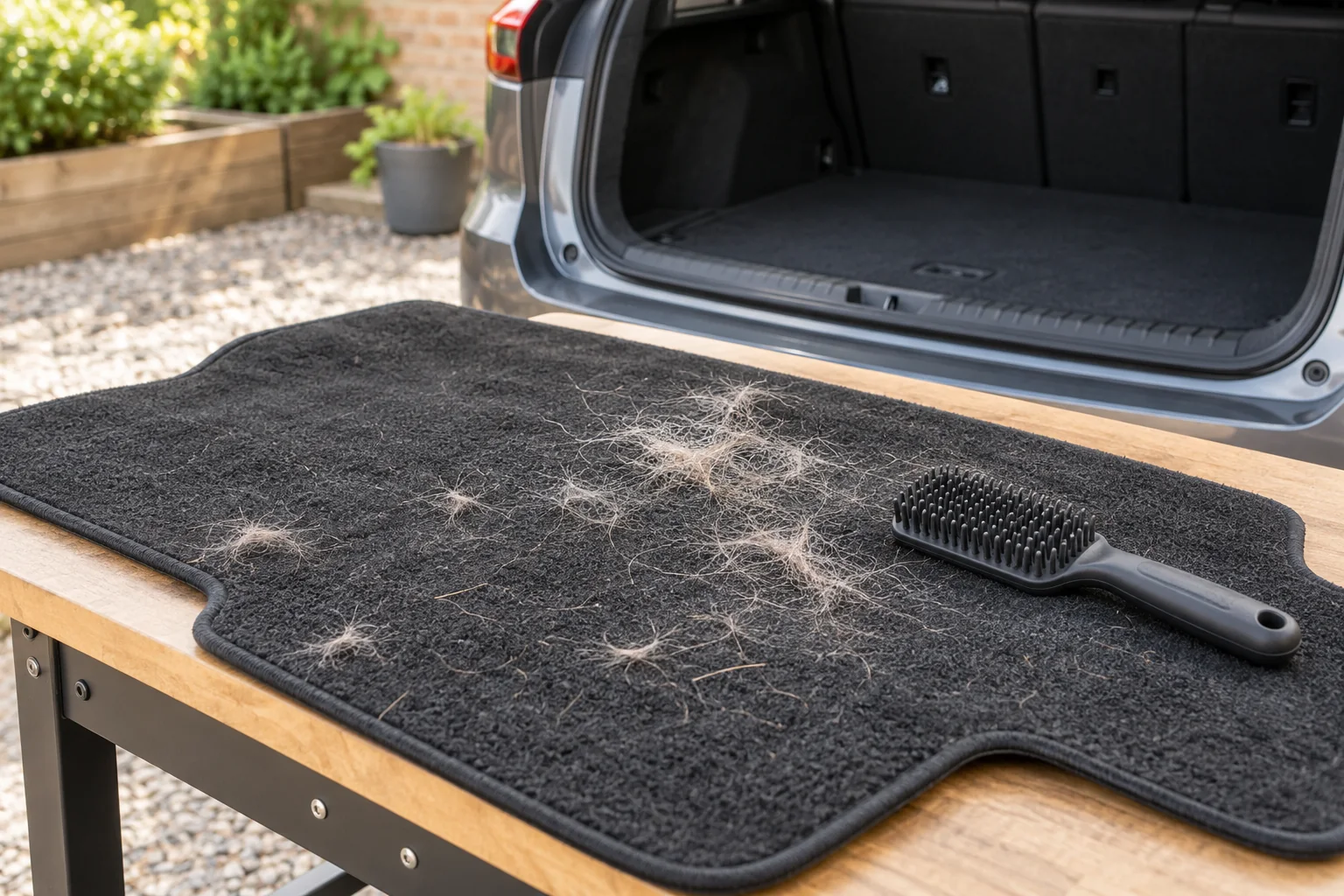
Work out where the hair is trapped
Pet hair on a smooth removable liner is a different job from hair woven into a felt-like boot carpet. Start by identifying the material and checking its care guidance. Some fibres release hair readily; others catch it so firmly that repeated vacuum passes alone make little progress.
This guide is for ordinary dry pet hair on compatible car carpets and mats. Delicate upholstery, leather, suede-like panels and headlining need their own methods. Do not use the appearance of a rubber tool as proof that it cannot catch or distort a fabric.
Take the pet out of the car and put cleaning equipment somewhere it cannot be reached. Keep the work area clear of harnesses, loose straps and small objects that could enter the vacuum.
Set up before removing a mat or liner
Remove loose belongings and inspect the carpet in good light. If a removable mat or liner can be taken out according to the vehicle instructions, clean it separately on a suitable raised surface or clean support. Do not drag it across paintwork or shake grit towards the car.
Keep the driver's mat fixings in mind before removal. Refit the correct mat securely and check pedal clearance before driving. Do not add another mat on top to cover remaining hair.
For fixed boot carpet, work around the accessible area without levering out trim or disturbing wiring. If a lining needs removal to reach the hair, check the vehicle's instructions or seek suitable help rather than pulling at clips blindly.
1. Vacuum the loose debris first
Collect large objects safely by hand and vacuum dry crumbs, grit and loose hair with an approved attachment. This clears the surface and makes it easier to see embedded hair. A pile of loose grit should not be rubbed through the carpet with a hair tool.
Use a nozzle that makes useful contact without its hard edges scratching adjacent plastics. Check the vacuum cup and filter if pickup is weak. A more elaborate hair-removal tool will not fix a blocked air path.
2. Test a gentle rubber tool in a hidden area
The SONAX 04978000 uses a flexible rubber lip with two prong sizes. Its compact shape provides a manual way to gather hair where the carpet and vehicle care permit it. Start in an inconspicuous area with light pressure, and inspect the fibres before continuing.
Work in short passes rather than leaning hard on the tool. Choose an angle that gathers hair without digging into the backing or catching loops. Stop if the pile lifts, pills, stretches or snags. Do not assume more force will improve a poor material match.
For loosening hair on compatible car carpet
SONAX Pet Hair Brush
A compact pet-hair comb with a flexible rubber lip and two prong sizes. It helps gather embedded hair into accessible clumps before the next vacuum pass.
- Rubber lip
- Two prong sizes
- Model 04978000
Test light pressure in a hidden area. Stop if the carpet snags, pills or distorts; do not transfer the technique to leather, delicate fabrics or headlining.
3. Gather small clumps and vacuum them promptly
Work in manageable sections and bring the loosened hair towards an accessible area. Vacuum the clumps before moving on so you are not repeatedly redistributing them across the boot. Check the tool for collected hair and clean it as directed.
Change your working direction gently if the first pass leaves embedded strands, provided the material remains unaffected. Avoid chasing a small number of hairs with repeated pressure once the carpet begins to look disturbed. An acceptable routine clean should not damage the pile to achieve a perfectly hair-free photograph.
For corners, use a controllable edge or appropriate nozzle without prying at trim. A broad tool that works on the centre of a mat may be less useful around a tight luggage-area recess.
When a motorised pet attachment is useful
A suitable powered tool can combine agitation and suction on permitted carpet or upholstery. The Shark CH950UKT includes a motorised pet tool, alongside a crevice tool and dusting brush. Consider it when you also need a cordless handheld, rather than buying a whole vacuum solely because one hair tool looks convenient.
Check clearance from loose threads and seams, and follow the tool's material restrictions. Keep the rotating part away from hair, straps and hands. Switch off before clearing a blockage or removing tangled hair, using the manual's maintenance method.
For short cordless cleans and compatible carpet
Shark CH950UKT Handheld Pet Vacuum
A cordless handheld supplied with a motorised pet tool, crevice tool and dusting brush. Shark specifies up to ten minutes of runtime and a 0.45-litre dust cup.
- Cordless handheld
- Motorised pet tool
- 0.45L dust cup
Dry surfaces only; do not collect liquid. The motorised tool needs a compatible surface and clearance from loose threads. Store indoors and follow the manual’s charging and filter-care instructions.
The Shark is dry-only. Do this work before any damp carpet cleaning and do not use it to recover cleaning solution. Its stated runtime is up to ten minutes, so plan small areas and check the dust cup rather than assuming unlimited cleaning time.
Avoid adding residue to solve a dry problem
Household fabric-softener mixtures, strong fragrance sprays and improvised adhesive methods can leave a second problem behind. Do not apply them simply because hair still remains after one pass. First reassess the surface, tool and vacuum contact.
If the carpet needs chemical cleaning as well, finish the dry hair-removal stage first and then choose a compatible method. The fabric-seat guide explains moisture and residue control, but a carpet or liner still needs its own material check.
Address the source of recurring build-up
A removable, correctly fitted pet-area liner can make future cleaning easier where the vehicle and restraint arrangement permit it. Keep it clear of seat belts, anchors and moving mechanisms. Clean the liner itself rather than allowing loose hair and grit to accumulate underneath it.
Deal with small amounts regularly so hair is less likely to become tightly worked into the pile. For a large shedding load, a short clean after a journey may be more manageable than waiting until the whole boot is embedded with hair. There is no universal cleaning interval; use the actual condition.
Check the finished area before use
Look for disturbed fibres, remaining clumps and tools left in crevices. Refit dry mats and liners correctly and check that seat mechanisms, fixings and pedals are clear. Empty and maintain the vacuum, then store the hair tool separately from bodywork and wheel equipment.
Persistent smell, damp backing or deep contamination is a separate cleaning problem. Gather the relevant material information and ask for an appropriate assessment instead of covering it with fragrance. Keep hair removal within the wider interior routine so the cabin is usable as well as tidy.
Common questions
Why does hair remain after vacuuming?
Some hairs work into the carpet pile instead of lying loosely on top. Gentle permitted mechanical loosening can help before another vacuum pass. Check airflow and the nozzle as well as the hair-removal tool.
Can I use a metal carpet scraper in the car?
Do not assume it is suitable. Sharp or abrasive edges can catch fibres or damage surrounding trim. This guide uses a gentle rubber approach with a discreet material check on compatible carpet, with a stop rule for snagging.
Should I spray fabric softener onto the carpet?
Do not add household treatments unless the vehicle and material guidance permits them. They can introduce residue and make the next cleaning decision harder. Try a permitted dry mechanical method first.
Can the same rubber tool clean leather seats?
Do not transfer the carpet method to leather, suede-like coverings or headlining. Each surface needs its own care instructions. A pet-hair tool’s suitability depends on the material and pressure used.
Does removing hair remove pet odour too?
Not necessarily. Hair removal addresses loose and embedded fibres. Odour may involve damp material, a liner or contamination below the surface, so persistent smell needs separate assessment.
Sources and product instructions
Follow the label and care instructions for the exact version and surface you own.