
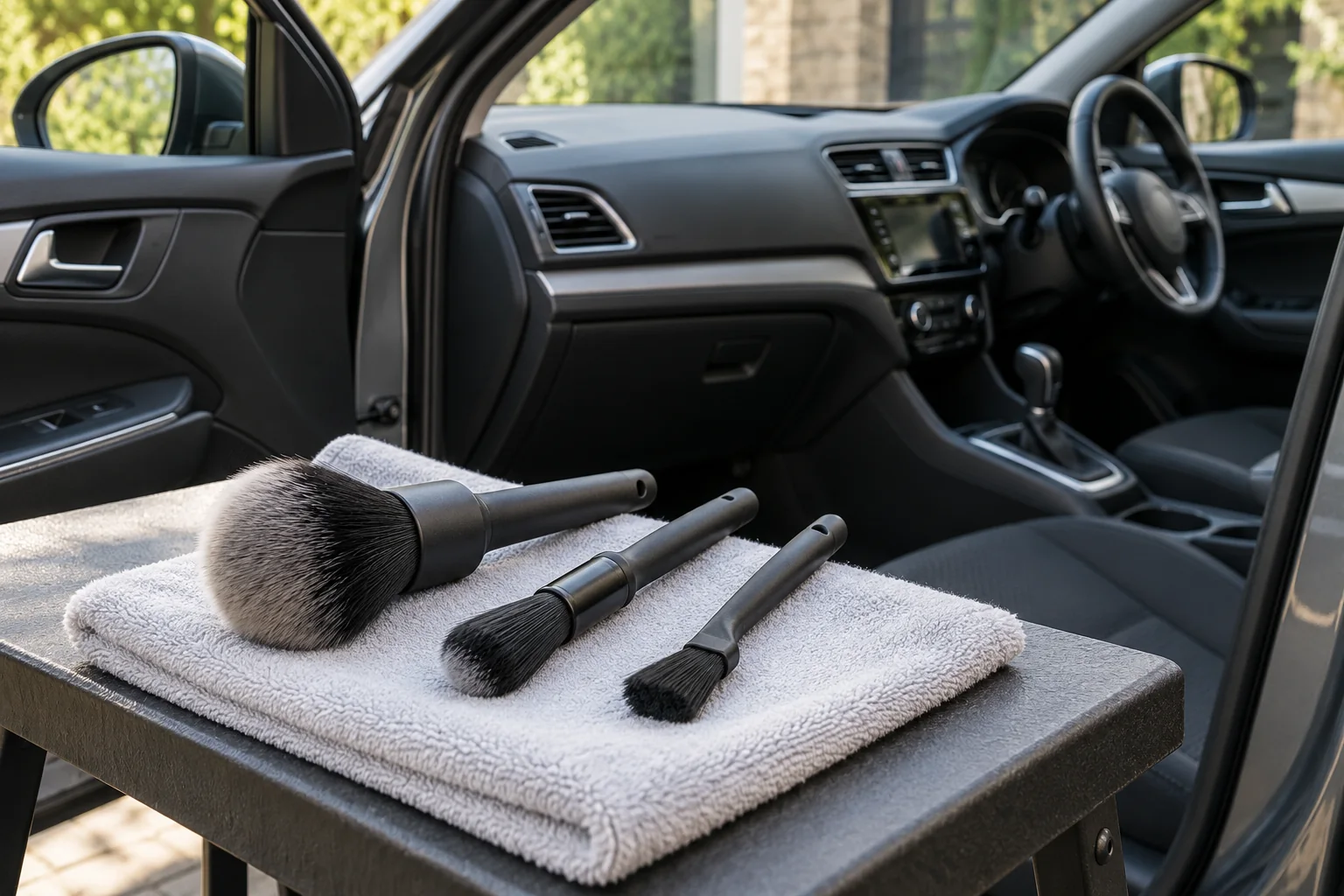
Buy around a detail you cannot clean comfortably
An interior detailing brush is useful when a cloth cannot reach a permitted recess or when loose dust needs gentle lifting towards a vacuum nozzle. It should solve a specific access problem. Buying a large mixed set does not show that any of its brushes suits a delicate dashboard.
Look at the cabin before buying: vent slats, textured plastics, seams around controls and broad open panels present different shapes. Gloss trim and coated displays need particularly careful checks. Sometimes the correct tool is still the soft cloth specified by the vehicle maker.
The options here are ultra-soft synthetic brushes for light-duty work. They are not a recommendation to scrub a seat, scour a sticky coating or remove ingrained grit by force.
Two useful brush shapes
| Option | Useful shape | Where it is less suitable |
|---|---|---|
| Detail Factory Ultra-Soft set | Two brush sizes for smaller details and varied access | Broad carpet cleaning or heavy scrubbing |
| Detail Factory Curveball XL | Broad head for open accessible surfaces | Narrow vents, deep slots or cloth-only displays |
Ultra-Soft set: two sizes for smaller details
Detail Factory's grey set combines two synthetic brushes of different sizes. The maker describes light-duty work on scratch-prone automotive surfaces and metal-free construction. Choose it where you need a controllable detailing shape and the vehicle permits brushing.
The distinction between the two sizes is practical access, not a claim that one can force its way into every gap. Hold the tool so the handle stays clear of edges, and avoid flattening the bristles until harder parts approach the trim.
The manufacturer's examples include instruments and infotainment. Treat those as possible applications subject to the car's care instructions. Do not brush a display that requires a particular cloth-only process.
For light dust and small interior details
Detail Factory Ultra-Soft Detailing Brush Set
Two grey-handled synthetic detailing brushes in different sizes. Their soft bristles and metal-free construction suit controlled light-duty work around compatible interior details.
- Two brush sizes
- Synthetic bristles
- Metal-free construction
Follow vehicle care before brushing delicate trim or displays. Grit and hard-part contact can still mark a surface; this is not a carpet-scrubbing set or a scratch-free guarantee.
Curveball XL: a larger head for open areas
The grey Curveball XL has a broad synthetic head and comes with a storage rack. Its shape is useful to consider for a larger accessible area where you want a comfortable grip and the panel permits brushing.
It is not a narrow detailing replacement. A large head can be awkward around closely spaced slats, and pushing it into a recess may bring the body against the surrounding trim. Choose it to add a different shape, not simply because the head looks more substantial.
A separate clean storage position helps stop the bristles picking up debris between uses. The rack is a storage feature, not evidence that the brush stays clean regardless of where you put it.
For broader accessible interior surfaces
Detail Factory Curveball XL — Grey
A broad ultra-soft synthetic brush with a short ergonomic handle and storage rack. Its larger head covers open areas rather than replacing a narrow detailing brush.
- Broad synthetic head
- Grey model
- Storage rack included
Use only where brushing is permitted. Keep the hard body away from trim edges, inspect for trapped grit and avoid forcing the broad head into vents or narrow gaps.
Judge softness and clearance together
Soft bristles help only if the entire contact is controlled. Check the brush before each use for embedded particles, hardened residue, broken strands and rough hard parts. A brush dropped onto the driveway needs cleaning and reassessment before returning to the cabin.
Use light pressure. If the head has to bend sharply to reach the area, choose another angle or a different permitted tool. Do not use a firm brush to compensate for contamination that requires a surface-compatible cleaner.
Chemical-resistant materials describe the tool, not the dashboard. A brush that tolerates a cleaner does not establish that the cleaner suits gloss lacquer, rubberised trim or a screen coating.
Use dry brushing to collect dust, not relocate it
Where permitted, loosen light dust with small controlled movements and collect it with a suitable vacuum attachment nearby. Keep the nozzle and brush body clear of the trim. Work from accessible upper details towards lower surfaces before finishing the footwells.
Do not drive the bristles deep into a vent, lever against a slat or poke into a switch opening. You are cleaning accessible surfaces, not dismantling the ventilation system. If dirt lies beyond safe reach, leave it for a method approved by the vehicle supplier.
For the vacuum itself, see choosing a car vacuum. The dusting brush already supplied with a machine may cover the job, so check that before buying another accessory.
Keep wet agitation conditional
Some interior cleaners permit a brush on compatible textured surfaces; others specify a cloth or sponge. Follow that method and the vehicle care together. Do not spray cleaner through a brush directly into controls or electronic openings.
Use a clean cloth to remove loosened residue as directed. Foam is not the end result: the dirt and cleaner still need to leave the surface. Avoid adding more liquid simply because a brush can generate visible lather.
For leather and fabric, read the leather-seat guide or fabric-seat guide before choosing agitation. A dashboard brush is not automatically an upholstery brush.
Separate the kit by contamination and job
Give interior brushes their own clean storage. Keep them away from brake dust, tyre cleaners, wheel brushes and damp exterior textiles. Distinct colours or labelled storage can make the separation easier to maintain, but colour alone does not clean a contaminated tool.
After use, follow the brush maker's cleaning and drying directions. Remove residue without leaving bristles pressed into a distorted shape, then store when appropriate. Avoid putting a damp brush into a sealed box and forgetting it.
Buy the smallest set that improves the routine
For accessible light dust, a small ultra-soft set may be enough. A broader brush can make sense if it addresses an open area your smaller tool handles awkwardly. Neither is essential when the car's instructions specify a cloth or your existing vacuum attachment already works well.
The interior routine puts brushing before final vacuuming and glass finishing. That order helps collect the dirt you lift without turning a simple clean into an unnecessary collection of accessories.
Common questions
Can I brush an infotainment screen?
Only if its care instructions permit that method. A brush manufacturer’s screen-use claim cannot establish compatibility with every display coating. Use the vehicle’s specified cloth method when that is required.
Are boar-hair and ultra-soft synthetic brushes interchangeable?
No. Bristle material, stiffness, shape and hard-part clearance differ. Choose for the actual surface and job. A brush useful for chemical agitation elsewhere may be too firm for delicate interior trim.
Do I need a separate brush for wheels?
Yes. Keep wheel and tyre equipment out of the interior kit. A brush used on brake dust or tyre residue should not become a dashboard brush after a quick rinse.
Can these brushes scrub fabric seats?
They are light-duty detailing choices, not a recommendation for upholstery scrubbing. Follow the seat and cleaner instructions for fabric, and use only the permitted cloth, sponge or brush method.
Does metal-free construction prevent scratches?
No guarantee follows from that description. Grit, damaged bristles, excessive pressure and contact from the handle or body can still mark trim. Inspect and clean the tool before use.
Sources and product instructions
Follow the label and care instructions for the exact version and surface you own.