
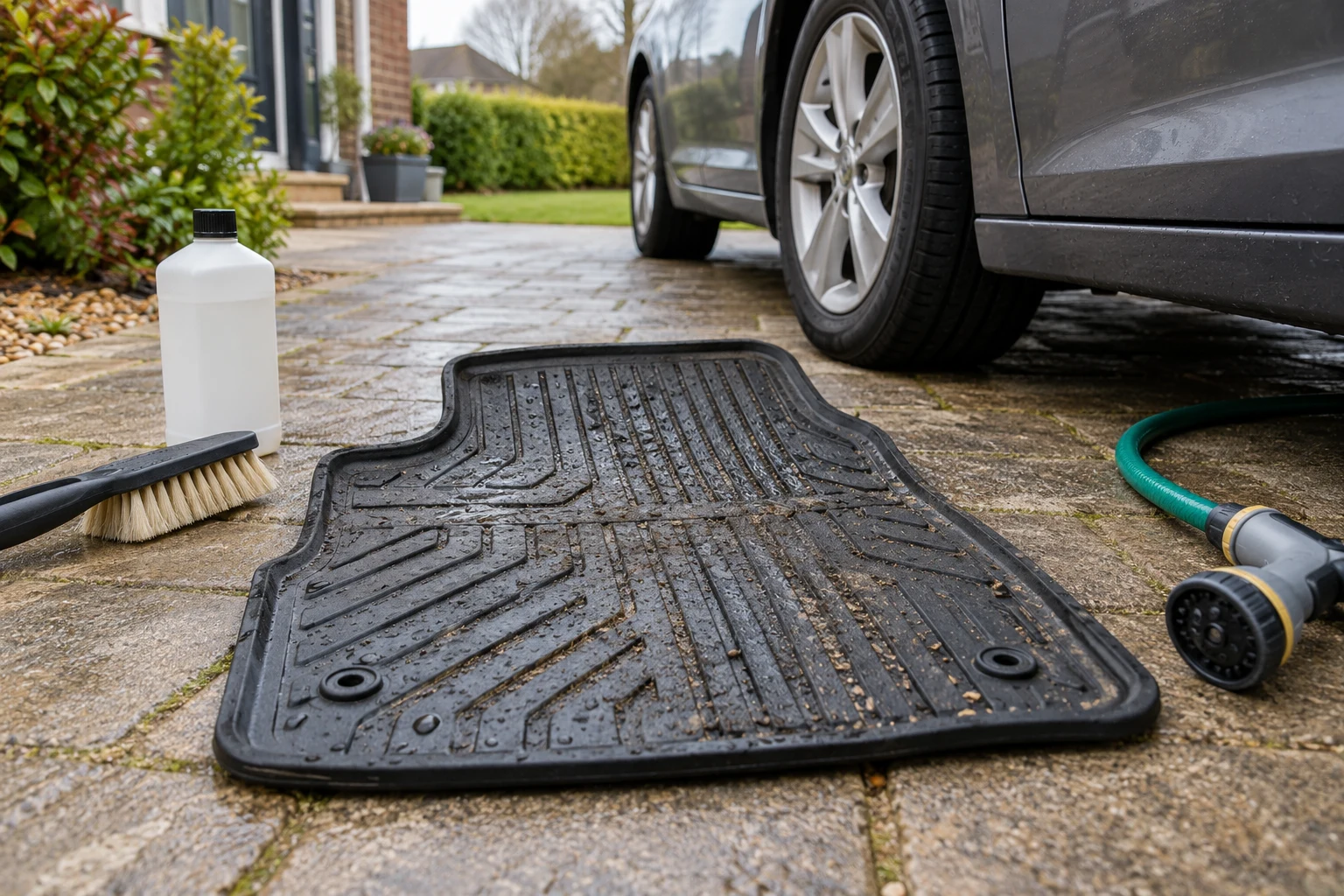
Clean the mat outside the footwell
Rubber car mats should be removed before a wet clean, so dirty water stays out of the fixed carpet, pedals and electrical areas. Begin by identifying the mat material and its care instructions. Some flexible all-weather mats are different plastics or elastomers rather than ordinary rubber, and colour alone does not establish chemical compatibility.
A useful routine is to remove loose dirt, wash by the permitted mild method, clear cleaner from the channels and dry the mat completely before refitting. The desired finish is clean and free from slippery residue. Tyre shine, bumper gel and glossy interior dressing do not belong in this routine simply because they darken black rubber.
Check the mat’s condition before washing. A curled edge, cracked fixing point or distorted shape is a fitting problem, not a cleaning stain. If a driver’s mat cannot be secured correctly or can interfere with the pedals, obtain a suitable replacement or vehicle-specific advice.
1. Remove and inspect the mat
Park and release the retaining devices as the handbook describes. Lift the mat without spilling collected dirt into the footwell. Do not pull against a locked fixing or bend the mat sharply around a retainer. Put it on a stable surface outside the car, where the runoff can be managed appropriately.
Remove visible stones and loose objects before rinsing. Check both the top channels and underside for trapped grit. If the fixed floor beneath is wet, investigate that separately and dry it by a suitable method. Cleaning the removable mat alone will not resolve a leak or soaked underlay.
Keep each mat’s position clear while they are out. Front, rear, left and right mats may have different shapes or fixings. A mat that fits approximately is not necessarily suitable for the driver’s pedal area.
2. Start with the mat maker’s mild wash
Ford’s cited rubber-mat example uses mild soap with cold or lukewarm water and requires complete drying before refitting. Use that as an illustration of a restrained method, not permission to copy one car’s instructions onto every mat. Follow the exact mat’s approved cleaner and temperature limits.
If an interior cleaner is permitted, Autoglym Interior Shampoo is one option whose maker lists mats among its uses. Match the label to the actual material and test discreetly. It is a cleaning choice, not a dressing, and it should not be mixed with another chemical to make a stronger solution.
For fabric seats and removable mats
Autoglym Interior Shampoo 500ml
A ready-to-use cleaner for compatible interior fabrics and hard surfaces. Useful for local cleaning after vacuuming, without introducing an extraction machine.
- 500ml spray
- Fabric and carpet cleaning
- Use after vacuuming
Vacuum first and apply lightly on compatible fabric. Not suitable for displays or infotainment. Autoglym permits leather use through a soft clean cloth, rather than direct spraying; vehicle material care still governs use.
Use a soft suitable cloth or a mat-approved hand brush to work the accessible channels. A brush used for wheels or tyres can carry grit and chemical residue, so keep interior-mat tools separate. Avoid scrubbing so hard that moulded markings, logos or surface texture begin to change.
Work through the grooves methodically rather than polishing one smooth raised area while leaving dirt in the corners. Turn or rinse the cleaning tool as it loads with soil. If dirt is not releasing with the permitted method, reassess the deposit instead of immediately switching to an aggressive degreaser.
3. Rinse or remove the cleaner completely
Follow the mat and product instructions for removing loosened dirt and cleaner. A controlled rinse may be permitted for some mats; a wipe method may apply to others. Pay attention to recessed channels, edges and the reverse face, where residue can remain after the broad top surface looks clean.
Do not direct a pressure-washer jet at a mat by default. High-pressure cleaning is a separate compatibility question involving the material, edging, fixings and control of the mat. Do not pin it down with a foot while spraying around footwear or use the car’s footwell as the rinse area.
A dedicated soft interior cloth can help with permitted wiping and accessible drying. Keep one used on mats separate from display, glass and seat cloths, even if the same cloth type is suitable for those cleaner jobs when new.
For a dedicated soft cloth in the interior kit
Autoglym Hi-Tech Interior Microfibre
A single 40 × 40cm interior microfibre cloth for dust removal and permitted interior-cleaning work. Fold to clean faces and keep it separate from wheels, exterior dressing and dirty mat tools.
- One cloth
- 40 × 40cm
- HTIM interior microfibre
Use only where the particular surface permits this type of cloth. Display care can require a different specified cloth. Wash as the maker directs without fabric softener and inspect before each use.
If suds or a slick film remain, complete the permitted cleaner-removal method before judging the result. Do not cover remaining residue with a fragrant spray. The surface should feel appropriate for its normal use, without an added glossy coating.
4. Dry the top, underside and fixing areas
Let the mat dry fully in a suitable place, with air reaching the reverse as well as the channels. Follow any restrictions on direct sun or heat. Do not put the mat against an improvised heater or distort it over a narrow rail to hurry the process.
Water can collect around deep grooves, logos and retention holes after the broad surface has dried. Check those places and the backing before refitting. There is no single drying time that works for every material and weather condition.
If using a wet-and-dry vacuum to recover permitted residual liquid, configure it for liquids first and use an appropriate tool. The wet-vacuum buying guide explains why bag and filter setup differ between machines. Liquid pickup is not proof that the mat is fully dry, and an ordinary dry car vacuum cannot perform that stage.
5. Refit the correct dry mat securely
Check that the vehicle floor is clean and dry enough for refitting. Return each mat to its intended position, engage every applicable retention device and inspect the edges for curling. Keep the mat clear of seat tracks and other moving parts as the vehicle instructions require.
For the driver’s position, confirm that the mat stays in place and does not obstruct pedal travel. Do not stack mats or add a loose liner over the cleaned one. Remove bottles, brushes and other loose items from the footwell before the car is used.
Deal with persistent marks without adding shine
| What remains | Useful next check | Avoid |
|---|---|---|
| Dirt in grooves | Tool access and complete permitted wash/removal | A wheel brush carrying grit |
| Slick surface | Cleaner residue or a previous dressing | Adding tyre shine |
| Pale patches when dry | Residue, wear or material change | Judging only the darker wet appearance |
| Distorted edge or failed fixing | Correct fit and replacement advice | Forcing it under the pedals |
Some marks are wear or permanent material change rather than dirt. If the safe permitted method does not improve them, seek mat-maker advice instead of progressing through solvents. Keeping the mat correctly fitted and free of loose grit matters more than making it look newly dressed.
Build ordinary debris removal into the interior routine, particularly after muddy trips. A lighter clean before the channels are packed with dirt is easier to control and gives the mat more realistic drying opportunities between uses.
Common questions
Can I put tyre shine on rubber car mats?
Do not use tyre shine or glossy trim dressing as part of mat cleaning. The aim is a clean surface without slippery residue, with the mat securely fitted and clear of the pedals.
Is every all-weather car mat made of rubber?
No. Similar-looking mats may use other plastics or elastomers. Check the mat’s identity and care instructions before choosing a cleaner or assuming pressure washing is permitted.
Can I pressure-wash rubber mats?
Only where the exact mat maker permits it and you can control the process safely. It is not the default method here. Mild approved washing avoids assuming the edging, fixings and material tolerate a pressure jet.
Why are the mats slippery after washing?
Check for incomplete cleaner removal or a previous dressing. Complete the permitted rinse or wiping stage and inspect after drying. Do not add more product to cover the feeling.
Can I refit a mat that is still damp underneath?
No. Dry the underside, channels, edges and fixing areas fully first. Check the fixed carpet too, then secure the correct mat using the vehicle’s retention system.
Sources and product instructions
Follow the label and care instructions for the exact version and surface you own.