
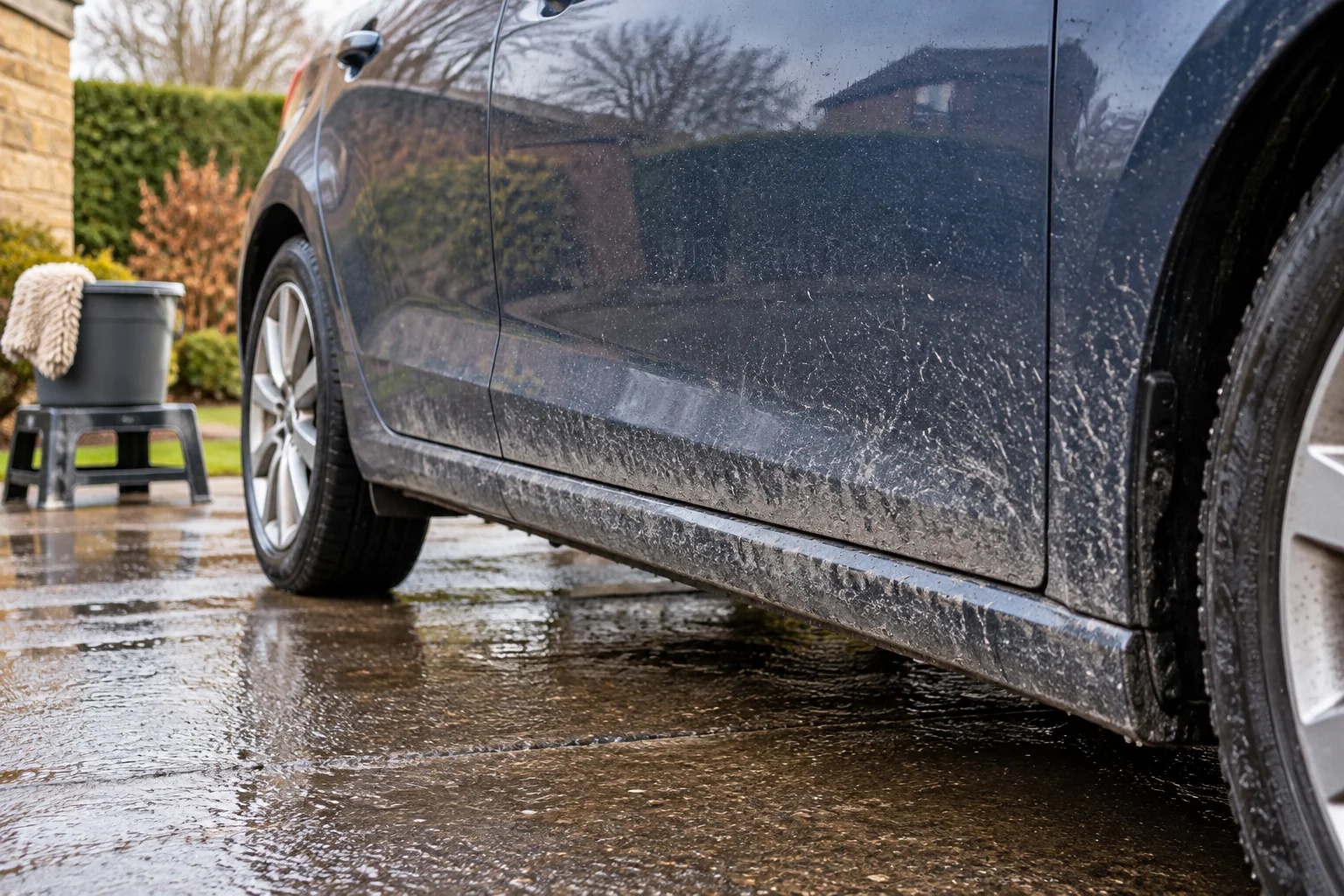
Treat salt as contamination to remove, not a stain to scrub
After driving on treated roads, lower doors, sills and the rear of the car can carry a pale film mixed with road dirt. The useful first action is a permitted rinse and wash, not rubbing the white residue with a dry cloth. Grit within that film can be dragged across the finish.
Vehicle makers advise cleaning corrosive contamination such as salt promptly. How you do that still depends on the car's finish, washing instructions and working conditions. A wrapped panel, matt finish, damaged coating or exposed repair area can need different care from ordinary sound gloss paint.
This guide covers routine exterior cleaning. It does not promise to prevent all corrosion or repair damage that is already present.
Choose a washing opportunity you can complete
Do not wash where water or runoff may freeze or create unsafe footing. Check shaded paving and the car's temperature rather than relying only on the air feeling mild. If the driveway is unsuitable, wait for a safe opportunity or use an appropriate washing facility.
Use an area where wastewater is managed appropriately, following vehicle and local guidance. Set out the rinse and drying equipment before starting. A partly completed chemical wash is not a useful shortcut when light or access is limited.
Keep hoses clear of traffic and walkways. Follow equipment instructions for water supply and operation, and read the car's preparation requirements, including any restriction on washing while connected to a charging cable.
1. Inspect the lower panels and close the car
Check for chips, lifting paint, loose trim and visible damage before spraying. Note which areas are ordinary road film and which look like a repair problem. Do not aim a strong jet at a damaged edge in an attempt to prove it is clean.
Close windows, doors and other openings as directed by the vehicle maker. Give wheel areas their own care checks; bodywork shampoo suitability does not approve a wheel chemical for every alloy finish.
2. Rinse the loose contamination thoroughly
Use the vehicle's permitted method to loosen and carry away salt and dirt before contact washing. Work deliberately across accessible lower panels and allow runoff to leave the surface. A quick wetting mist is different from a rinse that actually carries contamination away.
If using a pressure washer, follow the machine, nozzle and vehicle guidance together. Keep the jet away from vulnerable openings, seals, cameras and loose or damaged finishes as directed. There is no single nozzle distance that overrides every combination of equipment and car.
Do not insert a lance into a sill, aim into door drains or crawl beneath a car that is not safely supported. Underbody and wheel-arch cleaning requires vehicle-specific access and limits; use a suitable facility if the job cannot be done appropriately from your working position.
3. Decide whether remaining film needs a pre-wash
A rinse can remove loose contamination while leaving bonded traffic film. If that film would load the mitt immediately, a compatible pre-wash can be a useful next stage. It is optional according to condition, rather than a guarantee that the car will need no contact wash afterwards.
Bilt-Hamber Touch-Less is one chemical choice with a panel-concentration approach. Check the vehicle finish and the current product instructions, and calculate the delivery for your actual setup. Do not make a winter mixture stronger simply because the film looks grey.
For a measured panel concentration
Bilt-Hamber Touch-Less 5L
A pre-wash that can be applied through suitable pressure equipment or a compatible pump sprayer. The selected 5-litre listing states a 0.5–2% panel-impact-ratio range, matching the manufacturer’s guidance.
- 5-litre concentrate
- 0.5–2% stated PIR
- Lance or compatible pump application
Use the exact pack’s dose and check the finish and application equipment. A lance needs calibration; a pump sprayer uses its final working mixture. Follow the 1–5-minute instruction without allowing drying.
Rinse before the pre-wash dries and remain within its stated method. For concentration calculations, use the panel-impact ratio guide. If you cannot control application or rinsing, stop rather than extending dwell.
4. Contact-wash remaining dirt with clean equipment
After rinsing away loosened contamination, use a compatible shampoo and clean mitt for the remaining film. Dose the shampoo correctly and work in manageable sections. Refresh the tool and water as needed, especially as you reach the lower panels.
Gtechniq GWash is a routine shampoo option, subject to your finish and protection-system guidance. It is not a specialist salt neutraliser or a repair product. Its role is the permitted contact wash after the loose dirt has been removed.
A standalone bucket-wash shampoo
Gtechniq GWash 500ml
A concentrated, pH-neutral shampoo for a regular contact wash. A useful single-bottle choice when you already own a mitt and towels and do not need another boxed set.
- 500ml concentrate
- Bucket-wash shampoo
- pH-neutral formulation
Use the dilution on your UK bottle. This is GWash, not Ceramic GWash or a snow-foam pre-wash; follow your coating or finish supplier’s care instructions.
Keep wheel tools out of the bodywork wash. A cloth used on a dirty door shut should also stay separate from the main painted panels. If the mitt becomes gritty, deal with that contamination before continuing; another bucket does not automatically clean it.
5. Rinse away cleaner and dry the clean surfaces
Finish the rinse deliberately, paying attention to accessible edges and trim while respecting opening and pressure restrictions. Look for remaining foam or residue rather than assuming that the first clear-looking panel means the whole car is ready to dry.
Use a clean suitable drying towel only on washed bodywork. The Meguiar's Duo Twist towel is a drying option; inspect it before contact, keep it off the ground and follow its laundering instructions. Do not use a drying pass to remove a patch of salt film you missed.
For a dense 50 × 90cm drying towel
Meguiar’s Duo Twist Drying Towel
A 1200gsm duo-twist microfibre towel, with a longer rectangular shape. Consider it if you want a dense textile and can comfortably control that length around lower panels.
- 50 × 90cm
- 1200gsm microfibre
- 87% polyester / 13% polyamide
Follow its own wash and drying label. Density is not an independent absorbency test and does not guarantee one-towel drying for every car. Keep the trailing edge clear of the ground.
Use separate suitable textiles for accessible dirtier sills and shuts. Follow the vehicle's after-wash and brake-drying instructions, and check that no equipment or unsafe runoff remains before using the car.
What to do when a white mark remains
Let the cleaned area dry before deciding what you see. A persistent mark may be mineral residue, another contaminant or coating damage. Do not automatically repeat pre-wash at a higher concentration or move straight to an acid treatment.
Use the water-spot troubleshooting guide for mineral-mark possibilities. Rust, bubbling or failed paint needs repair advice. If uncertain, describe the surface and previous products to the vehicle supplier or a suitable detailer.
Reduce build-up through a manageable winter routine
Inspect after significant salt exposure and clean when you can complete the job under suitable conditions. No fixed schedule can account for every journey and parking arrangement. A winter routine also checks interior moisture and glass, so salt removal does not become the only seasonal task.
Protection products may form part of a compatible care system, but they do not remove the need to wash or repair damaged paint. Keep the priority on removing contamination with a method the vehicle and conditions allow.
Common questions
Does rinsing alone remove all road salt?
A thorough permitted rinse can remove loose salt and contamination, but traffic film and other dirt may remain. Assess the surface and use a compatible wash method where needed rather than claiming every rinse is a complete clean.
Should I neutralise salt with vinegar?
Do not introduce a household acid mixture without explicit material guidance. Begin with water and the vehicle-approved washing method. Ordinary salt film does not justify an improvised chemical treatment across paint and trim.
Can I dry-wipe a small white patch on the sill?
Avoid rubbing dry gritty residue across the finish. Rinse and clean the area appropriately first, using tools kept separate from the main bodywork where contamination requires it.
How do I tell salt residue from a water spot?
Appearance alone may be inconclusive. Note where the residue lies and how it responds to a permitted wash. A mark that remains after washing and drying may be a mineral deposit, damage or another contaminant rather than loose salt.
Will washing repair corrosion caused by salt?
No. Cleaning removes contamination but cannot replace missing paint or reverse established corrosion. Chips, bubbling, lifting lacquer and exposed rusty areas need appropriate repair advice.
Sources and product instructions
Follow the label and care instructions for the exact version and surface you own.