
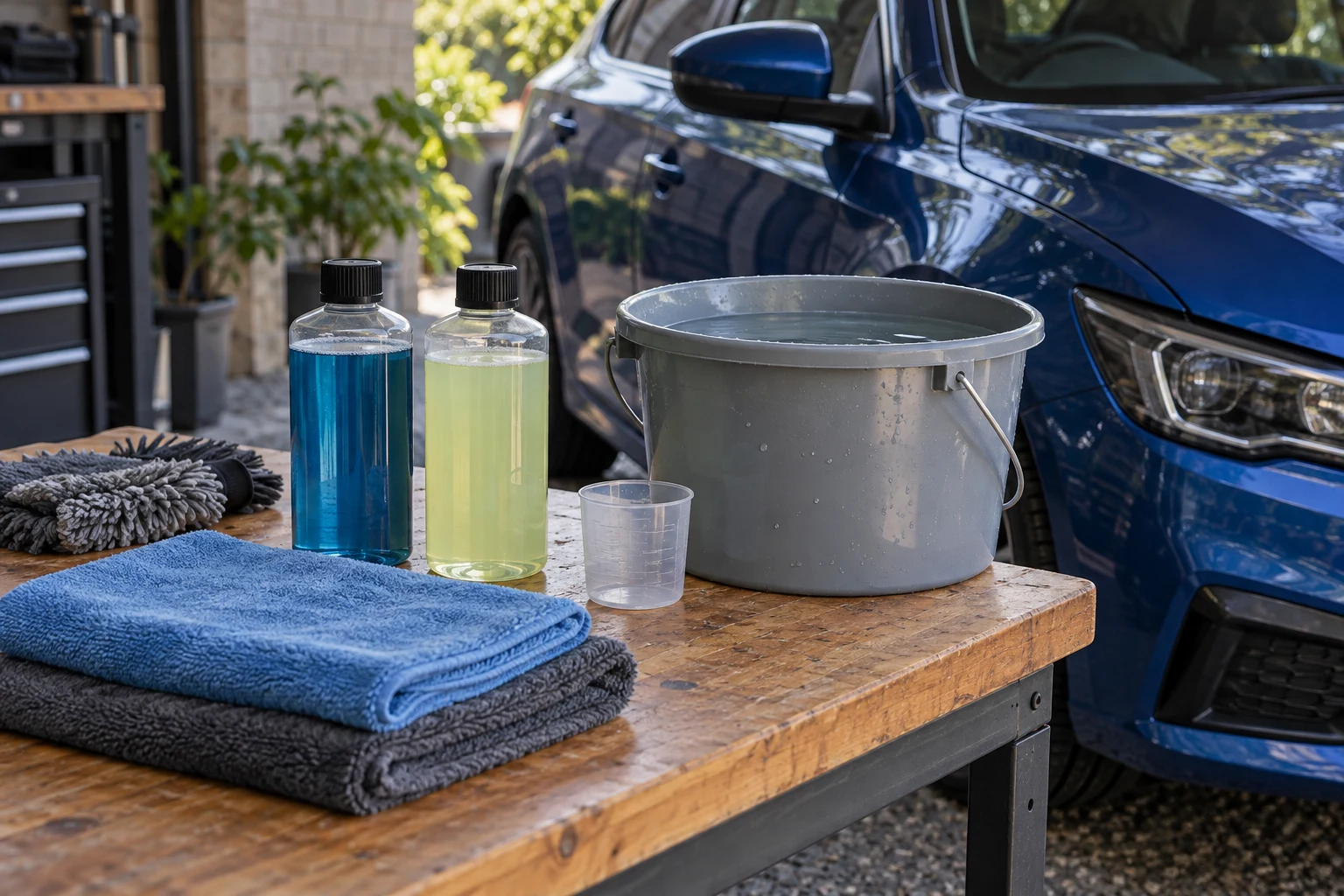
Choose a washing system before comparing bottle sizes
Check rinseless versus waterless washing if you were expecting a ready-to-use spray. The concentrates below belong to a measured-water routine, so include clean wash media and drying towels in the purchase.
A rinseless concentrate is useful when its method fits the car, the available working space and the dirt you need to remove. It is not a way to bypass bulk-grit removal, and it is not ordinary shampoo with the rinse step left out. Make those decisions before comparing a small bottle with a gallon container.
This guide compares two specific concentrates and a separate cloth pack. The selection is about formula identity, quantity and a workable routine.
Check the surface first. A gloss-painted daily driver, a fresh coating and a matt wrap can need different product permissions. Choose against the exact vehicle, finish and installer instructions. If the car is muddy or gritty and you cannot arrange an appropriate pre-rinse, changing concentrate is unlikely to solve the main obstacle.
Two concentrates with different pack sizes
| Product | Exact selected size | Practical fit |
|---|---|---|
| Optimum No Rinse Wash & Shine | 946ml / 32 US fl oz | A smaller container for building a measured routine |
| P&S Absolute Rinseless Wash | 1 US gallon / about 3.785L | A larger supply for regular use with suitable storage and measuring |
A smaller blue Wash & Shine bottle
The selected ONR bottle is the blue Wash & Shine formula in a 946ml pack. Keep it distinct from green Wash & Wax and yellow Opti-Coat products. The title does not establish which revision will be supplied, so use the received bottle’s matching directions.
For a measured bucket-based rinseless wash
Optimum No Rinse Wash & Shine 946ml
A single 946ml bottle of the blue Wash & Shine rinseless concentrate. Used with the specified water mixture and clean wash media, followed by drying each completed section.
- 946ml single bottle
- Blue Wash & Shine concentrate
- Water dilution and separate drying required
Check the received revision and directions. This is not the green Wash & Wax or yellow Opti-Coat formula. Heavy mud and grit need bulk removal first; no universal permission for specialist finishes, displays or interior assemblies.
Optimum’s current washing method uses a measured water mixture, wet wash media and section-by-section drying. That is the role to compare here. Do not buy a familiar name and then use an unrelated quick-detailer recipe from another version or a different-coloured formula.
The smaller container is easier to organise in a compact kit and makes sense when you are still establishing how much solution your routine needs. Keep it upright and labelled, with a measuring tool that can handle a small dose accurately. Convenience at mixing time is part of the purchase.
A gallon container for an established routine
The selected Absolute listing is a US-gallon pack, approximately 3.785 litres. It is not the quart bottle sometimes shown in other listings. The larger container is relevant if you wash regularly and have suitable storage and controlled decanting arrangements.
For an established rinseless routine using a larger container
P&S Absolute Rinseless Wash 1 US gallon
The selected pack is one US gallon, approximately 3.785L, of Absolute rinseless concentrate. It is a soap-alternative washing product; clean wash media and a separate drying towel are still needed.
- 1 US gallon / about 3.785L
- Rinseless concentrate
- Measure the application-specific dose
This is the gallon container, not a 946ml quart. Measure the received label’s washing dilution and decant only into a suitable labelled container. Bulk grit, mud and incompatible finishes still require a different method.
P&S describes Absolute as a rinseless soap alternative with a broad materials list. That does not override a vehicle or finish exclusion. Keep the buyer decision focused on the permitted exterior washing task rather than assuming the same solution should clean screens, upholstery and every coating.
A large container can become awkward if you cannot measure from it without spilling. Use a suitable clean labelled container if decanting is permitted; never a drink bottle. Factor the space and handling into the choice instead of treating the largest quantity as automatically best value.
Compare source-specific doses at three water volumes
These calculations extend the pack-size comparison to 5, 8 and 10 litres of water added. The methods are deliberately separate: Optimum’s V6 washing directions give one US fluid ounce in two US gallons of water; P&S Japan’s metric washing directions give 30ml in 8 litres. Their metric rates are not identical.
Use the row only when the received product’s washing instructions match it. The selected ONR listing does not guarantee V6, and the P&S regional example does not establish the dose printed on every UK-supplied Absolute bottle. A different received instruction needs its own calculation. Neither a pre-spray nor a clay-lubricant recipe belongs in this washing comparison.
| Water added Assumed | ONR V6 method Dose | 946ml ONR Complete doses | Absolute Japan method Dose | 3785ml Absolute Complete doses |
|---|---|---|---|---|
| 5 litres | 19.53ml | 48 | 18.75ml | 201 |
| 8 litres | 31.25ml | 30 | 30ml | 126 |
| 10 litres | 39.06ml | 24 | 37.5ml | 100 |
Method: Optimum’s US-volume instruction converts to one product part for 256 water parts, or 3.90625ml per litre of water. The P&S regional method is 30 ÷ 8 = 3.75ml per litre. Dose = water litres × that rate. Complete doses = bottle ml ÷ unrounded dose, rounded down; leftover concentrate = bottle ml − complete doses × dose.
The selected packs are modelled at their rounded 946ml and 3785ml quantities. A US gallon is approximately 3.785 litres, and these inputs are not measurements of bottle contents. At the 5-litre comparison, the ONR model leaves 8.5ml after 48 complete doses; Absolute leaves 16.25ml after 201. The remainder can contribute to another correctly mixed batch; it is not automatically waste.
These are bucket-dose counts, not whole-car wash counts. Extra solution, spills, pre-rinsing, wet-media preparation and laundry change practical consumption. Five litres of water plus concentrate also makes slightly more than five litres of finished solution. For a fixed final-volume recipe, use the total-parts method explained in the direct-mixture comparison.
Calculate the delivered bottle-price threshold
For concentrate allocated to one mix, use delivered bottle price × unrounded dose ÷ bottle ml. Dividing by the rounded-down count of complete doses instead assigns the entire bottle cost to those doses and leaves no value for the remainder; keep those two accounting methods distinct.
| Source method and pack | Equal-cost price Percentage of ONR price | Calculated delivered price |
|---|---|---|
| ONR Wash & Shine Optimum V6 US washing method | 100% | £18.00 |
| P&S Absolute P&S Japan metric washing method | 416.78% | £75.02 |
The £18 is an assumed example, not an Amazon offer. Threshold = ONR delivered price × (Absolute bottle ml ÷ Absolute dose per litre) ÷ (ONR bottle ml ÷ ONR dose per litre). With these methods, the Absolute threshold is about 4.17 times the ONR price. The multiplier stays the same across the three bucket sizes because both doses scale with water volume. Displayed prices and percentages are rounded; calculations retain unrounded inputs.
Below that threshold Absolute has the lower allocated concentrate cost under the stated methods; above it ONR does. That does not establish equivalent cleaning, finish or material approval. Clean textiles, drying equipment, water and other chemicals remain separate costs. Download the six dose scenarios, remainders, price thresholds and source links (CSV) to reproduce the figures or substitute matching label inputs. Calculated CSV values retain up to 12 significant digits.
Include enough suitable cloths
The liquid is only one part of a rinseless purchase. You need clean wet media for collecting soil, a place for used cloths and separate drying media. A plush four-pack is useful for establishing the routine, but the number of fresh faces needed depends on the car’s condition.
For a supply of separate clean plush cloth faces
The Rag Company Eagle Edgeless 500 — blue four-pack
Four blue 16 × 16in plush edgeless microfibre towels, specified as 500gsm and a 70/30 blend. Useful for permitted rinseless or waterless methods with frequent changes to clean faces.
- Four blue towels
- 16 × 16in / about 41cm square
- 500gsm / 70:30 blend
A four-pack is a starting supply, not a guaranteed whole-car allowance. Wash and inspect before use, keep dirty cloths separate and follow textile care. Plush fibres do not make trapped grit harmless.
Check the exact textile pack. This selection is four blue 16-inch-square Eagle Edgeless 500 towels. Different sizes and weights can appear under related names. Keep a clean spare supply rather than planning to stretch a single dirty cloth through the whole job.
Wash and inspect the towels before use, then follow their care instructions. Separate wheel, tyre and dressing cloths from paint-washing media. Replacing a contaminated face promptly is more useful than buying a thicker towel and assuming it can carry dirt indefinitely.
Ask what the formula leaves behind
Some washing products add wax, gloss or protective ingredients; others are selected for a particular existing protection system. Decide whether that fits the finish you want to maintain. A low-sheen surface should not receive a gloss-enhancing routine just because the product is described as gentle.
Keep rinseless selection separate from the later choice of wax or sealant. You can assess a clean dry panel more easily when several finishing products have not been layered during the same session. If an installer recommends a specific maintenance system, use that as the starting point.
Check practical limits before buying
A workable routine needs a cool manageable surface, a suitable place to wash and a way to handle wet equipment and waste solution. It also needs time to dry sections promptly. A product described as usable without a hose does not make every shared parking space an appropriate wash area.
Do not buy a concentrate to solve damage or bonded contamination. Scratches, tar, iron fallout and dried mineral deposits have their own assessment and removal decisions. Follow the rinseless method for the ordinary wash and stop when the surface falls outside it.
Start with the pack you can store and measure sensibly, add enough clean media, and keep the process repeatable. That gives the purchase a clear role: maintaining a suitable car with controlled wet contact and drying, without confusing low water use with permission to clean every condition in the same way.
Common questions
Is rinseless wash the same as waterless wash?
No. Rinseless washing normally uses a diluted bucket solution and wet wash media, followed by drying. Waterless cleaning uses a suitable ready-to-use or separately diluted spray-and-wipe method. Match the product’s instructions to the intended job.
Which bottle size should a beginner buy?
Choose a manageable pack that matches expected use and storage. The selected ONR is 946ml; the selected Absolute is one US gallon, about 3.785L. Neither size tells you how many whole cars can be washed without a stated water-volume assumption.
Does a rinseless wash replace all my other cleaners?
No. Do not transfer broad product descriptions to every display, seat assembly, specialist finish or contamination problem. Use the exact material and vehicle instructions and keep individual tasks separate.
Can I compare cost per wash without a product price?
Use a stated water volume, matching label dose and selected bottle quantity to calculate consumption. Allocated concentrate cost per mix is delivered bottle price multiplied by dose and divided by bottle volume. Dividing instead by rounded-down complete doses assigns the full cost to those doses, including the remainder. Neither method includes pre-rinsing, laundry or drying equipment.
Does a plush cloth guarantee scratch-free washing?
No. The condition of the paint, dirt and cloth all matter. Frequent changes to clean faces, appropriate lubrication and bulk-grit removal remain necessary regardless of cloth thickness.
Sources and product instructions
Follow the label and care instructions for the exact version and surface you own.