
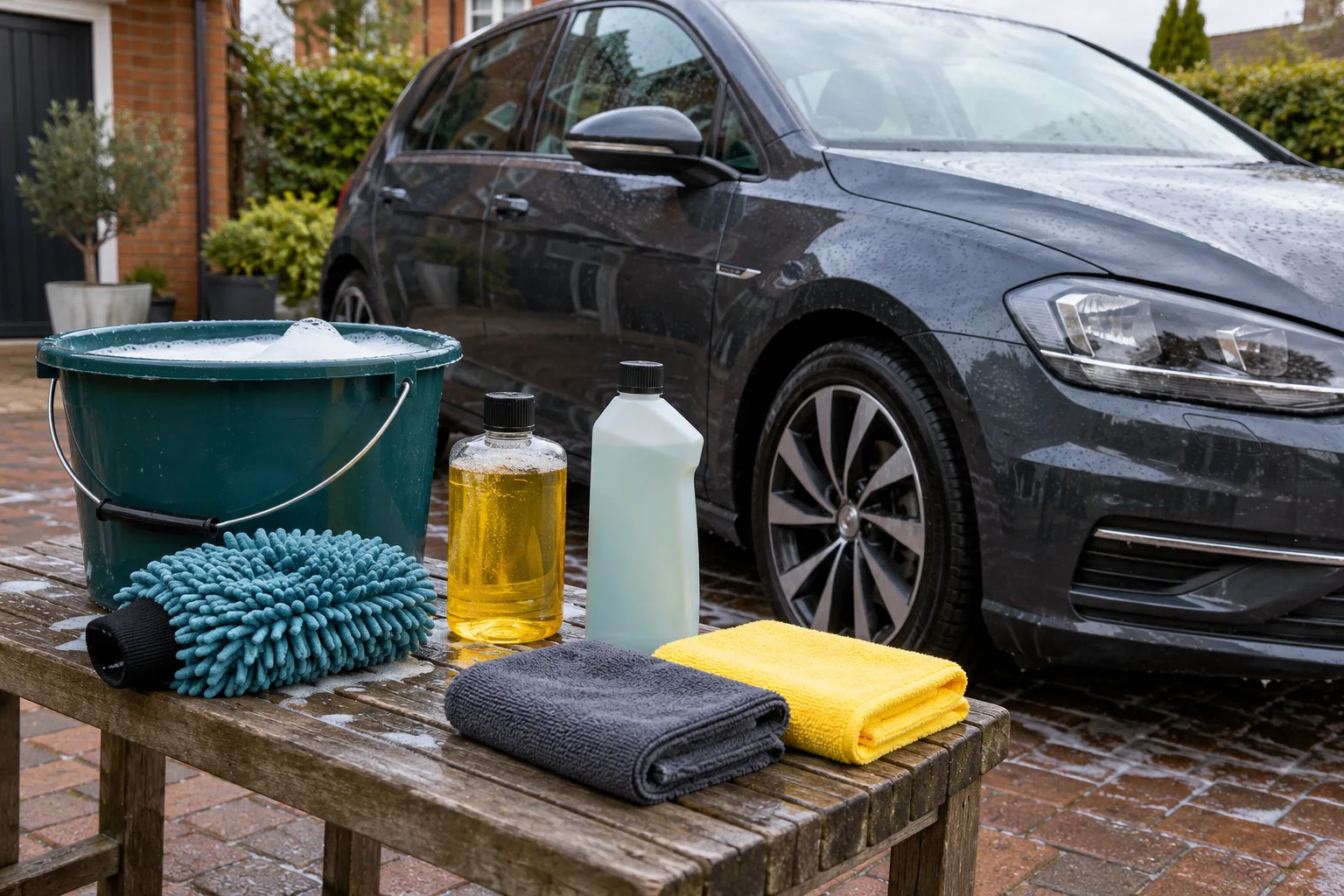
Ordinary shampoo focuses on the wash; wash-and-wax adds a finishing ingredient during that wash. A ceramic wash can also leave a protective film, even when the name does not contain “wax”. Choose according to the routine and finish you want rather than assuming one label is a more powerful version of another.
The distinction matters if you already maintain a coating, prefer a separate finishing step or own matt paint. A product can be pH neutral and still add gloss or water repellency that is not suitable for every surface.
Three different ways to finish the wash
| Product type | What the wash stage does | What it does not establish |
|---|---|---|
| Clean-rinsing shampoo | Removes routine dirt without an added finishing film | Does not remove every bonded deposit or correct paint |
| Wash-and-wax shampoo | Washes while leaving wax/polymer ingredients | Does not prove a particular protection lifetime |
| Ceramic or protective wash | Washes and leaves the manufacturer’s protective film | Not the same as applying a professional ceramic coating |
| Shampoo followed by separate wax | Keeps cleaning and finishing as two deliberate stages | Needs the separate product’s own preparation and cloths |
A shampoo marketed with conditioners may behave differently again. Do not classify it solely by the amount of foam or a single word on the label. Look for an explicit description of what remains after rinsing and any surface exclusions.
When a clean-rinsing shampoo makes sense
Choose this approach if you want the washing stage to remain separate from waxing or sealing. It can be simpler when you already have a compatible finishing routine and do not want another film changing the surface’s appearance or water behaviour.
Autoglym Foaming Car Wash is an example without an added finishing film. It is not automatically a stronger cleaner than a wash-and-wax. Its value here is that the finishing decision remains yours after rinsing and drying.
For a clean-rinsing bucket wash
Autoglym Foaming Car Wash 1L
A pH-neutral shampoo without added finishing film. The 1-litre bottle is a separate purchase when you already own your wash tools or prefer a separate wax or sealant step.
- 1 litre concentrate
- No added finishing film
- Two capfuls per 10 litres
Autoglym specifies two capfuls in 10 litres of water. Keep panels cool, rinse thoroughly and do not let the solution dry. Check the label and safety data sheet for your pack.
You can stop after the normal drying step when the existing finish and its care instructions allow. There is no rule that a separate wax must be applied after every wash. Equally, a clean-rinsing shampoo should not be used as a promise that every existing wax or coating is unaffected in every condition; follow the specific maintenance guidance.
When a wash-and-wax fits the routine
A rinse-off wash-and-wax can be convenient on compatible glossy bodywork when you want its added ingredients as part of a regular wash. Meguiar’s describes Ultimate Wash & Wax as a wash using carnauba and synthetic polymers between regular waxing jobs.
This selected 473ml bottle is the bucket shampoo. It is not Ultimate Waterless Wash & Wax, which has a different method and suitability limits. Check the full product name before comparing bottle sizes or substituting instructions.
For washing between separate waxing jobs
Meguiar’s Ultimate Wash & Wax 473ml
A bucket-wash shampoo containing carnauba wax and synthetic polymers. This smaller 473ml version suits someone who wants to try a wash-and-wax approach without buying a larger bottle.
- 473ml bottle
- Carnauba and synthetic polymers
- Rinse-off bucket shampoo
This is the rinse-off bucket shampoo, not Ultimate Waterless Wash & Wax. Use its own dilution. Check finish compatibility; added wax is not a substitute for preparing or correcting damaged paint.
The convenience is combining jobs. The trade-off is that you are deliberately leaving something behind. If you are diagnosing an unexpected film or checking a specialist finish, that may complicate the picture. Choose the finishing behaviour intentionally instead of treating it as a free upgrade on every car.
Where a ceramic wash belongs
Autoglym Ceramic Wash & Protect uses a low-foaming formula and leaves a water-repellent, high-gloss film. Its stated dose is 30ml per 10 litres. It demonstrates why low foam does not mean low concentration or poor cleaning, and why “ceramic” needs a product-specific explanation.
For a wash with added finishing film
Autoglym Ceramic Wash & Protect 1L
A low-foaming shampoo that adds a water-repellent, high-gloss finish. The manufacturer gives a measurable dose of 30ml per 10 litres, making bottle-yield calculations straightforward.
- 1 litre concentrate
- 30ml per 10 litres
- Added protective film
Not recommended for matt paint. Check your coating’s maintenance guidance and follow the exact label. Autoglym recommends cleaning the windscreen afterwards with a suitable glass product.
It is excluded for matt paint because it increases gloss. Autoglym also recommends cleaning the windscreen afterwards with a suitable glass product. Those detailed instructions matter more than a broad claim of exterior suitability.
A protective wash is not equivalent to a professionally installed coating, and water beading does not measure protection life. Do not use a glossy result as proof that a previous coating has been restored, or that defects in the underlying finish have been repaired.
A wet-applied wax is a different method again
A kit can contain ordinary shampoo and a separate wax intended for a wet car. In that situation the shampoo itself is not a wash-and-wax. You wash, rinse and then follow the separate product’s spreading and buffing method.
Autoglym’s Bodywork Wash & Protect kit uses that sequence with Rapid Aqua Wax. By contrast, a finishing spray intended for a clean, dry panel starts after the standard drying stage. The right order comes from the particular bottle, not the general word “wax”.
Pick one routine before buying more bottles
- You already like your separate wax or sealant: consider a compatible clean-rinsing maintenance shampoo.
- You want a wash-stage finishing film on glossy paint: compare a wash-and-wax with a protective wash and read their exclusions.
- You own matt paint, a wrap or a coating with a specified care system: begin with the finish supplier’s instructions.
- You are trying to remove an unexplained film: check what the current shampoo is designed to leave behind before changing concentration.
Our shampoo buying guide compares the individual bottles. The complete home-wash guide covers the shared washing stages that still matter whichever formulation you choose.
Troubleshoot residue before changing the product type
Streaks can come from excess concentrate, incomplete rinsing, a contaminated towel or water draining from trim. Pale dried rings can be mineral residue. Those are different causes, and adding another wax will not reliably distinguish them.
Check your measured water volume and dose, rinse thoroughly and use clean task-specific textiles. If the finish is still unexpected, compare the product’s intended residue with what you are seeing. Persistent marks may need a separate diagnosis rather than repeated washing or a stronger mixture. The water-spot guide provides a careful starting point.
Common questions
Does wash-and-wax replace a separate wax?
Not automatically. It adds finishing ingredients during washing, while a separate wax has its own preparation and application method. Use the manufacturer’s description rather than assuming the two approaches give identical protection or duration.
Can wash-and-wax damage a ceramic coating?
Check the coating manufacturer or installer’s care instructions for the exact wash product. A compatibility statement for one system does not settle every coating. Added finishing film can also change visible water behaviour without proving the condition of the original coating.
Is a low-foaming shampoo worse?
No. Some formulations are intentionally low foaming. Autoglym Ceramic Wash & Protect is one example with a stated dose and a protective film. Use the label’s amount and judge the intended routine rather than adding extra product to create more suds.
Is wash-and-wax suitable for matt paint?
Only if both the product and the finish guidance permit it. A gloss-enhancing formulation may be unsuitable even if it is pH neutral. Ceramic Wash & Protect specifically excludes matt paint; do not generalise another product’s compatibility.
Does beading mean the paint is fully protected?
Water behaviour is not a complete protection measurement. Different products leave different films and contaminants can change what you see. Follow the finish’s maintenance instructions rather than using a few water beads to infer a guaranteed protection period.
Sources and product instructions
Follow the label and care instructions for the exact version and surface you own.