
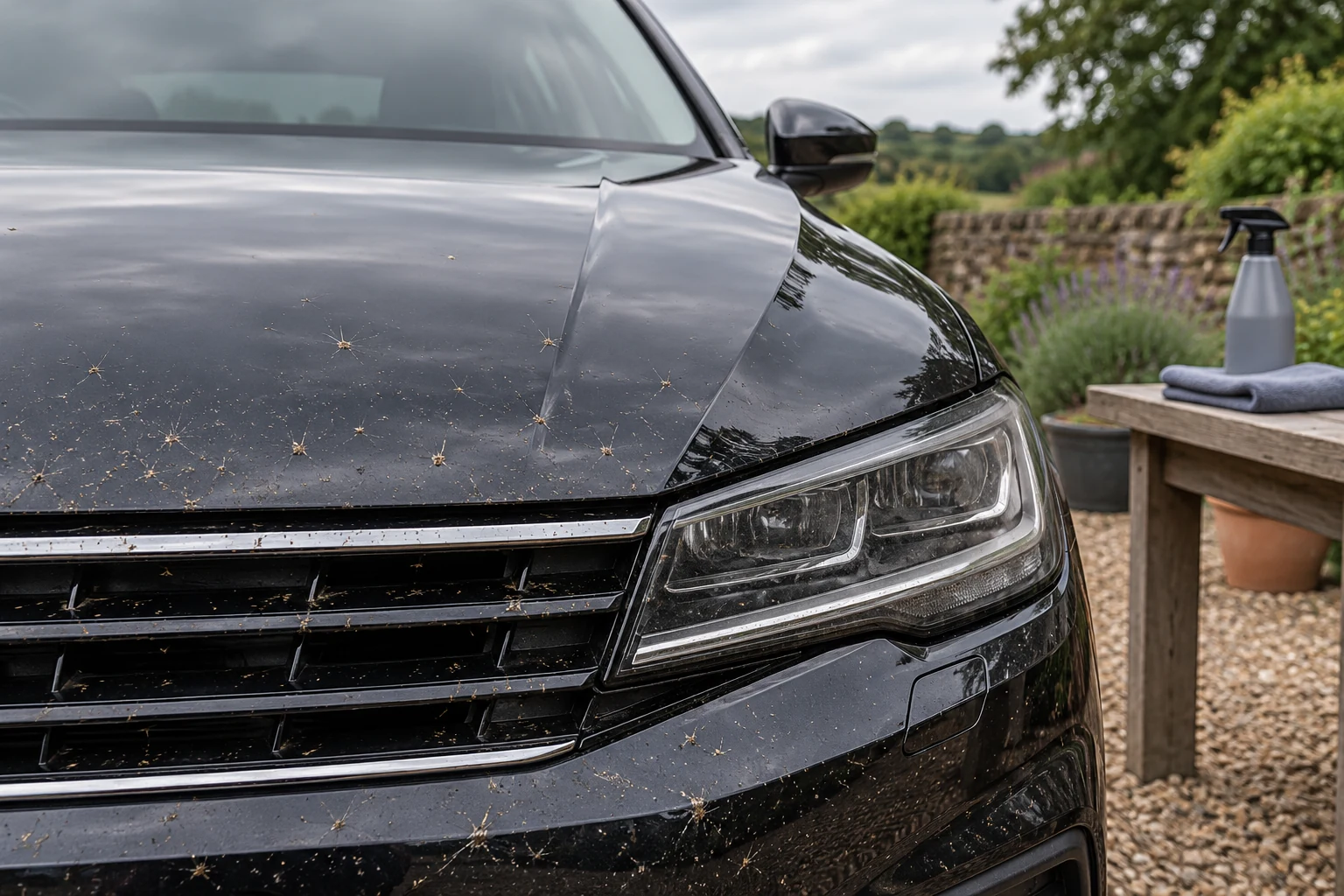
Treat dried insects as a softening job
Insect remains collect along bumper faces, bonnet edges, mirrors and other forward-facing surfaces. A normal wash may remove fresh deposits, while dried material can resist a quick pass. That resistance is a reason to improve the compatible softening process rather than choose a rougher tool.
Begin by checking the surface and working conditions. The front of a car combines paint, plastics, lights, number plates, sensors and sometimes film or repaired areas. A broad bodywork recommendation does not automatically approve every one of those materials.
Work while the surface and weather meet the cleaner’s directions. Have rinsing or the required removal method ready before applying product, so the cleaner does not sit unattended while you arrange equipment.
Step 1: rinse loose dirt and assess the load
Remove loose dust and grit through a suitable rinse before rubbing the front end. Keep pressure-washer use within the vehicle and equipment guidance, especially around damaged edges and sensitive components. A strong close jet is not a substitute for softening a stuck deposit.
If a normal compatible wash removes the remains comfortably, no dedicated chemical stage is compulsory. Where deposits persist, identify the actual problem and choose one suitable insect cleaner. Do not combine a bug remover, snow foam and solvent into one stronger mixture.
| Choice | Relevant instruction | Practical implication |
|---|---|---|
| Autoglym Active Insect Remover | Approximately 30 seconds to soften, followed by soft-cloth removal or a hose rinse before a full wash | A controlled short treatment; exclude hot surfaces |
| Gtechniq W8 | Three-to-five-minute dwell, then rinse; repeat or use permitted gentle cloth agitation if necessary | Allow a suitable working window and reliable rinse access |
| Ordinary wash first | Remove what responds through the compatible routine | Do not add another chemical just because insects were present |
Step 2: use the Autoglym softening method where suitable
Autoglym Active Insect Remover is a foaming trigger product with an approximate 30-second softening instruction. Its removal routes differ according to the job: a soft cloth for an appropriate isolated clean, or hosing off when it precedes a full wash.
Choose the route before application. A soft cloth should not become a way to wipe unrelated road grit over the panel. For a dirty front end, a controlled pre-wash treatment followed by the proper wash can be easier to manage than local wiping across every deposit.
For softening insects before wiping or washing
Autoglym Active Insect Remover 500ml
A foaming insect cleaner for compatible hard exterior surfaces. Its directions allow a soft-cloth removal or a hose rinse when used before a full vehicle wash.
- 500ml trigger spray
- Approximate 30-second softening
- Wipe or pre-wash rinse method
Avoid hot surfaces. The maker’s approximate 30-second softening method is specific to this product, not a dwell time for every bug remover. Check specialist coatings, film and trim instructions.
Avoid hot surfaces. Although the maker describes several hard exterior uses, check any specialist coating, film or material instructions separately. Do not turn a headlight or number-plate claim into permission for every aftermarket treatment.
Step 3: keep W8’s rinse method separate
Gtechniq W8 is an alternative with a different dwell-and-rinse sequence. The maker specifies three to five minutes and use out of direct sunlight, with suitable protective handling. It describes gentle MF1-type cloth agitation only for more difficult cases.
This is not a reason to import W8’s timing into the Autoglym method. Product loading, formulation and conditions differ. Follow the received bottle and finish requirements, and keep the area under observation rather than treating the longest possible dwell as the target.
For an insect-removal rinse stage
Gtechniq W8 Bug Remover 500ml
An insect remover with a three-to-five-minute dwell and rinse method. Gtechniq specifies compatibility with its own coatings; difficult remains may need the permitted gentle cloth agitation.
- 500ml bottle
- Three-to-five-minute dwell
- Rinse before assessment
Follow finish and received-label instructions, wear the specified protection and work out of direct sunlight. Do not copy another insect cleaner’s timing or use coating-safe wording as universal surface approval.
Gtechniq states compatibility with its own coatings. If another brand or installer controls the finish, check that maintenance guidance too. “Coating safe” is not a complete material specification for every surface on a bumper.
Step 4: use only the contact the process needs
After the permitted softening stage, remove loosened material with the specified rinse or suitable soft tool. Keep contact gentle and controlled. A textured insect pad is not automatically appropriate simply because its packaging uses a car-cleaning description.
Inspect cloths and mitts for hard fragments as you work. Use a clean face and rinse or change tools before collected remains become part of the next pass. Keep wheel brushes and heavily contaminated utility cloths out of the bodywork process.
If material remains stuck, reassess rather than increasing pressure. Repeat only where the product supports it and conditions remain suitable. A persistent line may be residue or a finish defect, not a deposit needing progressively harder scrubbing.
Step 5: complete the wash and rinse
Where the treatment is part of a full clean, continue through the compatible contact wash and rinse. Avoid washing over material that has not softened or been removed sufficiently for safe contact. Keep the shampoo dose and other chemical instructions separate from the insect cleaner’s method.
Rinse around accessible edges and gaps without driving liquid into components excluded by the vehicle guidance. Do not use an ordinary bodywork article as permission to flood sensors, connections or damaged parts. Finish the cleaner’s removal stage before choosing a protective product.
Dry through the suitable routine with clean textiles. Do not finish with the cloth that collected insect residue. Give drying and chemical-removal cloths separate collection and cleanup routes.
Inspect what is actually left
Keep different deposits separate: bird-dropping removal uses its own softening and inspection decisions, while tar removal needs a confirmed compatible treatment. A mark left after either clean is not automatically more dirt.
Assess clean paint in useful light. Smearing may indicate residual product or contamination, while a persistent outline can require finish assessment. A change in reflection when wet does not prove that a mark can be corrected without consequence.
Stop if there is unexpected colour transfer, softening, damage or an unfamiliar surface change. For a blemish in the finish, seek appropriate advice before abrasive correction. Insect cleaner is a maintenance product, not a repair for damaged lacquer.
Make the next clean more manageable
Check the front end after insect-heavy journeys and remove identified deposits through a suitable method rather than allowing every wash to become a major cleanup. Maintain compatible protection where appropriate, but do not assume wax or coating eliminates the need for prompt care.
Keep product instructions accessible and choose a weather window you can complete. The useful result is clean bodywork with controlled contact, not the strongest foam, longest dwell or most aggressive sponge.
Common questions
Can I use a kitchen scouring sponge on dried insects?
Avoid abrasive pads and rough household scrubbers on bodywork. Use a suitable cleaner and softening process, then only the gentle contact permitted by the product and finish instructions.
How long should insect remover dwell?
Use the exact product’s directions. Autoglym Active Insect Remover gives approximately 30 seconds for softening, while Gtechniq W8 specifies three to five minutes before rinsing. Neither is a universal timing rule.
Can I apply insect cleaner to a hot bonnet?
Do not use the featured Autoglym product on hot surfaces, and follow the other cleaner’s conditions. Move to suitable shade or postpone the job. Rapid drying makes the treatment harder to control.
Is insect remover suitable for a ceramic-coated car?
Check both the product and coating guidance. Gtechniq specifies W8 compatibility with its own coatings. That does not establish identical approval for every coating, wrap, film or specialist finish.
Why do insect outlines remain after cleaning?
Some may be residue, while others may be blemishes in the finish. Inspect after the permitted cleaning and drying process. Do not repeatedly scrub a clean panel or assume more cleaner will reverse damage.
Sources and product instructions
Follow the label and care instructions for the exact version and surface you own.