
Identify the film before choosing a cleaner
A coloured wrap is a surface in its own right. It may be gloss, satin, matt, textured or printed with an additional laminate. A colour description does not tell you its chemical resistance, and a ceramic coating over the wrap adds another set of aftercare instructions. Keep the installer’s film name and care sheet with your cleaning kit.
Check where the material ends. Door edges, fuel flaps, bonnet corners and recesses deserve attention before washing, because a vulnerable join can be hidden in an otherwise tidy panel. If film is lifting, cracked or torn, ask the installer about that area before continuing. Washing does not repair adhesive or improve a damaged edge.
A newly applied wrap also needs its own settling period. 3M specifies at least 72 hours for its 2080 film before washing. Follow the actual installation instructions, including any coating restrictions, rather than counting from collection and assuming all work finished at the same time.
Build a simple wrap-washing kit
Choose a mild shampoo with relevant wrap coverage and without a finish-changing wax or gloss package where that is excluded. Auto Finesse lists Lather for vinyl wraps and describes it as a pure shampoo. Confirm the particular film permits it, then use the label dose and a small compatibility check.
For a permitted additive-free wrap or matt-finish wash
Auto Finesse Lather Car Shampoo 500ml
A 500ml pH-neutral contact-wash shampoo without waxes, fillers or gloss enhancers. Auto Finesse lists vinyl-wrap use and includes Lather in its matt/satin care system.
- 500ml single bottle
- LAT500 pure shampoo
- No wax or gloss-enhancing finish
Film installer and vehicle-paint instructions still take priority, followed by a small hidden-area check. This is not Wash N Gloss, a spot-removal solvent or a way to repair a shiny patch on matt paint.
Avery Dennison’s routine guidance also considers detergent composition and hidden-area testing. The lesson is broader than a pH number: an all-purpose degreaser and a dedicated shampoo can have very different purposes even when their marketing sounds gentle. Do not treat a bodywork tar remover as a wrap spot cleaner without explicit permission.
Keep two or more clean soft wash tools available, especially for dirty lower sections. Reserve separate equipment for wheels, tyres and exhaust tips. A soft cloth with dried wax, grit or greasy dressing on it is no longer an appropriate wrap cloth simply because its fibres feel plush.
A reusable bodywork wash tool
Meguiar’s Super Thick Microfibre Wash Mitt
A microfibre mitt for contact washing the bodywork. Meguiar’s specifies machine washing, so it can be cleaned and reused as part of your regular wash routine.
- Microfibre
- Machine washable
- Separate from wheel-cleaning tools
Rinse it frequently during the wash and keep it separate from wheel tools. A dirty mitt can mark paint; no mitt guarantees scratch-free washing.
Wash in manageable sections
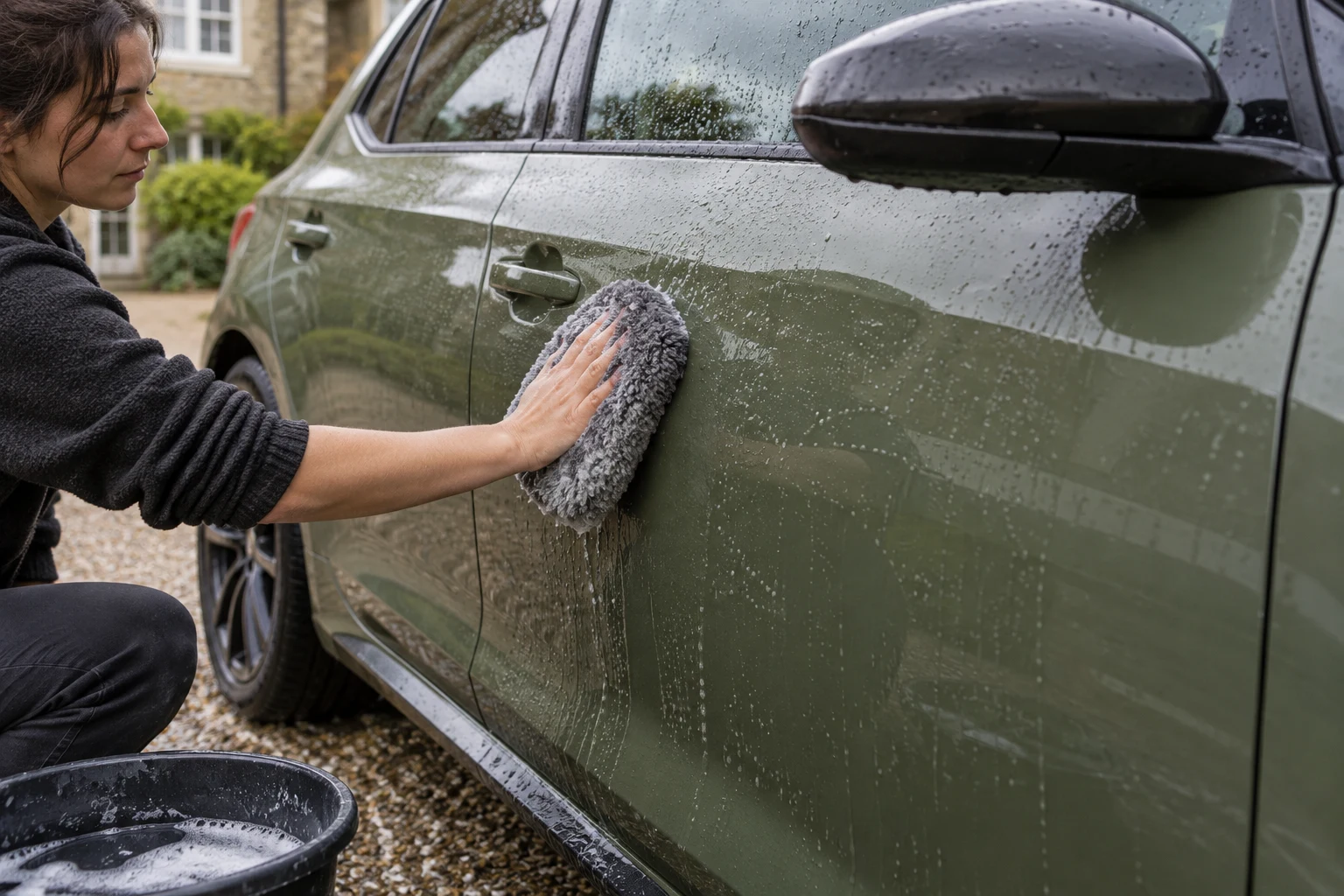
Park out of direct sun and wait for cool panels. Set the hose down where it will not scrape across the doors. Rinse away loose dirt using a gentle flow, looking at the surface as you go. A wrap can collect ordinary road grime without needing an intensive decontamination routine at every wash.
Wash from cleaner upper areas towards the lower body. Use enough permitted solution to lubricate the tool, light passes and frequent rinsing of the mitt. Do not work a dirty patch repeatedly with the same small face of the mitt. Reload with clean solution or change the tool.
Around joins, reduce contact and keep the tool controlled. Avoid snagging a cloth corner on a film edge, pushing a brush into a recess or dragging dirt from a wheel arch across the wrap. If water alone is not clearing an edge, leave it for a careful inspection rather than forcing it clean.
Rinse before shampoo dries. A small section that is rinsed and dried properly is more useful than coating the whole vehicle in solution while the first side bakes in the sun. If conditions change during the job, shorten the working area or pause.
Treat pressure-washer advice as film specific
A pressure washer can make loose-dirt removal convenient, but its nozzle, distance, water temperature and direction all change what reaches the film. An appliance’s maximum rating is not a wrap-care instruction. Use the film maker’s complete limits if pressure washing is permitted.
Keep a jet away from exposed or suspect edges. Do not direct water under a corner, into a cut line or along a lifting overlap. A gentle hose is a practical choice when you cannot confidently control those areas. The general pressure-washer guide explains equipment handling, while the film instructions set the surface limits.
Dry without dragging across joins
Use a clean soft drying towel with light contact. Support it so that it cannot drop onto the ground or snag a mirror or badge. Work broad areas carefully and use a clean folded section around details rather than sweeping a heavy wet towel through every recess.
For an 80 × 60cm twisted-loop towel
Autoglym Ultra-Soft Drying Towel
A dedicated twisted-loop drying towel, listed at 80 × 60cm. Its shape offers a broad drying area without moving up to an especially long towel.
- 80 × 60cm
- Twisted-loop construction
- Dedicated car-drying towel
Wash separately before use and follow the care label. Current manufacturer directions allow machine washing up to 40°C without softener and recommend tumble drying; check the supplied drying setting.
Inspect for water trails from mirrors, handles and panel gaps. Catch an accessible drip gently after it appears; do not force the cloth underneath the film to remove hidden water. A drying towel should collect clean water, not polish away an unidentified mark.
Handle contamination without borrowing a paint recipe
Bird residue, insect remains, fuel and tree deposits deserve prompt attention, but urgency is not permission to scrub. Remove loose contamination with the mild method allowed for the film. If it has hardened or stained, ask the installer for the correct spot treatment before buying a solvent.
3M and Avery publish product- and situation-specific care details that do not form one interchangeable recipe. In particular, solvent allowances for one named film should not be transferred to another, and professional heat work is not a driveway cleaning step. Keep household alcohol mixtures, adhesive removers and steam out of the routine unless the exact instructions permit them.
If an approved spot treatment is needed, protect nearby materials, test where directed and stop if colour, sheen or texture changes. Rinse or remove residues as instructed. Record what you used so an installer can assess a persistent mark without guessing through several layers of products.
Preserve the intended sheen
Gloss wrap and matt wrap should not share an automatic finishing stage. Ordinary waxes, polishing compounds and gloss sprays may leave a different appearance on a low-sheen surface. Even a product sold for matt paint needs separate film approval if you intend to use it on a wrap.
Judge the finish when it is clean and dry under consistent light. Wet film can hide marks, while strong reflections can exaggerate them. Do not try to blend a shiny patch by rubbing a larger area. Stop and ask about the film condition before making a small defect more visible.
Keep between-wash care realistic
Choose parking that reduces avoidable contamination where possible and clean spills promptly using the approved method. Keep a clean suitable cloth and the installer-approved spot product together, rather than improvising with a wheel cloth from the boot. Any cover should be clean and appropriate for the vehicle and film; a gritty cover creates another contact problem.
A useful home routine ends with an edge check and clean tools ready for next time. Persistent staining, shrinking, bubbling or lifting belongs with the installer. Photograph the location and describe the cleaning history. That gives a much better starting point than attempting heat, trimming or adhesive repairs during a wash.
Common questions
How soon can I wash a newly wrapped car?
Use the installer’s instructions for the exact film. For example, 3M’s 2080 maintenance guidance says at least 72 hours. That example does not establish the waiting time for another film, adhesive or coating.
Can I polish scratches out of a matt wrap?
Do not apply a normal paint-polishing method. Abrasion can alter the film’s sheen and texture. Show the installer a clean dry photograph; repair or replacement may be more appropriate.
Is a pH-neutral shampoo enough to prove wrap compatibility?
No. Additives, solvents, concentration and the film finish also matter. Use the film/installer guidance, choose a product with relevant coverage and test a discreet area as instructed.
Can I pressure wash a wrapped car?
Only within the exact film maker’s conditions. Avoid directing water into edges, seams or damaged areas. Gentle hose rinsing is easier to control around vulnerable joins; do not borrow paint-only pressure limits.
What should I do if an edge starts lifting?
Stop brushing or spraying that edge and contact the installer. Do not pull it, trim it with a blade, apply household glue or use a heat gun as a cleaning repair.
Sources and product instructions
Follow the label and care instructions for the exact version and surface you own.