
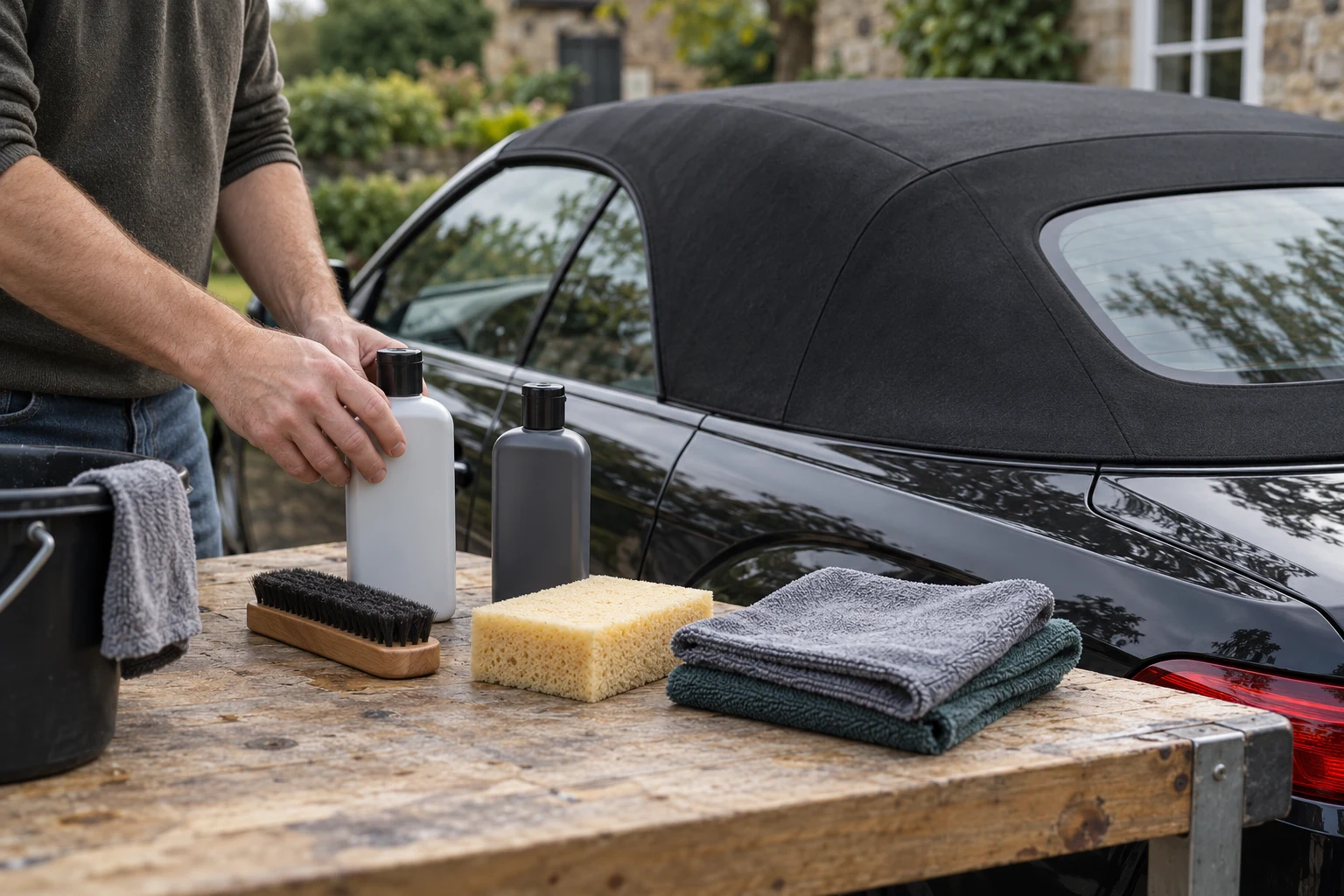
Choose the system around the roof and your drying space
The most useful fabric-roof kit is one that suits the actual covering and can be applied properly where the car lives. A box with more bottles is not necessarily more complete. Check whether it includes a cleaner, a protector, appropriate application tools and enough instructions to manage the transition between those stages.
Confirm fabric rather than vinyl using the vehicle or replacement-roof record. Then inspect the condition. A kit is appropriate for maintenance of a suitable serviceable roof; it cannot solve torn material, separated windows, failed seams or an unidentified leak. Budget for assessment first if water is already entering the cabin.
This comparison covers one boxed system and two ways of buying separate products. They have different preparation and moisture requirements. The useful choice is the complete method, including tools and shelter, rather than a contest over bottle size or promised durability.
Compare the complete systems
| Approach | What you buy | Practical requirement |
|---|---|---|
| Autoglym STCPKIT/1 | Matched cleaner and protector with two sponges | Clean and thoroughly rinse; selected protector goes onto damp fabric |
| Renovo separate bottles | Fabric cleaner and fabric Ultra Proofer; tools separate | Follow each stage’s label, with drying between permitted protection coats |
| Gtechniq separate preparation and I1 | Approved exterior cleaning stage plus I1 fabric protection | Thoroughly dry fabric, suitable ventilation and protected curing time |
A matched box with the application tools supplied
The selected Autoglym kit has two 500ml bottles and separate white cleaning and blue protector sponges. This is the current STCPKIT/1 version. Older spray-kit instructions still appear elsewhere, so match the method to the pack you receive.
For a matched fabric-roof system with two application sponges
Autoglym Soft Top Clean & Protect Complete Kit
The selected current kit contains 500ml Soft Top Cleaner, 500ml Soft Top Protector, a white cleaning sponge and a blue protector applicator. It separates cleaning and protection, with the protector applied to a clean damp hood.
- 500ml cleaner + 500ml protector
- White cleaning / blue application sponges
- Fabric roof; damp-surface protection
For compatible mohair, double duck, fabric and canvas hoods, not vinyl. Follow the received version: older spray kits have different instructions. Completely rinse cleaner before protection; let the treated roof dry fully before driving or folding.
This option makes sense where the roof permits the system and you prefer a matched set of tools and liquids. Its damp-roof protection stage can fit a different working day from a dry-fabric system. It still needs complete cleaner removal and a protected drying period after treatment.
Do not assume the supplied tools eliminate every other need. You still need gentle rinse water, clean cloths for nearby surfaces, suitable gloves and somewhere to organise the job. Check whether the car can remain raised-roof and undisturbed until the treated material is ready.
Separate Renovo cleaner and fabric protection
Renovo sells the cleaning and protection stages separately. This can suit someone replacing one depleted bottle or assembling a maintenance kit without a colour-restoration stage. Check the word Fabric on both products; the similarly branded vinyl range is a different purchase.
For separate cleaning of a compatible fabric hood
Renovo Fabric Soft Top Cleaner 500ml
A 500ml fabric-roof cleaner, applied with a separate brush and rinsed away. It is a cleaning stage, without a fabric protector or colour reviver included.
- 500ml bottle
- Fabric cleaner only
- Separate application brush required
Fabric only, not vinyl. Test colourfastness, use the bottle method without dilution or mixing, and avoid pressure washing. Cleaners and applicators are not interchangeable with a proofer or dye.
The cleaner is not a waterproofer. Include the correct application tools and a rinse plan, then decide whether the roof needs the separate protector. A darker wet roof after cleaning is not evidence that its colour has been restored or that protection has been added.
For a brush-applied fabric protector bought separately
Renovo Fabric Soft Top Ultra Proofer 500ml
A 500ml fabric protector, also described by Renovo as Fabric Soft Top Protector. It is a separate stage after cleaning and is applied with a suitable clean brush.
- 500ml bottle
- Fabric protection, not cleaner or dye
- Application brush bought separately
Not the Vinyl Ultra Proofer and not a recolouring product. Follow the received label for preparation, stirring, coating and drying. Dry between any permitted coats and keep out of rain until fully dry; it does not repair roof damage.
Renovo’s naming includes Fabric Soft Top Protector and Ultra Proofer. Read the complete bottle and its directions rather than choosing by a familiar-looking label. A colour Reviver is a separate product and is not included in this two-bottle approach. Avoid paying for recolouring unless the roof’s condition and material justify that additional job.
Buy a suitable clean application brush and container separately if required by the received instructions. Keep the protection brush distinct from the dirty cleaning tool. A brush with dried cleaner or paint residue is not a saving when it introduces another contaminant onto prepared fabric.
I1 for a routine with thorough drying and shelter
Gtechniq I1 is another separate fabric-protection choice. Its current instructions require fabric substantially drier than touch dry. That preparation can be the deciding factor for a car kept outside through unsettled weather.
For fabric protection where thorough drying and curing are practical
Gtechniq I1 Smart Fabric 500ml
A 500ml fabric protector for compatible textiles, including approved fabric convertible roofs. Gtechniq’s current instructions require fabric to be significantly drier than touch dry before treatment, followed by a protected curing period.
- 500ml bottle
- Fabric protector; cleaner separate
- Thorough drying and curing required
This exact Amazon listing says I1, without a guaranteed V3 designation. Match the received bottle to its instructions; do not transfer Autoglym’s damp-roof method. Protect adjacent surfaces and ventilate as directed. Use a separate approved treatment for vinyl roofs; this product does not repair leaks.
The selected Amazon bottle is listed as I1 500ml; do not assume a particular revision from the short title. Follow the received label and its matching manufacturer instructions. Set aside the required ventilation, surface preparation and curing conditions before committing to this route.
Gtechniq specifies W5 as an exterior preparation option for its system. Confirm the roof permits that cleaner and use the matching preparation directions; its general all-purpose uses do not establish universal roof approval.
For approved cleaning with task-specific dilution
Gtechniq W5 Citrus All Purpose Cleaner 1L
An all-purpose cleaner with different preparation and dilution directions for different jobs. Choose the method for the actual surface and rinse as instructed before the next stage.
- 1L bottle
- Dilution depends on job
- Rinse after cleaning
Use the exact label and material approval, test discreetly and do not let the cleaner dry. Do not transfer a heavy-duty or neat application to every surface. Remove residue thoroughly and follow the next product’s preparation requirements.
This is a separate-product system rather than a boxed roof kit. It can be practical for someone who already has the approved preparation tools and a suitable sheltered drying space. It is a poor choice if the plan relies on treating fabric that has merely stopped looking wet after a short rinse.
Pair the cleaner and protector allocations
The current Autoglym STCPKIT/1 instructions use 250ml cleaner with 500ml water and approximately half of the 500ml protector bottle. Its FAQ describes two applications per kit. These figures belong to this sponge-applied version; do not transfer them to an older spray pack or a different roof system.
One stated cleaner batch is 750ml of working mixture. A 500ml cleaner bottle makes two such batches in ideal arithmetic. Modelling “approximately half” the protector as 250ml gives two protection allocations. Pairing two cleaner batches with two protection allocations gives two nominal complete routines, rather than four: the stages are used together.
| Protector per routine | Basis | Complete cleaner batches Calculated | Complete protection allocations Calculated | Matched routines Calculated |
|---|---|---|---|---|
| 200ml | Hypothetical consumption sensitivity, not a dosing instruction | 2 | 2 | 2 |
| 250ml | Approximate half-bottle source example | 2 | 2 | 2 |
| 300ml | Hypothetical consumption sensitivity, not a dosing instruction | 2 | 1 | 1 |
Method: round down each bottle volume ÷ its consumption, then take the smaller count. At the hypothetical 300ml protector consumption, one complete protection allocation leaves 200ml, so the whole-system count is one despite enough cleaner for two batches. The 200ml and 300ml rows are sensitivity examples, not alternative application instructions.
Actual roof size, condition and transfer losses can change yield. Never spread an inadequate amount more thinly to reach a calculated count. Follow the received kit’s required coverage, fully remove cleaner, retain the instructed damp-roof stage and let the finished roof dry. No constant square-metres-per-bottle figure is invented for Renovo or I1, and these counts do not establish equal protection duration across systems.
Download the source recipe, three consumption scenarios and paired counts (CSV).
Build the drying window around the exact system
A kit’s active application time is only part of the job. Autoglym’s current system retains a damp roof before protection, whereas the Renovo fabric protector and the sourced I1 V3 method require a thoroughly dry fabric surface. Keep those stage requirements with their own products.
| System / revision | Before protection Source reference | After protection Source reference | Combined interval Calculated where possible |
|---|---|---|---|
| Autoglym STCPKIT/1 | No fixed hours | No fixed hours | Not calculable from fixed hours |
| Renovo Fabric Ultra Protector | No fixed hours | 3h | Not calculable from fixed hours |
| Gtechniq I1 V3 — matching label only | 48h | 24h | 72.5h reference interval |
Renovo describes roughly three hours of drying, dependent on ambient conditions, with thorough drying between additional coats. Its table row does not become a complete 3.5-hour cleaning-to-driving schedule: the time to achieve the required dry roof before application is unknown.
For I1 V3 specifically, the best-results preparation describes 48 hours in good drying conditions, fabric moisture below 15%, application at least 5°C with ventilation, and 24 hours after application. Adding an assumed 0.5-hour application gives 48 + 0.5 + 24 = 72.5 hours as a reference interval after cleaning. It is not a fixed readiness guarantee: the stated moisture and environmental conditions still have to be achieved.
The selected Amazon I1 title does not guarantee V3. Use this timing example only when the received version and instructions match. Other revisions keep their own requirements. The model also excludes cleaning time, unexpected rain, further drying and any repeated stage. Autoglym supplies no fixed drying-hour total here, so its cells remain unknown rather than zero. Allow the exact system’s full drying and weather protection before driving or folding the roof.
Download the stage references, assumptions, conditions and unknown durations (CSV). The practical fabric-roof reproofing guide covers preparation and application decisions.
Include missing application tools in the system cost
Compare purchase outlay only after checking material approval and whether you can provide the required drying space. This example assumes common rinse equipment and cloths are already owned. The matched box needs no extra application tool in the example; separate systems receive an assumed £8 brush/container allowance. Replace each assumption with the actual approved supplies you lack.
| System | Liquids Assumed | Missing tools Assumed | Delivery Assumed | Total Calculated |
|---|---|---|---|---|
| Autoglym matched box | £30 | £0 | £4 | £34.00 |
| Renovo separate system | £26 | £8 | £4 | £38.00 |
| Gtechniq preparation + protection | £30 | £8 | £0 | £38.00 |
The hypothetical Renovo liquids are £12 cleaner + £14 protector; the Gtechniq route is £10 preparation cleaner + £20 protector. Their totals are both £38 after the table’s extras, against £34 for the assumed £30 Autoglym box plus £4 delivery. The box’s item price could rise to £34 before its £4 delivery brings the basket to £38. That threshold is arithmetic, not an offer or a reason to choose an unsuitable system.
These are purchase totals, not equal-area or equal-duration treatment costs. Different consumption, roof condition, application methods and drying requirements prevent a fair per-roof value ranking from the bottle volumes alone. If an extra coat or different approved brush is required, add it before using the comparison. Avoid giving an unwanted included item an arbitrary cash saving.
Compare tools as carefully as liquids
A complete purchase decision includes the things that allow controlled work. Check brush softness against the roof instructions, the supplied sponge or applicator, a clean suitable measuring container where needed, and cloths for catching runs on surrounding materials.
Do not buy a stiff drill brush because the roof has green staining. Nor should a wheel brush become a roof brush after a quick rinse. Dedicated clean tools keep grit, brake dust and greasy tyre products away from the fabric. A manufacturer-specified sponge is often a clearer choice than an improvised assortment of attachments.
Put a clean cloth within reach before applying anything. Stopping to search for one while a chemical run dries on glass or paint defeats the convenience of a kit. Arrange the work area so bottles cannot tip into the wash water or be confused with the protection container.
Plan the weather window, not just the application time
Time spent spreading product is only part of the job. Loose-debris removal, cleaning, thorough rinsing, drying to the required condition and final curing all occupy the car. Consider whether it must be driven, parked under trees or lowered-roof before those stages are complete.
Damp and fully dry are not interchangeable instructions. The reproofing guide explains the separate workflows. If a particular system needs more dry shelter than you have, choose a compatible method that fits the conditions or postpone treatment.
Avoid using a car cover as an automatic substitute for suitable drying conditions. Contact with wet fabric, trapped moisture and movement against paint introduce additional questions. Follow the product and vehicle instructions rather than improvising a cover immediately after application.
Make a realistic value comparison
Bottle volume does not tell you the number of complete roof treatments. Roof area, absorbency, condition and the specified coverage affect consumption. Check the received instructions before estimating usage and have enough product for an uninterrupted stage.
Compare the complete basket: cleaner, protector, missing tools and any storage needs. Do not count a colour reviver as essential maintenance if no recolouring is planned. Equally, a cheap protector is not a complete purchase if it leaves you without a compatible cleaning stage.
Keep the method repeatable. Store chemicals in their labelled containers as directed, clean application tools after use and put roof equipment apart from wheel tools. The right purchase supports a careful routine you can finish properly; it does not promise that an ageing or damaged hood will become new again.
Common questions
Do I need a complete kit or separate bottles?
A matched kit can simplify tool and chemical selection. Separate bottles can suit an established compatible routine, but include the cleaner, protector, application tools and drying plan in the comparison.
Is a cleaner-and-reviver set the same as a protection kit?
No. Cleaner removes soiling, a colour reviver changes or restores colour, and a protector provides a separate treatment. Check the exact contents rather than relying on the word restoration.
Can I mix the Autoglym cleaner with another protector?
Do not assume a mixed system is compatible. Check both manufacturers’ preparation and residue requirements and the roof maker’s approval. Using a matched method avoids borrowing incompatible damp/dry instructions.
How many roof treatments does a bottle provide?
Coverage depends on roof size, absorbency, condition and the specified application. Use the product’s own guidance and allow enough for a complete treatment. Bottle volume alone is not a reliable cost-per-roof comparison.
Will a protection kit stop a leaking roof?
It is not a structural repair. Identify torn fabric, failed seams, seal problems, window separation and drainage faults before buying chemicals. Persistent water entry needs a roof specialist.
Sources and product instructions
Follow the label and care instructions for the exact version and surface you own.
- Autoglym STCPKIT/1: current cleaner and sponge-applied protector instructions
- Renovo Fabric Soft Top Maintenance Kit: separate cleaner and protector stages
- Renovo Fabric Soft Top Cleaner: fabric-only method
- Renovo Fabric Soft Top Protector: preparation, application and drying
- Gtechniq I1 Smart Fabric: thoroughly dry fabric and cure requirements
- Gtechniq: fabric and vinyl convertible-top care
- Ford Mustang: convertible-top tools, pressure and folding restrictions