
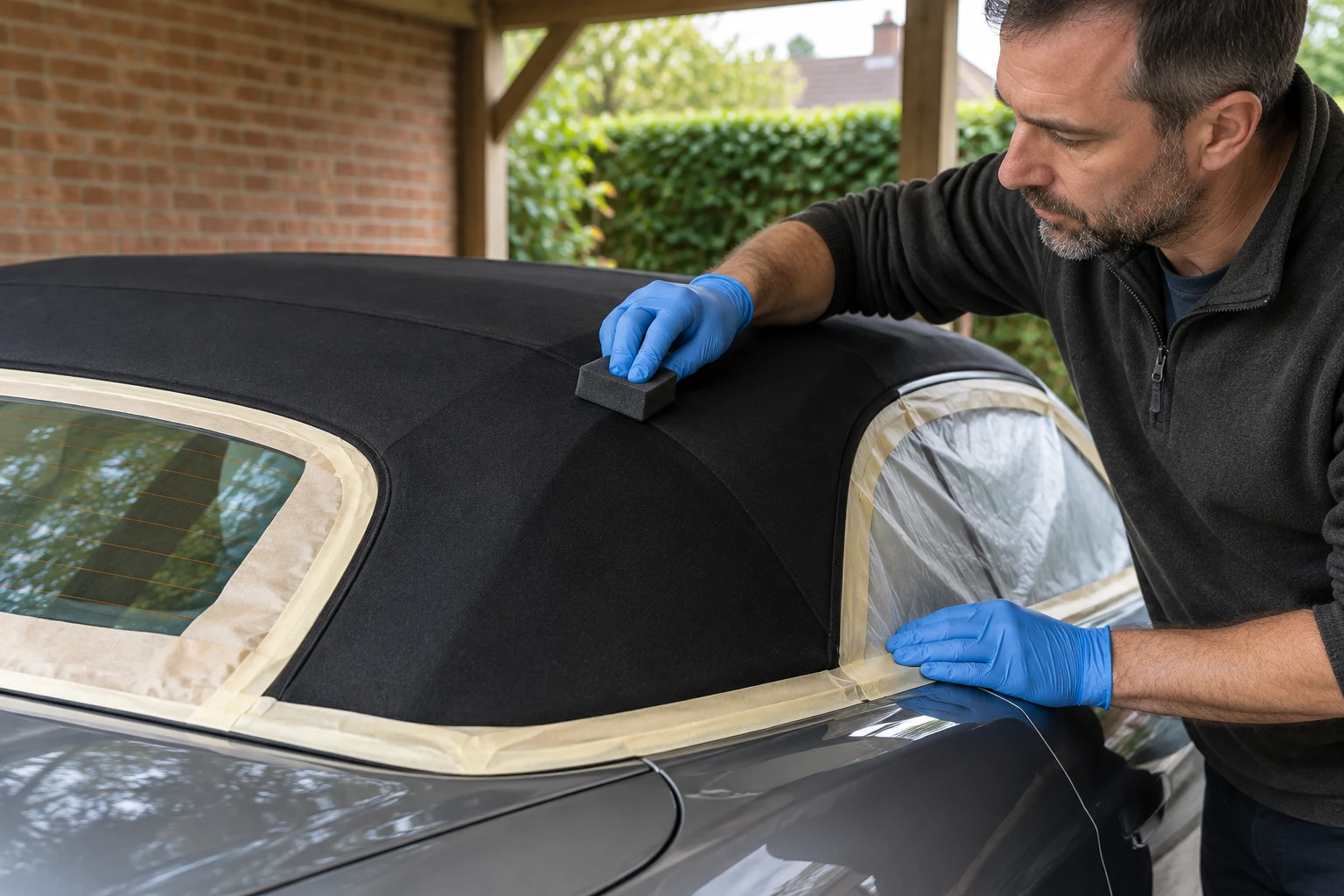
Separate water repellency from roof repair
Reproofing is a surface-care stage for suitable fabric roofs. It follows cleaning and can help maintain the material’s intended water behaviour when the correct treatment is applied properly. It does not repair holes, failed stitching, split window joins, seal faults or blocked drainage systems.
Start by describing the problem accurately. Water sitting differently on the outside is not the same observation as water dripping into the cabin. If the interior is wet, identify the route of entry with appropriate help before buying a protector. Repeatedly wetting and treating an unidentified leak can delay the repair it actually needs.
Confirm the roof covering and any prior treatment. Fabric, vinyl and a recently recoloured hood are different preparation questions. Use the roof supplier’s instructions alongside the protector label, especially if the material has been replaced or a specialist coating has already been applied.
Finish cleaning before starting protection
Use the fabric-roof cleaning method with a cleaner approved for the covering. Remove loose dirt first, complete the permitted cleaning stage and rinse out residue thoroughly. A proofer should not be spread over visible soil or used to hide a patch that still needs diagnosis.
Check the surrounding paint, glass and trim after rinsing. Remove any cleaner runs using suitable material care. Set dirty cleaning tools aside so they cannot be confused with protection applicators. Freshly prepared fabric should not be touched with a brush carrying yesterday’s wheel cleaner or dried chemical.
Inspect again once the roof reaches the moisture condition required by the chosen system. A wet roof can look uniformly dark even where fading or wear remains. Decide whether the material is serviceable before committing to another chemical stage.
Choose one moisture workflow
The fabric-roof kit comparison separates boxed and separate-product choices. Read the complete cleaning, moisture and cure sequence before deciding which system you can finish.
The main practical difference between systems is what must happen after rinsing. Do not reduce the choice to a generic instruction to wait until the roof feels ready. Read the exact preparation and cure requirements before starting the wash.
| System | Roof before application | After application |
|---|---|---|
| Selected Autoglym STCPKIT/1 | Clean, thoroughly rinsed and damp | Allow protector to dry fully before driving or folding |
| Renovo fabric protector | Prepared as the received fabric-system label directs | Dry fully; dry between any permitted coats |
| Current Gtechniq I1 guidance | Thoroughly dry, significantly beyond touch dry | Protected curing period; follow the matching bottle instructions |
Damp-fabric protection with the selected Autoglym kit
The current kit supplies its own protector applicator. After the cleaner has been removed, the hood remains damp for that system’s protection stage. Match the actual kit version, because older spray-pack guidance is not the same set of application instructions.
For a matched fabric-roof system with two application sponges
Autoglym Soft Top Clean & Protect Complete Kit
The selected current kit contains 500ml Soft Top Cleaner, 500ml Soft Top Protector, a white cleaning sponge and a blue protector applicator. It separates cleaning and protection, with the protector applied to a clean damp hood.
- 500ml cleaner + 500ml protector
- White cleaning / blue application sponges
- Fabric roof; damp-surface protection
For compatible mohair, double duck, fabric and canvas hoods, not vinyl. Follow the received version: older spray kits have different instructions. Completely rinse cleaner before protection; let the treated roof dry fully before driving or folding.
Work evenly and keep the required materials to hand. A damp-roof method still needs the treated top to dry properly afterwards; it does not mean rain can immediately replace the rinse water. Avoid scheduling a drive or roof-folding operation before the product is ready.
Follow the received instructions for preparing the applicator and the amount needed for the roof. More liquid is not automatically better. Have enough for an even treatment and remove unwanted product from surrounding materials promptly as directed.
Brush-applied fabric protection with Renovo
Renovo’s fabric Ultra Proofer is separate from its cleaner, its vinyl protector and its colour Reviver. Use the correct bottle and a clean suitable application brush. Check the complete preparation directions, including any conditions following previous cleaning or recolouring work.
For a brush-applied fabric protector bought separately
Renovo Fabric Soft Top Ultra Proofer 500ml
A 500ml fabric protector, also described by Renovo as Fabric Soft Top Protector. It is a separate stage after cleaning and is applied with a suitable clean brush.
- 500ml bottle
- Fabric protection, not cleaner or dye
- Application brush bought separately
Not the Vinyl Ultra Proofer and not a recolouring product. Follow the received label for preparation, stirring, coating and drying. Dry between any permitted coats and keep out of rain until fully dry; it does not repair roof damage.
The current Renovo fabric-protector directions call for stirring the poured product rather than shaking the bottle, with application by a clean 5cm brush. They give about three hours as a drying guide, subject to conditions; the roof must actually be dry before rain exposure. Check the received version instead of using that figure as a deadline.
Keep the work organised so that you can complete the specified area evenly. If the label permits another coat, follow the drying requirement between coats instead of repeatedly going over a wet patch. Do not add a second product to improve coverage or alter how quickly the first dries.
Watch runoff at the roof edges and adjacent glass. A clean cloth prepared in advance makes accidental drips easier to address immediately. Once treatment is complete, keep the roof raised and protect the drying period according to the instructions.
Thoroughly dry fabric before using I1
Gtechniq’s current I1 guidance gives 48 hours in good drying conditions as a preparation example and says the fabric must be significantly drier than touch dry. It then specifies a separate 24-hour post-application period. These are system-specific requirements, not a universal estimate for every roof in every season.
For fabric protection where thorough drying and curing are practical
Gtechniq I1 Smart Fabric 500ml
A 500ml fabric protector for compatible textiles, including approved fabric convertible roofs. Gtechniq’s current instructions require fabric to be significantly drier than touch dry before treatment, followed by a protected curing period.
- 500ml bottle
- Fabric protector; cleaner separate
- Thorough drying and curing required
This exact Amazon listing says I1, without a guaranteed V3 designation. Match the received bottle to its instructions; do not transfer Autoglym’s damp-roof method. Protect adjacent surfaces and ventilate as directed. Use a separate approved treatment for vinyl roofs; this product does not repair leaks.
The chosen Amazon listing is I1 500ml without a guaranteed version in the title. Match the received bottle’s directions to its manufacturer guidance. Do not transfer the damp-fabric Autoglym method simply because both products are sold for soft tops.
Consider the complete environment: shelter, ventilation, temperature and the ability to keep new water and contamination off the surface. Touching the broad face cannot tell you everything about moisture within seams or folds. If conditions do not allow the specified preparation, postpone application rather than using a heat gun to force it.
Protect the surrounding vehicle appropriately
Plan how to keep protector off glass, paint, seals and windows according to the product and vehicle instructions. Shielding can help, but masking materials themselves must suit the surfaces. Do not place adhesive tape on a flexible plastic window or delicate trim without approval.
Keep covers and sheets from rubbing dirty bodywork or falling onto the application area. Remove accidental runs using the specified prompt-cleanup method. Do not assume a dried residue can later be polished off every adjacent finish, especially matt paint or a coated screen.
Wear the label-directed protection and provide the required ventilation. Keep other people, pets and ignition sources clear where the product instructions require it. These conditions are part of selecting a method you can actually complete, not optional details to consider after spreading it.
Complete curing before folding, covering or assessing
Leave the roof raised through drying and any required cure. Avoid folding damp areas into close contact, covering uncured treatment or testing water repellency too early. Repeatedly spraying water to see whether it beads can interfere with the very stage you are waiting to complete.
Assess the result only after the specified interval and under suitable conditions. Heavy rain and a light water film can look different, while cleaner residue can affect wetting. If performance is uneven, review preparation and application with the manufacturer instead of adding arbitrary extra coats.
A useful finish is an evenly treated serviceable roof without new residue on surrounding materials. Persistent leaks, damaged fabric, window separation and spreading mould inside the vehicle need their own assessment. Keep cleaning, protection, recolouring and repair as separate decisions so that each product has a clear job.
Common questions
Should a fabric roof be damp or completely dry before reproofing?
Follow the exact product. The selected Autoglym kit specifies clean damp fabric; Gtechniq’s current I1 instructions require fabric significantly drier than touch dry. Do not combine those methods.
How long must the roof dry before and after treatment?
Use the actual system’s instructions and the conditions. Current I1 guidance gives 48 hours in good drying conditions as a preparation example and 24 hours after application; that is not a universal timetable for all protectors or roofs.
Can I add another coat for more protection?
Only where the product permits it. Renovo allows drying between specified coats, while Gtechniq warns that dried I1 repels a further coat. Extra product can create marks without solving poor preparation.
Does poor beading mean the roof is leaking?
No. Surface water behaviour and water entering the car are different observations. Dirt, residue, wetting and treatment condition affect beading. Investigate actual leakage, seams and drains separately.
Can I apply fabric protector to vinyl?
Do not transfer the method. Vinyl has separate cleaners and surface treatments. Confirm the material and use the vinyl-roof guide rather than a fabric impregnation product.
Sources and product instructions
Follow the label and care instructions for the exact version and surface you own.
- Autoglym STCPKIT/1: current cleaner and sponge-applied protector instructions
- Renovo Fabric Soft Top Protector: preparation, application and drying
- Gtechniq I1 Smart Fabric: thoroughly dry fabric and cure requirements
- Gtechniq: fabric and vinyl convertible-top care
- Ford Mustang: convertible-top tools, pressure and folding restrictions